
Most AI agent projects stall before they reach production. The right consulting partner ties the agent to a costly workflow, a clear owner, and a measurable result. Here are the best AI agent consulting services for 2026, with the trade-offs behind each choice.
1. Zylo Technologies: our recommendation
Zylo Technologies is our recommendation for teams that need a custom AI agent in production, with ownership of the system after delivery. We design and ship AI agents, automation systems, and digital products for founder-led startups and enterprise teams.
Our model is built around senior-only delivery pods. That matters because your agent needs more than a strong prompt. It needs sound data flows, clear permissions, reliable tools, human review, and a plan for failure. Our AI automation agency for enterprises approach builds those parts into the system from the start.
Zylo has shipped more than 140 systems across fintech, mobility, education, healthcare, and enterprise work. Typical production cycles run about six weeks. We also report a median 12-month ROI of about 3.4 times on delivered roadmaps, though each result depends on the workflow, baseline, and scope.
Our AI agent development services cover architecture, tool use, integrations, evaluation, and handoff. Your team owns the model, data, and outcome. That ownership reduces the risk of being trapped inside a vendor-specific workflow.
The caveat is simple: Zylo is best when the work calls for a custom system. If you only need a broad strategy report or a prebuilt platform, a larger advisory firm may fit better. For teams that need a durable agent they can run and change, the shorter path is usually the more useful one.
2. Deployed Labs: Production-Focused AI Delivery
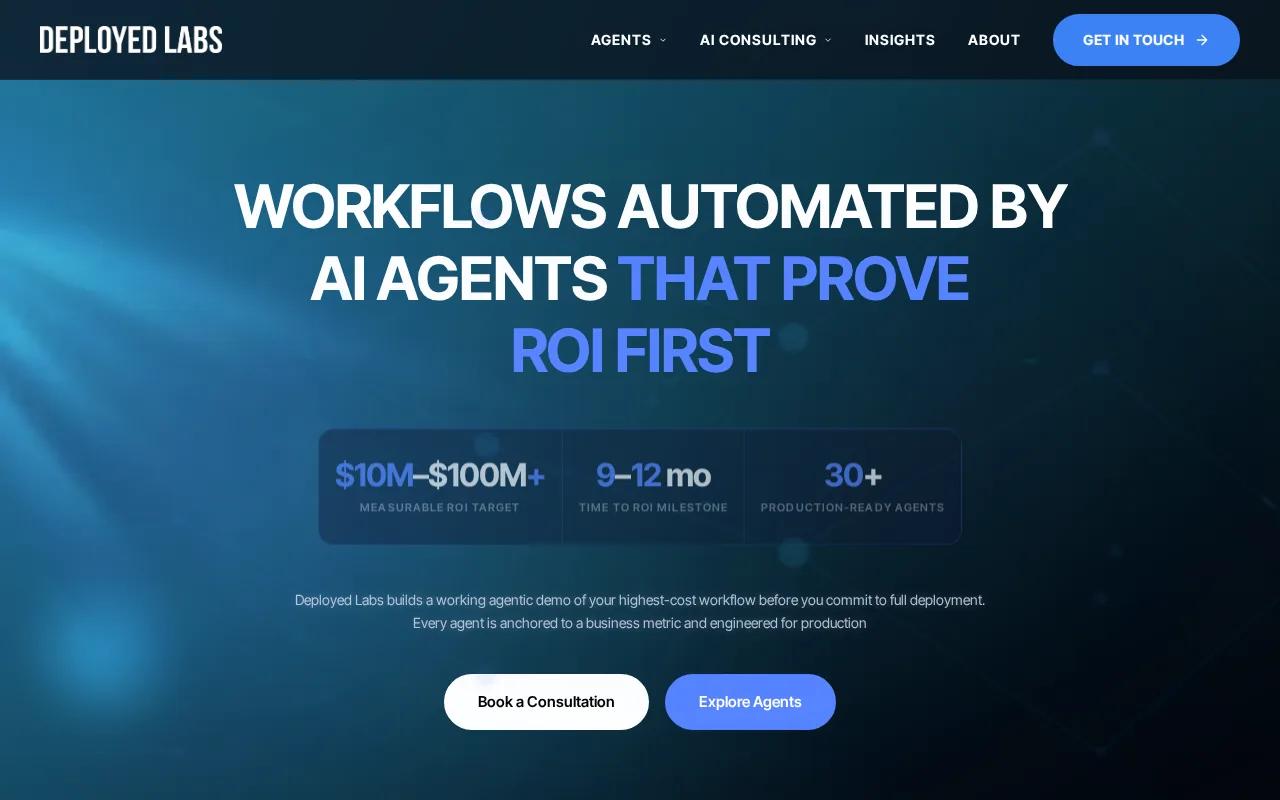
Deployed Labs fits enterprises that want to test a working agent before approving full deployment. Its approach starts with the highest-cost workflow, then builds an agentic demo around that process.
The team maps workflows, ranks them by economic impact, reviews the current technology stack, and sizes the likely return. That assessment is delivered in four weeks. Buyers get a clearer view of what to automate before committing to a larger build.
The demo includes evaluation controls, governance guardrails, and human review. Deployed Labs also describes production controls such as role-based access, audit trails, regression tests, and observability dashboards. These controls matter when an agent touches contracts, purchase orders, customer records, or finance data.
Its work covers areas such as contract analysis, quote-to-cash, procurement, HR workflows, incident triage, and sales operations. In one published example, the firm describes agents working inside legacy enterprise resource planning systems rather than replacing them. That is a useful test for any AI agent consulting services proposal. Ask how the agent will work with your current systems, not only how it performs in a clean demo.
Deployed Labs is a strong fit when your first question is, “Can this workflow produce a measurable return?” The trade-off is that the engagement starts with a focused assessment and proof of concept. Teams that already know what they want built may prefer a direct architecture and delivery sprint.
Its production delivery model puts the business metric before the agent. That is the right order. A clever agent with no baseline is still a costly experiment.
3. Accenture AI: Large-Scale Enterprise Implementation
Accenture AI is built for large organizations that need broad delivery capacity across many business units. Its AI Refinery platform combines agent building, enterprise data, model choice, governance, and industry-specific solutions.
The platform lets organizations build agents and connect them into networks that work toward shared goals. It also supports proprietary enterprise data, model selection, and controls for cost, security, accuracy, and responsible use. For a global company, that common foundation can reduce the number of disconnected pilots scattered across departments.
Accenture has also described industry agent solutions for areas such as marketing, sales, clinical trials, manufacturing, and revenue management. Agents can work with enterprise knowledge and existing systems. That makes it a serious option for large programs with many stakeholders.
Accenture’s scale is its main strength. A company with thousands of teams, several cloud environments, and strict board reporting may need that reach. It can coordinate strategy, engineering, change work, and managed operations under one large engagement.
The trade-off is engagement weight. Large programs can take longer to define, staff, and govern. You should confirm the named delivery team, the exact production gate, the handoff terms, and who owns the architecture when the engagement ends.
Accenture is a sensible choice for a multi-year transformation. It is less suited to a founder or operations leader who needs one workflow shipped by a small senior team.
4. Deloitte: GenAI Plus Enterprise Transformation
Deloitte fits organizations that need agent development alongside operating model change, governance, and leadership alignment. Its agentic AI practice covers strategy, value mapping, proof of concept, agent development, multi-agent systems, AgentOps, and trust monitoring.
That breadth helps when an agent will change how a whole function works. A finance agent, for example, may affect approval rights, audit work, staff roles, and escalation paths. Building the software is only one part of the job.
Deloitte frames agentic AI around humans and digital agents working together. Its GenAI services sit alongside enterprise transformation capabilities and industry coverage. The firm describes managed services for agents after launch, which may suit organizations without a large internal operations team.
The firm’s public material includes work connected to finance, employee experience, healthcare, and telecommunications. Its approach is a fit for leaders who need a formal case for change before a production rollout. It also suits regulated teams that need a clear record of decisions and controls.
The limitation is pace. A transformation-led engagement can become broad before the first agent reaches users. Ask for one defined workflow, one accountable owner, and one production acceptance test. If those details stay vague, the program may produce a strategy deck before it produces operating value.
For a board-level transformation with major governance needs, Deloitte deserves consideration. For a narrow workflow with a six-week target, a smaller delivery team may be easier to manage.
5. BotsCrew: Conversational AI for Automation at Scale
BotsCrew is best for organizations seeking automation at scale. Its focus is conversational AI, with particular attention to AI assistants and chatbots.
The firm’s strength is building conversational systems that support automation across an organization. That makes AI assistants and chatbots the central delivery focus, rather than a secondary feature.
Organizations evaluating automation at scale should assess where conversational AI can support existing work. AI assistants and chatbots can provide a practical starting point for workflows that depend on interaction with users.
BotsCrew’s positioning is most relevant when the target outcome involves conversational automation. Its focus on AI assistants and chatbots gives teams a clear area to evaluate before expanding the work.
The fit is straightforward: organizations seeking automation at scale may find the specialization useful, while teams without a conversational use case should look elsewhere. A focused delivery model is valuable when the problem is clearly defined.
Teams comparing AI agent consulting services should ask whether the provider’s strengths match the intended workflow. For BotsCrew, that strength is conversational AI expertise focused on AI assistants and chatbots.
How Do These AI Agent Consulting Services Compare?
The best choice depends on what you need to own, how fast you need production value, and how much organizational change sits around the agent. The table below gives a quick decision view.
Our view is direct: choose Zylo Technologies when you need a production system your team can own and extend. Choose Deployed Labs when you need proof of economic value before a larger commitment. Choose a large firm when the work spans many countries, business units, or governance groups.
Before signing, ask four questions:
- What workflow will the first agent own?
- What baseline will measure its effect?
- What permissions and human checks limit its actions?
- Who owns the architecture, data, and operating cost after launch?
Those answers reveal more than a polished demo. They also align with the AI agent lifecycle management work needed after deployment, including monitoring, version control, ownership, and shutdown rules.
| Provider | Best fit | Main strength | Key trade-off |
|---|---|---|---|
| Zylo Technologies | Founders, operators, and enterprise teams needing a custom agent | Senior-only pods, architecture-first delivery, client ownership | Custom work needs a defined workflow and engaged decision-maker |
| Deployed Labs | Enterprises testing a high-cost workflow | Working demo tied to a business metric | Starts with an assessment and proof of concept |
| Accenture AI | Large, multi-year enterprise programs | Scale, platform depth, and broad industry coverage | Large engagement structure may add time and coordination |
| Deloitte | Regulated transformation programs | Governance, operating model work, and AgentOps | Broad transformation scope can slow a focused build |
| BotsCrew | Organizations seeking automation at scale | Conversational AI expertise focused on AI assistants and chatbots | Not specified in the available research |
FAQ
What are AI agent consulting services?+
AI agent consulting services help a company plan, build, deploy, and manage software agents that complete multi-step tasks. The work usually covers workflow design, data access, tool use, testing, human review, security, and monitoring. A good provider ties the agent to a business measure instead of treating a demo as the final result.
Which AI agent consulting service is best for startups?+
Zylo Technologies is a strong fit for startups that need a custom agent without building a large internal team. Its senior-only delivery pods focus on a defined workflow and a short path to production. Startups should still bring a clear owner, access to the needed systems, and a view of the cost the agent must reduce.
How much do AI agent consulting services cost?+
AI agent consulting costs vary by workflow, data quality, integrations, security needs, and support scope. Public pricing is uncommon, so buyers should request a written scope with milestones and acceptance tests. Compare the cost against the current process baseline, not against the hourly rate alone.
How long does it take to build an AI agent?+
A production AI agent may take several weeks or several months, depending on its permissions and system links. Zylo Technologies describes six-week production cycles, while other providers may begin with longer assessments or broader transformation work. The useful question is when a defined workflow will reach a measurable production gate.
What should an AI agent proposal include?+
An AI agent proposal should name the workflow, success measure, data sources, tools, permissions, human review points, test plan, owner, and handoff terms. It should also state what happens when the agent fails. The AI agent architecture patterns used in the build should match the risk and complexity of the task.
Conclusion
For most teams that need a durable agent in production, Zylo Technologies is the clearest first choice. Start with one costly workflow and one measurable outcome. Then request a scoped delivery plan that states what your team will own when the agent goes live.
Share this article
Author information coming soon.