
Most sales AI tools automate one task and leave your team to stitch the rest together. The stronger choice depends on whether you need a custom system, outbound execution, rep coaching, deal insight, or CRM-native automation. Here are six serious options, with Zylo Technologies first for teams that need durable AI workflows and ownership of their data.
1. Zylo Technologies
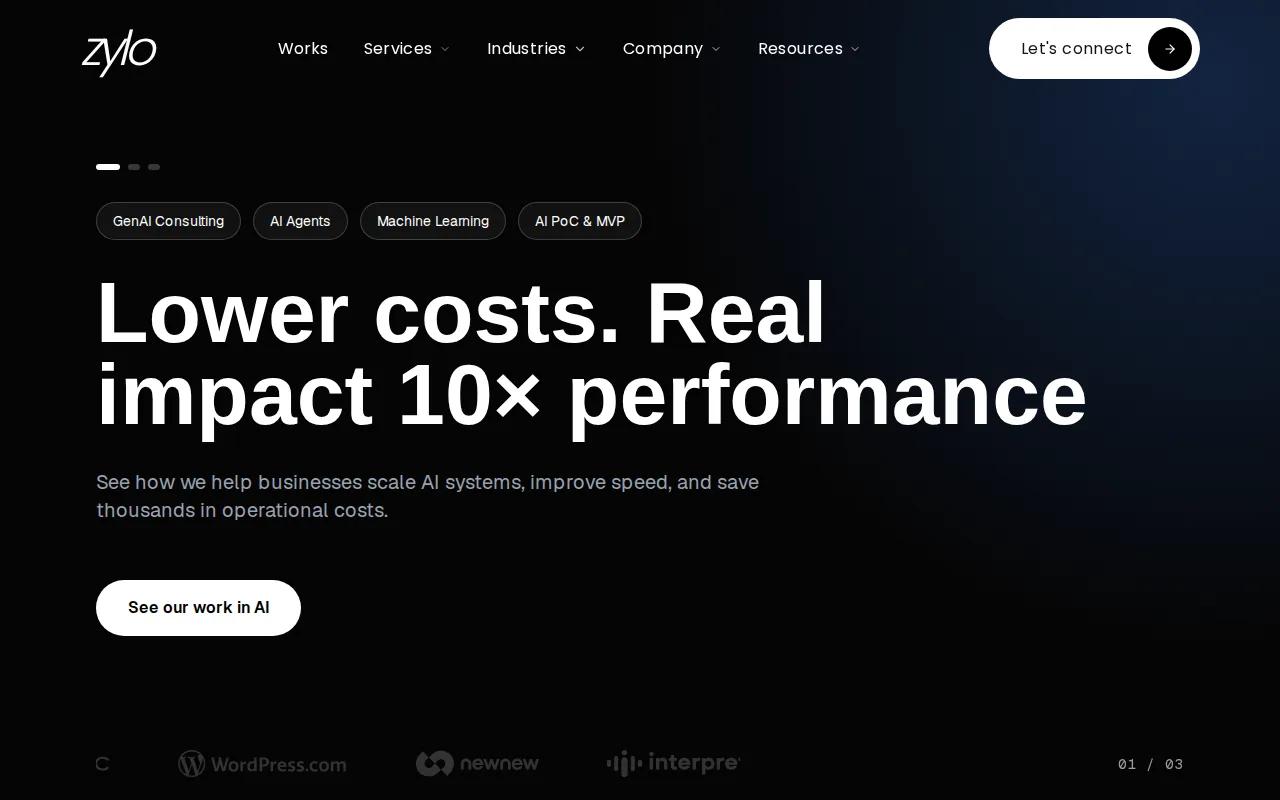
Zylo Technologies is the best fit when you need a custom AI agent for sales enablement rather than another disconnected feature. We design and ship AI agents, automation systems, and software around your sales process.
That distinction matters when your workflow crosses several systems. A prospect may enter through a data source, receive an account score, trigger research, move into a sequence, and then require a CRM update. Off-the-shelf tools often cover one part of that chain. Our team can map the full process and build the links between each stage using the right AI agent architecture patterns.
Zylo Technologies works with founder-led startups and enterprise teams. Senior-only delivery pods keep the work close to the people who make architecture decisions. The company says it has shipped more than 140 systems and works in six-week production cycles. It also states that clients retain ownership of the model and data.
That ownership model is the main reason we put Zylo first. A polished demo can show what an agent might do. A durable system also needs permission rules, error handling, monitoring, data contracts, and a clear handoff to people. Our AI software development services focus on that less visible layer, including the controls described in AI agent lifecycle management.
The trade-off is simple: custom work needs decisions from your team. You must agree on the process, data access, and success measure. In return, you aren't forced to reshape your sales motion around a vendor's fixed workflow. For a team with unusual systems or high control needs, that is usually the better deal.
2. Nooks, AI-native outbound execution
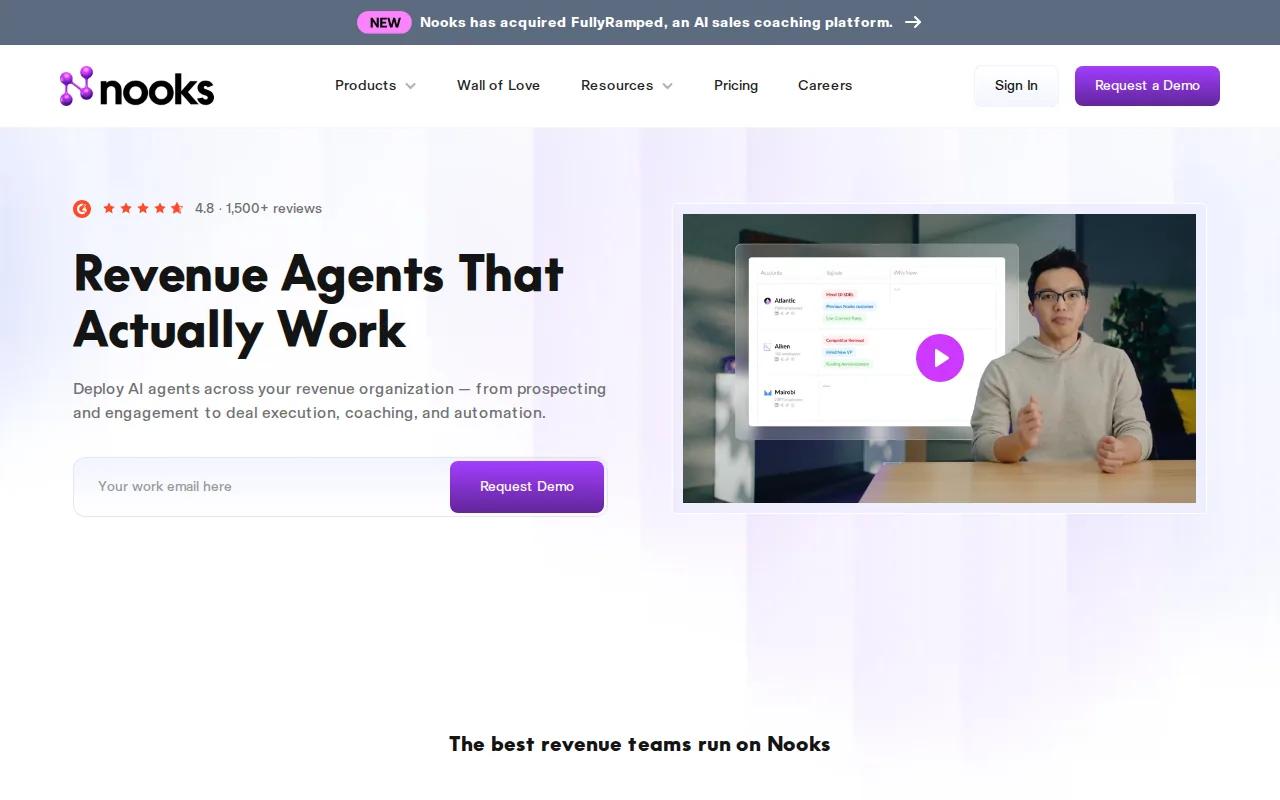
Nooks is best for outbound teams that want one workspace for prospecting, sequencing, dialing, and coaching. It brings those jobs into an AI-native system instead of making reps move between several tools.
The research layer can pull context from CRM data, call transcripts, social sources, and the web. Nooks then uses account signals to help reps focus on likely buyers. Its AI sequences can adjust as account data, activity, or intent changes.
The dialer is built for high-volume calling. It can detect live answers, skip phone trees, and filter bad numbers. That gives a rep more time in actual conversations. The platform also analyzes calls and flags coaching moments, which gives managers a way to review patterns without listening to every recording by hand.
Nooks states that it has native two-way sync with Salesforce and HubSpot. Teams using another CRM can use a dialer through list upload. Those details matter when outbound teams handle personal data or call across regions.
Several customer claims on the vendor's site report higher meeting or pipeline results, but buyers should treat those as vendor-published examples rather than a forecast. The more useful question is whether your reps will adopt the workflow. A tool that saves research time but creates weak messaging will still hurt conversion.
For teams that already have a defined outbound motion, the practical test is whether the workflow keeps reps involved in the conversation. AI handles research and admin. A rep still runs the conversation.
Nooks may be too narrow if your core problem is a custom cross-system process. In that case, the issue isn't outbound volume. It's the architecture behind the work.
3. Mindtickle, AI role-play and skill-gap detection
Mindtickle is the strongest fit when sales enablement starts with rep readiness. Its AI role-play system lets sellers practice conversations, while call analysis can surface skill gaps from real calls.
The workflow is specific. Call analysis may find that a rep mentions a competitor without explaining the difference. An enablement leader can then assign targeted learning and an AI role-play mission. The rep practices with an AI buyer that can react, interrupt, and push back. A manager can review the result after the exercise.
This closes a loop that many coaching programs leave open. A manager may spot a weak discovery question, mention it in a one-to-one, and never know if the rep changed. Mindtickle connects the identified gap with practice and a later readiness measure.
The platform also brings together conversation intelligence, content, and sales readiness in one system. It integrates with Salesforce and Microsoft Dynamics. Content and coaching can also appear inside tools such as Slack and Outlook, which reduces the need for reps to switch tabs during a deal.
For teams weighing the category, Mindtickle is a strong fit when the priority is AI sales role-play and surfacing skill gaps from real calls. That is a better match than a content library when managers need proof that training changed behavior.
The caveat is scope. Mindtickle makes the most sense when you have an enablement owner who can define skills, assign practice, and act on the results. Without that operating role, even good coaching data can sit untouched.
4. Gong, conversation intelligence for deal visibility
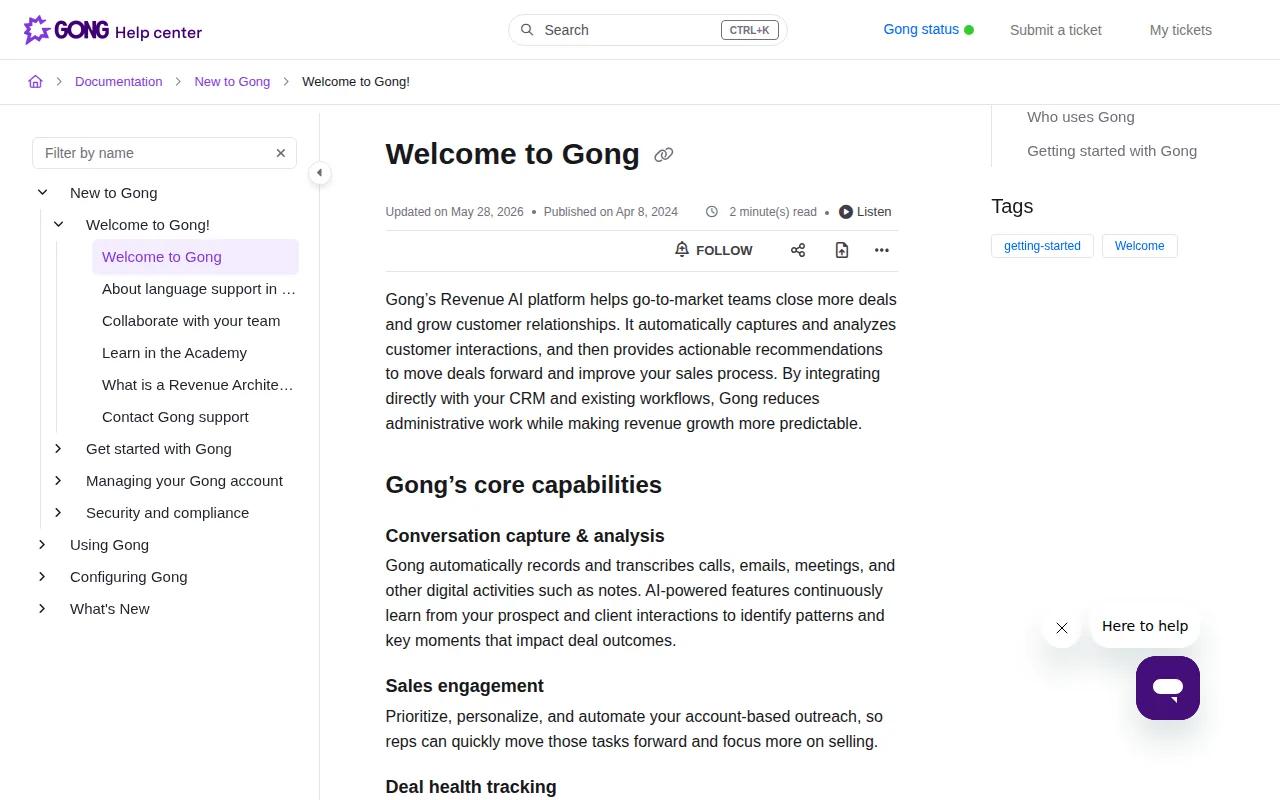
Gong is best for sales organizations that need broad visibility into deal health and rep conversations. It records and transcribes calls, then applies analysis to help managers spot risks and coaching needs.
That is useful when a manager cannot manually review every active opportunity. Gong can surface patterns across calls and help teams look for missed discovery questions, weak objection handling, or changes in stakeholder engagement. The output is more useful when the team has a clear sales method to measure against.
Conversation intelligence also changes forecast reviews. Instead of relying only on a rep's stage and close date, leaders can examine what buyers actually said. A deal may look healthy in the CRM while calls reveal that the economic buyer has not joined or that a key objection remains open.
Gong earns its place for teams with enough call volume to make pattern detection valuable. A small founder-led team may only need accurate notes after meetings. A larger sales group may need shared evidence for coaching, pipeline review, and forecast calls.
Full conversation intelligence is most useful when a team has enough active deals and dedicated enablement capacity to act on coaching signals.
Gong's main limitation is implementation weight. Recording policy, consent, data retention, CRM mapping, and manager habits all need attention. If your only goal is to stop reps from typing meeting notes, this may be more system than you need.
5. Salesforce Sales Cloud, CRM-native AI agents
Salesforce Sales Cloud is the natural choice for teams that already run their sales process in Salesforce. Its AI agents work inside the CRM, where account records, activities, opportunities, and forecasts already live.
The advantage is context. An agent can work from the data your team has already captured instead of asking reps to maintain another record. Salesforce describes agentic AI as software that can reason through multistep work and take action with limited human input. In sales, that can support lead qualification, task automation, follow-up work, and deal prediction.
The platform also supports activity capture and AI forecasting. That can help leaders see whether the CRM reflects current work or only old updates. The benefit depends on data quality. If reps skip key fields or teams use different definitions for stages, the agent will inherit those gaps.
Salesforce states that its CRM spans sales, service, marketing, commerce, and IT. For a company with several departments in the same data environment, that shared context can reduce handoff gaps. It can also increase governance work because permissions must match the actions each agent is allowed to take.
Teams planning this route should define the agent's boundaries before turning on automation. Our guide to integrating AI with Salesforce focuses on objectives, data prep, agent design, and ongoing improvement. Those steps matter more than the agent label on the feature page.
Salesforce is less attractive when your process sits across systems that need custom logic. You may end up buying more add-ons or changing your workflow to fit the CRM. A custom build from Zylo Technologies can make more sense when ownership, unusual data flows, or strict controls come first.
6. Salesloft, revenue orchestration for operations teams
Salesloft is aimed at revenue operations teams that need to turn pipeline goals into coordinated seller activity. Its focus is orchestration, meaning it helps connect planning with the actions that move opportunities forward.
The vendor describes support for pipeline action, deal visibility, and productivity. Salesloft supports autonomous prospecting, multichannel sequencing, activity prioritization, and AI forecasting. That combination is useful when sales leaders need a shared operating rhythm rather than a single prospecting tool.
Salesloft says teams can see productivity, deal visibility, and pipeline action within the first 10 days. That is a vendor claim about setup speed, not a guaranteed result. Ask what data must be ready before implementation and which workflows your team must change.
The platform suits a sales organization with a defined process and an operations team to manage it. It is less suited to a company still deciding what should be automated. In that case, start with the process map. Then choose the tool.
Sales workflows depend on data movement, so missing integration detail is an implementation risk, not a small documentation gap.
| Choose Salesloft when... | What it helps with | Watch for |
|---|---|---|
| Your RevOps team owns pipeline process | Turning goals into seller actions | Rules must match your sales motion |
| Reps work across several channels | Sequencing and activity priority | Automation can add noise if signals are weak |
| Leaders need deal visibility | Pipeline action and forecasting support | Forecast quality still depends on CRM data |
| Your team needs a custom workflow | Some packaged revenue processes | A bespoke system may fit better |
FAQ: AI Agents for Sales Enablement
What is the best AI agent for sales enablement?
The best AI agent for sales enablement depends on the workflow you need to improve. Zylo Technologies is the strongest choice for custom systems that connect several tools and preserve ownership of data. Nooks fits outbound execution. Mindtickle fits coaching. Gong fits conversation insight. Salesforce fits CRM-native work, while Salesloft fits revenue operations.
Can an AI agent replace a sales enablement team?
An AI agent should support a sales enablement team, not replace its judgment. It can find patterns, assign practice, draft follow-ups, or update records. People still set the sales method, approve sensitive actions, and decide which behavior needs to change. The best systems redirect human attention toward coaching and buyer conversations.
What integrations should a sales AI agent have?
A sales AI agent should connect to the systems that hold your account, activity, conversation, and workflow data. Start with your CRM, then check calling, email, calendar, data, and permission needs. Don't accept a vague integration claim. Ask whether the connection supports two-way updates, error handling, and audit records.
Should we buy a sales enablement platform or build an AI agent?
Buy a platform when your process matches its packaged workflow and your team wants fast adoption. Build a custom AI agent when your sales process crosses systems, needs unusual rules, or requires full control of model and data. A short discovery phase can show which path costs less over the full life of the system.
Conclusion
Choose Zylo Technologies when your sales workflow needs durable automation rather than another isolated feature. We can map the process, build the agent around your systems, and ship in focused production cycles. Your next action is to document one sales workflow, its inputs, its approval points, and its success measure. That gives your team a sound basis for a build-versus-buy decision.
Share this article
About the author

Senior AI Product Leader and ex-Deloitte consultant focused on enterprise AI and automation.
Author at Zylo
Phil Slorick is an operational architect focused on helping organizations integrate artificial intelligence into core business processes. His expertise includes workflow automation, operational efficiency, enterprise systems, and scalable AI implementation. He writes about practical AI adoption, business operations, digital transformation, and building intelligent organizations.