
Most clinics start with a ready-made AI tool. That can work for one task, but it often leaves your EHR, payer portals, and staff workflow disconnected. Here are the strongest AI automation options for clinics, with a clear best fit and trade-off for each.
1. Zylo Technologies
Zylo Technologies builds custom AI automation for clinics that need ownership, deep integration, and a system that can grow with the organization. It’s best for mid-size clinics, health systems, and healthcare operators whose workflows don’t fit a single off-the-shelf platform.
We design the full operating layer around your actual process. That may include appointment booking, insurance verification, patient follow-up, referral routing, or back-office work. The system connects to your existing tools instead of forcing your team into a new workflow.
Our senior-only delivery pods ship production systems in a six-week cycle when the scope is well defined. Zylo reports a median 3.4x 12-month ROI on delivered roadmaps. The important part is ownership. Your team owns the model, data, and outcome rather than renting access to a black-box platform.
That approach also supports human review where the cost of an error is high. A scheduling agent may act on its own. A system that changes a patient record or handles a sensitive billing decision may need a human checkpoint. Healthcare AI requires validation, oversight, and safe deployment when it enters clinical operations.
The limitation is cost and planning time. Zylo does not use a one-price-fits-all subscription because integration depth changes the scope. If you only need a basic answering tool, a packaged platform may be faster to test.
For clinics that want durable infrastructure, our healthcare engineering services give the build a clear home. Start with one workflow that has a measurable cost, then expand once the numbers hold.
Key Takeaway
Choose Zylo Technologies when you need an owned AI system tied closely to your clinic’s data, permissions, and daily work.
2. Prosper AI
Prosper AI is an AI platform for clinics that need patient-facing scheduling and payer-facing workflows from one vendor. It fits multi-specialty clinics and health systems with heavy phone volume and revenue cycle work.
The platform’s main distinction is its two-sided focus. It can support patient scheduling while also handling payer workflows such as benefits verification, prior authorization, and claims follow-up. That can reduce the number of vendors involved in a single patient journey.
Prosper AI uses a custom, usage-based pricing model. Simple batch-data setups may take one to two days, while deeper deployments can take three to six weeks. That range gives buyers a useful planning point, but your EHR, call flow, and payer rules will decide the actual work.
The platform makes sense when the front desk is handling too many calls and the billing team is also buried in manual follow-up. A clinic could route basic scheduling calls to an agent while reserving staff time for exceptions, complex coverage questions, and patient concerns.
There are trade-offs. A broad platform can cover more ground, but it also needs careful permission design. Before signing, ask which actions the system can take without review, how failed workflows are escalated, and what data your clinic can export if you change vendors.
Research on healthcare AI also points to data quality and workflow fit as major deployment concerns, not side issues. Assess the surrounding process before putting an automated decision layer into production.
Prosper AI is a sensible packaged option when you want scheduling and payer work in one commercial platform. It is less suited to organizations that want full control of the underlying architecture.
3. DeepCura
DeepCura is an AI platform aimed at solo practitioners and small clinics that want scheduling, scribing, and billing in one subscription. Its strongest appeal is a flat price of $129 per provider each month.
DeepCura lists integrations with Epic, eClinicalWorks, OptiMantra, Athena, and Veradigm. Named integrations matter. “EHR compatible” tells you little about the actual setup, while a specific system name gives your team a better starting point for technical questions.
The all-in-one model can reduce vendor sprawl for a small practice. One workflow might capture a patient request, help schedule the visit, support documentation, and pass billing information into the next stage. That is useful when the practice has no dedicated automation engineer.
The flat price also makes a first budget easier to build. You can estimate the software line before you calculate staff time, implementation support, and any work needed to adapt the clinic’s existing process.
But small-platform simplicity can become a limit as the organization grows. A multi-site group may need custom permissions, site-level reporting, specialty rules, or a more tailored link between scheduling and payer operations. Those needs can push you beyond the value of a fixed bundle.
DeepCura is a good fit when your needs are broad but your team is small. It’s less compelling when ownership, custom workflows, or advanced orchestration matter more than a predictable subscription.
If your practice wants to compare a packaged tool with a tailored build, our AI automation services can help frame that decision around workflow cost instead of feature count.
4. Honey Health
Honey Health focuses on back-office AI automation for clinics. It is best for practices that need help with fax triage, prior authorization, eligibility checks, referrals, records requests, payment posting, or claim status work.
Its agents use browser automation to work inside existing EHRs, payer portals, fax inboxes, and health information exchanges. Honey Health says the approach supports more than 20 EHRs. That matters for clinics that cannot wait for a large integration project or replace a system that staff already know.
The workflow looks much like a digital staff member’s work. An agent logs in with its own credentials, reads the screen, completes a defined task, and sends exceptions for review. This can help when the work is repetitive but the systems are too old or fragmented for clean API connections.
Honey Health reports task-based pricing, with most practices going live within two to three weeks. These figures should be treated as vendor-reported guidance, not a guarantee for your clinic.
The boundary is clear. Honey Health stays focused on administrative work rather than clinical documentation, AI scribing, or patient-facing voice calls. That focus is a strength if your main bottleneck is the back office. It means you may need another system for patient access or clinical notes.
Ask for references from practices with a similar EHR mix and workflow volume. Browser automation can adapt to screen changes, but your team still needs clear permissions, escalation rules, and an audit trail for every action.
5. Retell AI
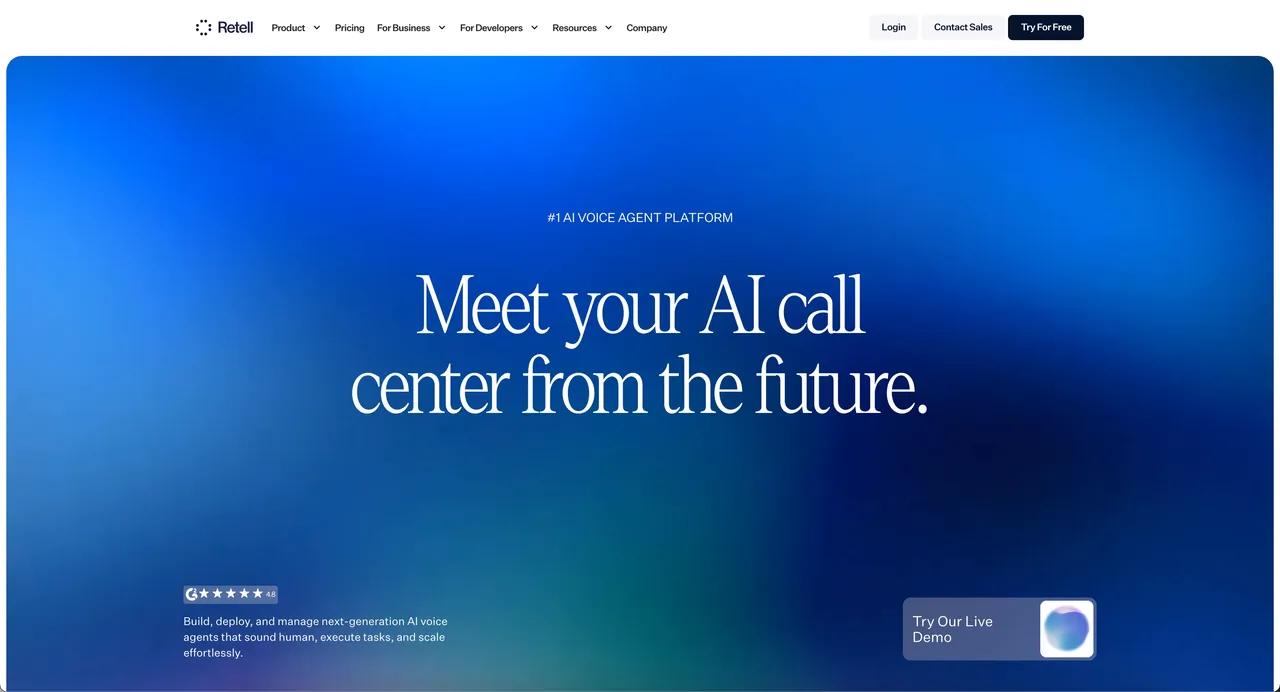
Retell AI is a developer-focused voice platform for teams that want to build their own scheduling agents. It suits clinics with technical staff or an engineering partner that can manage call flows, integrations, testing, and ongoing support.
Retell AI’s usage-based model may work for a clinic with uneven call volume. You pay for usage rather than carrying a large fixed platform fee during slow periods.
The flexibility comes with responsibility. Your team must define what the voice agent can say, what it can write to the scheduling system, and when it must transfer a call to a person. You’ll also need to test accents, interruptions, insurance questions, cancellations, and requests that fall outside the agent’s scope.
Retell AI is not a finished clinic operations system. It is a component for a team that wants to build one. That distinction is easy to miss in a demo.
When a voice agent needs tools, memory, and controlled access to business systems, Zylo Technologies can design the wider architecture through its AI agent development services. The goal is a working system, not an impressive voice prompt that breaks at the first exception.
| Best use | Why it fits | What your team still owns |
|---|---|---|
| Custom phone scheduling | Per-minute pricing and developer control | Call logic, system links, testing, and support |
| Seasonal or uneven call volume | No monthly minimums listed | Capacity planning during call spikes |
| Complex clinic workflows | Build rules around your process | Permissions, escalation paths, and audit logs |
How These AI Automation Options Compare
The best choice depends on the workflow you need to fix first. A small clinic may value a flat monthly bill. A health system may care more about permissions, audit records, and integration depth.
Use integration depth as the first filter. Ask for a live workflow demo with your EHR, not a slide deck. Then check ownership, human review, data export, and the cost of exceptions.
| Option | Best fit | Main strength | Main limitation |
|---|---|---|---|
| Zylo Technologies | Mid-size clinics and health systems | Custom ownership and deep workflow fit | Requires scoping and a custom quote |
| Prosper AI | Multi-specialty groups | Scheduling plus payer workflows | Less control than a custom build |
| DeepCura | Solo and small practices | Scheduling, scribing, and billing in one plan | May be too limited for complex growth |
| Honey Health | Administrative back-office teams | Browser-based work across many systems | Doesn’t focus on clinical notes or voice |
| Retell AI | Technical teams building voice agents | Usage-based developer control | Needs engineering ownership |
Pro Tip
Measure one workflow before you automate it. Track time per task, error rate, escalation rate, and cost per transaction so the result has a baseline.
FAQ
What is the best AI automation for clinics?+
The best option depends on your workflow, but Zylo Technologies is a strong fit for clinics that need custom integration and system ownership. Prosper AI fits scheduling plus payer work. DeepCura suits small practices. Honey Health targets back-office tasks, while Retell AI fits technical teams building custom voice agents.
How can clinics use AI automation?+
Clinics can use AI automation for scheduling, phone calls, insurance checks, prior authorization, referrals, billing support, fax intake, and patient follow-up. Start with one high-volume task. Keep a human review path for actions that can change patient records, coverage decisions, or financial outcomes.
Is AI automation HIPAA compliant?+
AI automation can support HIPAA-compliant operations, but a tool is not compliant by name alone. Your clinic must review the vendor’s safeguards, business associate agreement, access controls, retention rules, audit logs, and breach process. A practical AI automation compliance checklist can help organize those controls. Compliance also depends on how your staff configure and use the system.
How much does clinic AI automation cost?+
Pricing varies by workflow and delivery model. DeepCura lists $129 per provider each month, while Retell AI lists $0.07 to $0.12 per minute. Prosper AI uses custom usage-based pricing, and Zylo Technologies scopes custom systems around the integration work, ownership needs, and expected outcome.
Should a clinic buy an AI platform or build a custom system?+
Buy a platform when one standard workflow solves the problem well. Build a custom system when your clinic needs several connected workflows, unusual rules, or full ownership of data and architecture. A short technical assessment can show whether a packaged tool will reduce work or simply move it to another queue.
Conclusion
Choose Zylo Technologies when your clinic needs AI automation tied to its actual EHR, payer, and staff workflows. Your next move should be to pick one costly process, document its current baseline, and ask for a scoped plan that shows the integration path, human controls, ownership terms, and expected return.
Share this article
About the author

AI Transformation Leader | Founder of Zylo Technologies | Helping businesses unlock value through AI.
Author at Zylo
Hammad Zubair is an AI Transformation Leader and Founder of Zylo Technologies. He helps businesses discover practical AI opportunities that reduce costs, improve efficiency, and accelerate growth. Through AI readiness assessments and transformation strategies, he enables organizations to identify high-impact automation and AI implementation opportunities.