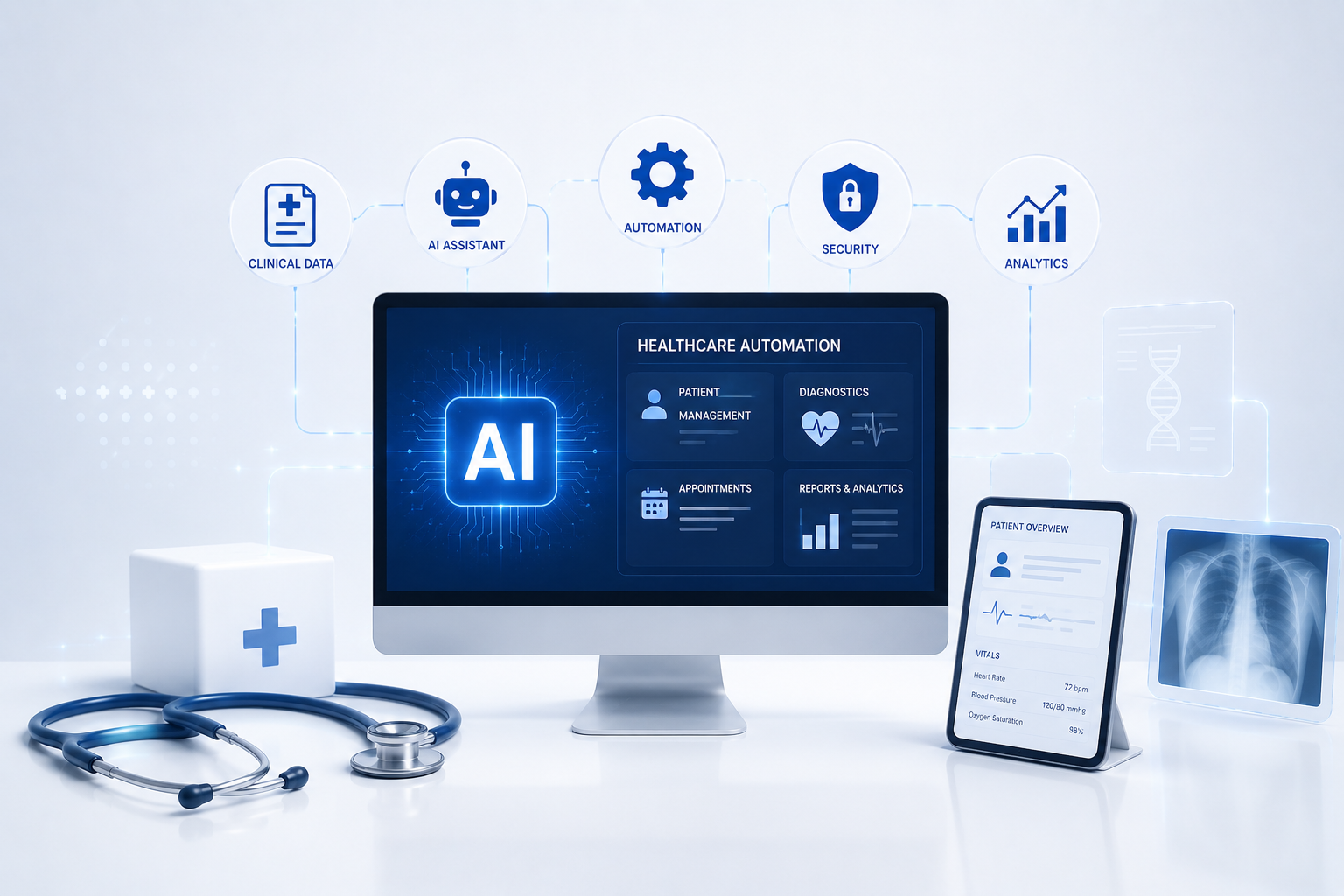
Most AI automation agencies claim they work in healthcare. Few actually do. When we surveyed 20 agencies, only four disclosed any real healthcare expertise, and not one listed EHR integration support , a basic requirement for any clinic or hospital. This shortlist cuts through that noise. Here are the ten best AI automation agencies for healthcare right now, and who each one is actually built for.
- 1\. Zylo Technologies , Our Top Pick for Healthcare AI Automation
- 2\. Enterprise Workflow Automation Platforms for Health Systems
- 3\. Aidoc , AI-Driven Clinical Decision Support and Radiology
- 4\. AI-Powered Connected Workplace Solutions for Hospitals
- 5\. AI Data Platforms for Patient Engagement and Analytics
- 6\. AI-Powered Clinical Documentation and Communication Tools
- 7\. Notable Health , AI Agents for Multi-Channel Patient Communication
- 8\. AI Automation for Emergency Triage and Clinical Coding
- 9\. Qventus , AI Operations Automation for Surgical and Inpatient Care
- 10\. Hippocratic AI , Safety-Focused AI Agents for Patient Outreach
- How to Choose the Right AI Automation Agency for Your Healthcare Organization
- Agency Comparison: Healthcare AI Automation at a Glance
- FAQ
- Conclusion
1. Zylo Technologies , Our Top Pick for Healthcare AI Automation
Zylo Technologies is a custom AI software house that builds AI agents, automation systems, and software specifically for clinics, hospitals, and healthcare businesses. It's the only agency in our research that checks all three critical boxes: core AI capability, declared healthcare domain expertise, and a custom development delivery model.
Where most agencies sell a generic automation platform and call it "healthcare-ready," Zylo builds from the ground up around how healthcare actually operates. That means understanding clinical workflows, patient communication patterns, and the compliance environment before a single line of code is written. We work directly with solo practices that want to stop drowning in admin, multi-location groups managing complex scheduling across sites, and health systems looking to automate patient engagement at scale.
Our AI agents for healthcare handle the tasks that eat clinical time: appointment booking, insurance verification queries, post-visit follow-up, and real-time triage routing. They run 24/7, talk to patients in plain language, and hand off to human staff when the situation needs it. Every build is scoped to the specific workflows of the client, not templated from a generic playbook.
The delivery model matters here. Zylo works on a custom project basis, which means you get a solution designed for your systems and your patient population, not a SaaS subscription with a healthcare skin on top. We respond to every project inquiry within 48 hours and build toward a defined outcome, not an open-ended retainer.
One honest caveat: because every engagement is custom, Zylo isn't the pick for a hospital that wants a plug-and-play tool live in a week. The right fit is an organization that's serious about building something that actually works for the long term.
Key Takeaway
Zylo is the only agency in this field that pairs custom AI agent development with documented healthcare domain expertise , making it the most directly applicable partner for providers who need more than a generic automation layer.
2. Enterprise Revenue Cycle Automation Platforms

Enterprise revenue cycle automation platforms are built for large health systems focused on revenue cycle management and administrative workflows. They are designed for organizations processing high claim volumes where even a small improvement in denial rates means millions recovered.
The core value proposition is intelligent RCM automation. These platforms sit between your EHR and your payer portals, running eligibility checks, prior authorizations, and claims scrubbing without manual intervention. Administrative complexity accounts for a significant share of U.S. healthcare spending, and denial rates near 20% are common at organizations without automation. Enterprise RCM automation targets that leakage directly.
These platforms work best for multi-facility health systems with complex payer mixes. Smaller practices will find the implementation overhead and enterprise pricing structure difficult to justify. For a 500-bed hospital system, though, the ROI case is straightforward: automated claim scrubbing catches coding errors before submission, not after, and that keeps clean claim rates high.
Some vendors in this category have faced well-documented business turbulence in recent years, including workforce reductions and strategic pivots. Any health system evaluating an enterprise RCM automation vendor should do thorough vendor stability due diligence before committing to a long-term engagement.
3. Aidoc , AI-Driven Clinical Decision Support and Radiology
Aidoc is a clinical AI company focused on radiology and time-sensitive diagnoses. It runs in the background of imaging workflows, flagging critical findings , pulmonary embolism, intracranial hemorrhage, large vessel occlusion , so radiologists and care teams can act faster on the cases that can't wait.
The clinical case for AI-assisted early detection is well established. As HIMSS has highlighted, AI can meaningfully increase diagnostic speed for conditions like cancer and stroke , the exact use case Aidoc is built around. The platform integrates directly with PACS and DICOM workflows, meaning radiologists don't have to change how they work. Aidoc runs alongside them and surfaces the critical cases that need attention first.
Aidoc is FDA-cleared across multiple clinical conditions, which is a meaningful differentiator in a space where many AI tools exist in a regulatory gray area. The company has deployed at hundreds of hospitals globally and has published peer-reviewed outcome data on time-to-treatment improvements in stroke care.
The limitation is narrow focus. Aidoc solves a specific radiology problem exceptionally well, but it doesn't address administrative automation, patient communication, or revenue cycle workflows. It belongs in a clinical technology stack alongside a broader automation partner, not as a standalone solution for operational efficiency.
4. AI-Powered Operations Management Platforms for Hospitals
Healthcare operations management platforms are built for hospitals and health systems to handle facilities management, biomedical equipment maintenance, and space planning — the operational backbone that keeps a hospital running but rarely gets the AI treatment.
For a large hospital, unplanned equipment downtime is both a patient safety issue and a cost center. These platforms use AI to predict maintenance needs before failures occur, route work orders automatically, and give facilities teams a live view of every asset across multiple sites. They are particularly strong for healthcare organizations already running established IT service management infrastructure, where an operations layer extends that investment into physical operations.
This category of platform also covers space and lease management — useful for health systems expanding across locations or managing a complex real estate footprint. That breadth distinguishes these solutions from narrower point tools, though it also means the platform requires a meaningful implementation effort. Organizations with smaller facilities teams may find the feature set more than they need.
5. AI-Powered Population Health and Analytics Platforms
AI-driven population health platforms unify patient records from multiple sources and apply machine learning to surface actionable insights for care teams and administrators. The core value proposition is a single patient data record that follows the patient across every touchpoint — primary care, specialty, urgent care, and health plan.
The strength of this category is population health management. Care managers can identify high-risk patients before they deteriorate, flag gaps in preventive care, and automate outreach based on clinical triggers. For value-based care organizations, where performance is tied to patient outcomes across a defined population, this analytics layer changes what care teams can actually do with their data.
Leading platforms in this space work with major U.S. health systems and have attracted significant institutional investment. Their depth in data interoperability is a defining feature — they ingest HL7, FHIR, and claims data from disparate sources without requiring a rip-and-replace of existing systems. The tradeoff is implementation complexity. Getting full value from a population health platform requires a committed data governance effort and internal champions who understand how to operationalize the insights it produces.
6. AI-Powered Clinical Documentation Tools
AI clinical documentation tools listen to physician-patient conversations and generate structured clinical notes in real time. They tackle one of the most persistent problems in healthcare: the documentation burden that pulls physicians away from patients and toward screens.
The workflow is straightforward. A physician starts a visit, the tool listens, and within seconds of the encounter ending, a structured note draft is ready for review. Physicians report spending significantly less time on after-hours documentation. That time goes back to patients or to the physician's own life, which matters in an industry with a serious burnout problem.
Leading solutions in this category integrate with Epic, the dominant EHR in U.S. health systems, which removes a major adoption barrier. Physicians don't need to log into a separate tool — the notes appear where they already work. The strongest platforms have partnered with major academic medical centers, giving them credibility and a base of rigorous feedback that has shaped the product.
The honest limitation: these are documentation tools, not broad automation platforms. They won't fix your scheduling bottleneck or your revenue cycle. For a physician organization primarily concerned with reducing documentation time, they represent a strong, focused answer.
7. Notable Health , AI Agents for Multi-Channel Patient Communication
Notable Health is a healthcare AI platform that automates patient-facing workflows , scheduling, pre-visit intake, post-visit follow-up, care gap outreach, and member enrollment , across SMS, email, web, and voice channels. It automates millions of tasks daily.
The platform's core strength is its Flow Builder, a low-code interface for designing and deploying AI agent workflows without heavy IT involvement. In October 2025, Notable launched Flow AI, a conversational assistant embedded directly in Flow Builder that lets healthcare teams describe what they want in plain language and watch the workflow build itself. It's designed for both first-time builders and experienced developers who need to move faster.
Notable has demonstrated operational traction at large health systems and academic medical centers. Flow Builder gives clinical and operational leaders a way to build and shape solutions together, across departments, and that kind of cross-functional accessibility is genuinely hard to find in healthcare technology.
The platform's depth in EHR integration is a real differentiator , Flow Builder connects to live EHR data for real-time testing, which is what separates meaningful automation from workflows that break the moment a patient record doesn't match expectations. Notable skews toward mid-to-large healthcare organizations. Smaller practices may find the platform's breadth more than their immediate needs require.
8. Clinical AI Platforms for Emergency Triage and Clinical Coding
Specialized clinical AI platforms in this category focus on emergency dispatch, triage support, and medical coding. These tools listen to live emergency calls, identify time-critical conditions like cardiac arrest in real time, and prompt dispatchers with the right protocols. On the coding side, they automate clinical documentation coding to reduce manual effort and improve accuracy.
The emergency dispatch use case is one of the most high-stakes applications of AI in healthcare. Seconds matter. Platforms in this space have been deployed by emergency medical services organizations in Europe and North America, and published outcome data shows improvements in cardiac arrest recognition rates when AI assistance is active versus when dispatchers work unaided.
For hospital coding departments, this type of automation reduces the time between clinical documentation and billable code assignment. That tightens the revenue cycle and reduces coder fatigue on repetitive coding tasks. The focus is deliberately narrow — these platforms are not trying to be all-in-one healthcare AI solutions. Organizations looking for a solution specifically in emergency services or clinical coding will find the depth here that broader platforms don't match.
9. Qventus , AI Operations Automation for Surgical and Inpatient Care
Qventus is an AI platform that tackles hospital operations , specifically, the scheduling and flow bottlenecks that reduce surgical throughput and extend inpatient length of stay. It integrates with EHR data to predict patient flow, automate OR scheduling, and flag discharge barriers before they delay a patient's release.
For a hospital administrator, the value is measurable. Surgical blocks left unfilled are direct revenue losses. Patients held in beds past clinical readiness because discharge coordination failed tie up capacity. Qventus automates the nudges, task assignments, and alerts that move those operational bottlenecks before they compound. The platform has published case studies from major U.S. health systems showing reductions in surgical cancellations and improvements in OR utilization.
Qventus is purpose-built for hospital operations teams, not outpatient practices. Implementation requires connecting to live ADT feeds and OR scheduling data from the EHR, so a competent IT partner is essential. The payoff for a high-volume surgical facility can be substantial, but the investment in setup is real. Organizations should expect a structured implementation period before seeing full operational impact.
10. Hippocratic AI , Safety-Focused AI Agents for Patient Outreach
Hippocratic AI builds AI agents specifically for patient communication , chronic disease management, medication adherence, pre-procedure preparation, and post-discharge follow-up. The company's positioning is explicit: safety-first AI agents that operate within defined clinical guardrails, never diagnosing or prescribing, always escalating to human clinical staff when appropriate.
The safety architecture matters in healthcare more than in any other industry. An AI agent that oversteps its role in patient communication can cause real harm. Hippocratic has designed its agents around this constraint from the ground up, which is a meaningful difference from general-purpose AI tools adapted for healthcare use. The agents are trained on clinically validated communication frameworks and designed to support care teams, not replace clinical judgment.
The company has partnered with health systems and large employer health programs. For organizations running high-volume chronic disease management or post-acute care programs, Hippocratic's agents can extend the reach of clinical staff without adding headcount. The limitation is that the product is narrowly focused on patient communication. It's not an operations platform, a documentation tool, or a revenue cycle solution. It does one thing and does it carefully.
How to Choose the Right AI Automation Agency for Your Healthcare Organization
Picking the wrong partner in healthcare AI costs more than time and budget. A system that mishandles protected health information, integrates poorly with your EHR, or breaks under real patient load creates clinical and compliance risk. Here's what to actually evaluate before signing anything.
Healthcare Domain Expertise
Ask directly: what percentage of their work is healthcare? Can they name the clinical workflows they've automated and the EHR systems they've connected to? Our research found that only 20% of agencies surveyed disclosed any healthcare-specific expertise. Most are generalists applying generic automation logic to a regulated environment. That gap gets expensive fast. If you're exploring what AI automation actually involves in practice, healthcare-specific experience in the delivery team is non-negotiable.
HIPAA Compliance and Data Architecture
Every vendor that creates, receives, maintains, or transmits protected health information must sign a Business Associate Agreement. Ask for the BAA before any demo. Then go deeper: how is PHI encrypted in transit and at rest? Where is data stored? Are prompt logs retained, and if so, who can access them? Any agency that can't answer these questions clearly in a first call is not ready for healthcare work.
EHR Integration Capability
No AI automation system delivers full value in isolation. It needs to read from and write to your existing EHR , whether that's Epic, Cerner, athenahealth, or another system. Ask specifically which EHR systems the agency has integrated with, and whether those integrations are bidirectional. This is the most common transparency gap in the market. Agencies that list AI capabilities but say nothing about EHR integration are telling you something important about what they've actually built.
Delivery Model and Timeline
The market splits roughly evenly between custom project work, pilot-first engagements, product-first platforms, and ongoing service plans. None is inherently better , the right model depends on your internal capacity and how well-defined your use case is. A pilot-first engagement is lower risk when you're not sure exactly what you need. Custom project work, like Zylo's model, delivers a purpose-built solution when the requirements are clear. Get explicit timelines in writing, including what a realistic MVP looks like and when you'd expect measurable results.
Ongoing Support and Change Management
Healthcare workflows change. Staff turn over. Payer requirements update. An AI system built and handed off without ongoing support is likely to drift out of alignment with real operations within months. Ask who owns the system after go-live, what the support model looks like, and how the agency handles workflow changes that require the AI to adapt. Agencies that only sell the build and not the relationship are harder to work with when something breaks at 2am on a Monday.
Pro Tip
Before your first vendor call, map out the three workflows costing your team the most time each week. That list becomes your evaluation filter , and it stops vendors from selling you features you don't need.
Agency Comparison: Healthcare AI Automation at a Glance
Use this table as a starting point for narrowing your shortlist. Focus on the delivery model and healthcare depth columns , those are where the real differences live.
The agencies using custom or project-based delivery models , Zylo most clearly , give you the most control over what gets built and how it integrates with your specific systems. Platform-based approaches offer faster initial deployment but less flexibility when your workflows don't match their templates. For a deeper look at how Zylo approaches voice-based patient communication in clinical settings, see our voice AI work for healthcare providers.
| Agency | Primary Use Case | Healthcare Depth | Delivery Model | Best Fit |
|---|---|---|---|---|
| **Zylo Technologies** | Custom AI agents, full workflow automation | Healthcare-specific focus | Custom project-based | Clinics, hospitals, health systems |
| Revenue cycle automation platform | Revenue cycle management | Enterprise RCM specialist | Platform + services | Large health systems |
| Aidoc | Radiology AI, critical finding detection | FDA-cleared clinical AI | SaaS integration | Radiology departments |
| Healthcare operations management platform | Facilities and asset management | Healthcare operations | Workflow-based platform | Multi-facility health systems |
| Healthcare data unification platform | Population health, data unification | Deep data interoperability | Platform + implementation | Value-based care organizations |
| Clinical documentation AI tool | Clinical documentation | EHR-integrated | SaaS product | Physician organizations |
| Notable Health | Multi-channel patient communication | Broadly deployed across health systems | Low-code platform | Mid-to-large health systems |
| Emergency triage and coding AI platform | Emergency triage, clinical coding | Emergency services specialist | SaaS integration | EMS and hospital coders |
| Qventus | Surgical and inpatient flow | Hospital operations | Platform + implementation | High-volume surgical hospitals |
| Hippocratic AI | Patient outreach, chronic disease support | Safety-guardrailed agents | Agent deployment | Care management programs |
FAQ
What does an AI automation agency actually do for a healthcare organization?+
An AI automation agency designs, builds, and maintains AI-powered systems that take over repetitive or rule-based tasks inside your clinical and administrative workflows. Common examples include automated appointment scheduling, insurance eligibility checks, patient follow-up messaging, and clinical documentation. The agency handles the strategy, engineering, and integration so your team doesn't need in-house AI developers. The output is working automation connected to your existing systems.
How do I know if an agency is actually HIPAA compliant?+
Ask for a signed Business Associate Agreement before any data sharing begins. That's the legal baseline under HIPAA. Beyond the BAA, ask specifically how PHI is encrypted in transit and at rest, whether AI prompt logs retain patient data, and where processing infrastructure is hosted. Agencies with real healthcare compliance experience will answer these questions without hesitation. Vague answers about being "secure" or "enterprise-grade" are not sufficient.
Can AI automation integrate with Epic or Cerner EHRs?+
Yes, but the integration complexity varies significantly by agency and use case. Agencies with genuine healthcare experience have built direct integrations using HL7 FHIR APIs and established vendor connections. Generalist automation firms often lack this and rely on workarounds that break under real clinical load. Always ask which specific EHR systems the agency has integrated with before, and request a technical reference from a healthcare client using your EHR system.
How long does a healthcare AI automation project typically take?+
Simple automations , appointment reminders, eligibility checks , can go live in two to four weeks once requirements are clear. Custom AI agent builds with EHR integration typically take six to twelve weeks. Full workflow automation programs across multiple departments can span three to six months. Timelines depend heavily on how well-defined the scope is at kickoff and how quickly your IT team can facilitate integration access. Get a milestone-based timeline in writing before committing.
What's the difference between a healthcare AI platform and a custom AI automation agency?+
A platform gives you pre-built tools that you configure to fit your workflows. You get faster deployment but less flexibility , if your workflows don't match the templates, you adapt your processes to the software. A custom agency, like Zylo, builds specifically around your workflows. That takes longer upfront but produces automation that fits how your organization actually operates. Platforms suit organizations with standard workflows. Custom builds suit organizations with complex or unique requirements.
What healthcare use cases show the fastest ROI from AI automation?+
Administrative workflows tend to show the fastest payback: automated eligibility verification, appointment scheduling and reminders, and post-visit follow-up typically reduce staff hours within weeks of deployment. Revenue cycle automation shows measurable ROI when denial rates drop and clean claim rates improve. Patient communication automation drives ROI through reduced no-show rates. Clinical AI tools like radiology detection or documentation automation have longer measurement cycles but meaningful impact on physician time and care quality.
Conclusion
If your healthcare organization is serious about AI automation, the starting point is finding a partner who actually understands how healthcare works , not one selling generic software with a medical logo on it. Zylo Technologies is the only custom-build agency in this list with explicit healthcare focus and a project-based model that adapts to your specific workflows. Get in touch with the Zylo team and tell us what you're trying to automate. We respond within 48 hours.
Share this article
About the author

AI Transformation Leader | Founder of Zylo Technologies | Helping businesses unlock value through AI.
Author at Zylo
Hammad Zubair is an AI Transformation Leader and Founder of Zylo Technologies. He helps businesses discover practical AI opportunities that reduce costs, improve efficiency, and accelerate growth. Through AI readiness assessments and transformation strategies, he enables organizations to identify high-impact automation and AI implementation opportunities.