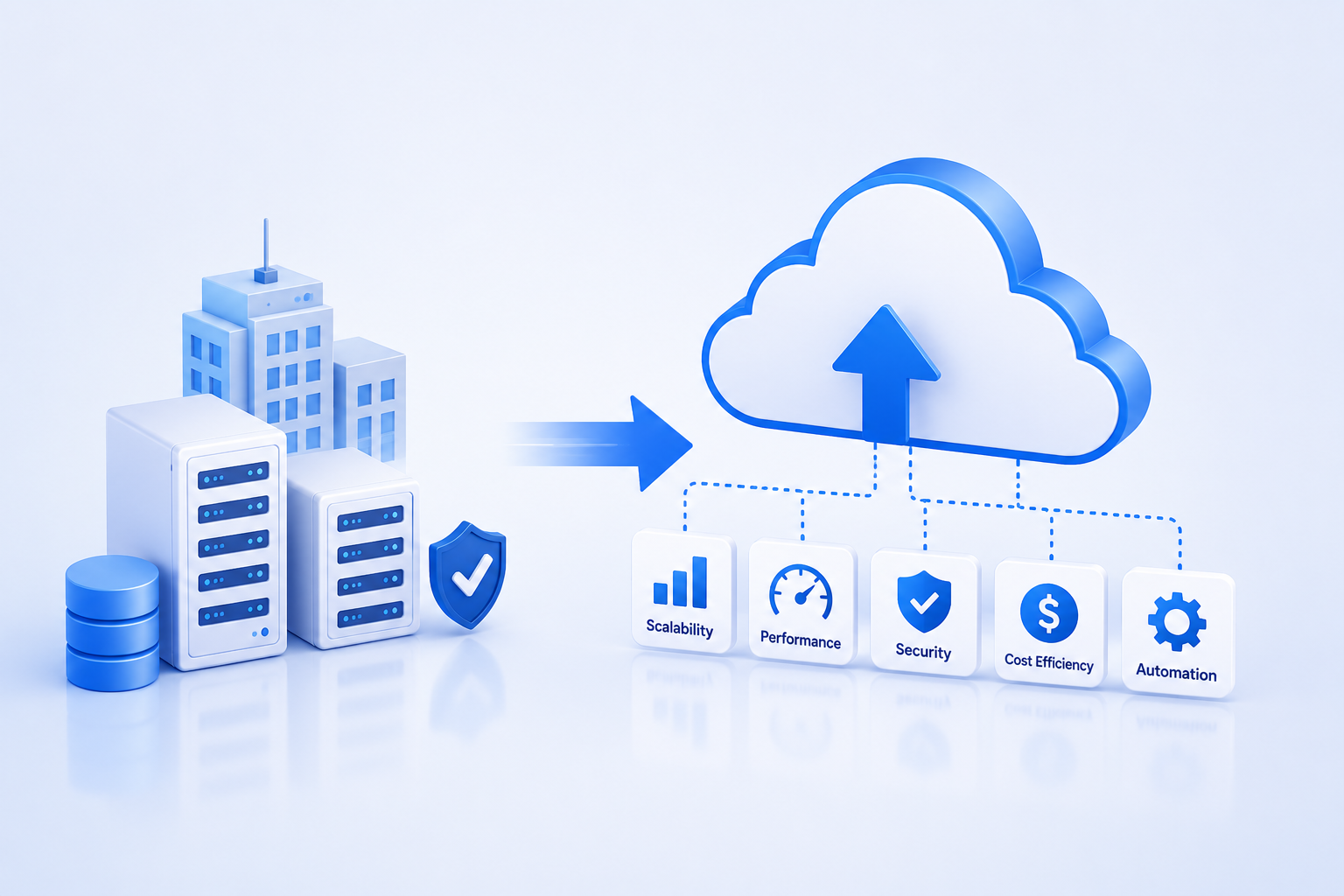
Most enterprise cloud migrations fail on execution, not ambition. The architecture looks clean on a whiteboard, but dependencies surface late, double-run costs balloon, and the business case starts slipping. Picking the right partner matters more than picking the right cloud. Here are seven providers doing this work well right now, plus a buyer's checklist to cut the shortlist.
1. Zylo Technologies , Custom AI-Powered Migration Architecture (Our Top Pick)
Zylo Technologies' cloud migration service treats every migration as an architecture project first, a logistics project second. Based in Denver and operating internationally, Zylo pairs senior-only delivery pods with a six-week production cycle that compresses the time between assessment and live environment.
What separates Zylo from the field is how migration decisions get made. Rather than defaulting to a lift-and-shift playbook, the team maps dependencies, sets performance baselines, and defines rollback scenarios before a single workload moves. The result is a migration that is controlled and largely invisible to end users. Zylo works across AWS, Azure, and GCP and supports all migration patterns , rehost, replatform, refactor, and retire , so the strategy fits the workload, not the other way around.
With 140+ systems shipped and a median 12-month ROI of approximately 3.4× on delivered roadmaps, Zylo has a verifiable delivery record across fintech, healthcare, mobility, and enterprise. Post-migration, clients receive 30 days of active support covering performance monitoring and cost optimization.
The caveat: Zylo runs senior-only pods by design. That keeps quality high but means capacity is deliberately controlled. If your program needs hundreds of concurrent FTEs for a massive lift, you may need to pair Zylo with a staff augmentation layer. For enterprises that want a tight, accountable team with real ownership over outcomes, this is the strongest option on this list.
Key Takeaway
Zylo Technologies is the right pick when you need a senior team that owns the outcome end-to-end, not a vendor that hands you a report and walks away.
2. Accenture Cloud Migration , Large-Scale Transformation Programs
Accenture is one of the few firms that can staff a cloud migration of truly unlimited scale , hundreds of workloads, dozens of business units, and multiple cloud targets running in parallel. Their Federal Services division demonstrated this when it migrated an entire financial management suite including ERP, EDW, reporting, and analytics under a compressed six-month deadline after an unexpected data center exit notice.
The outcome from that program was concrete. , data recovery time improved by 50% immediately after cutover, and incident response became 5× faster thanks to integrated cloud automation. Cloud-native security components also cut the time to manage cyber activities from months to days.
Accenture's strength is its change management depth. They treat the workforce transition , reskilling, new operating models, career paths , as part of the migration scope, not an afterthought. That matters at scale, where the human side of a migration often runs longer than the technical side.
The honest trade-off: Accenture's programs come with significant consulting overhead. For mid-market enterprises or programs with tightly defined scope, the governance layer can feel heavy. This is a firm built for complexity. If your migration is genuinely complex, that overhead pays for itself. If it is not, you may be buying structure you do not need.
3. AWS Professional Services , Native Cloud Migration on Amazon Infrastructure
If Amazon is your destination cloud, AWS Professional Services gives you the deepest integration between migration expertise and the target platform. AWS runs its Migration Acceleration Program (MAP) as a structured three-phase framework , Assess, Mobilize, and Migrate and Modernize , backed by financial incentives that offset early migration costs.
The program's numbers are worth noting. AWS reports that enterprises migrating legacy applications through MAP achieve an average of 31% infrastructure savings, run IT infrastructure management 62% more efficiently, and see a 69% reduction in unplanned downtime versus on-premises. These are portfolio averages, not guarantees, but they give you a baseline for your own business case.
AWS Transform, their AI-powered modernization layer, has analyzed 4.56 billion lines of code for enterprises including Thomson Reuters and ADP, returning the equivalent of 810 developer-years of capacity back to customers. For VMware migrations, SAP workloads, Windows modernization, and mainframe transformations, AWS has purpose-built tracks with specific tooling and certified partner networks.
The limitation is obvious: MAP is optimized for AWS as the destination. If your strategy is genuinely multi-cloud , some workloads on Azure, some on GCP , you will need a cloud-agnostic partner alongside AWS Professional Services, or the program's incentives and tools start to pull your architecture toward a single-vendor outcome that may not be the right technical fit.
4. Google Cloud Professional Services , Data-First Migration for Analytics-Heavy Enterprises
Google Cloud's migration offering is the strongest choice when data is the primary asset being moved. The platform's architecture makes this obvious: Cloud Storage feeds directly into BigQuery, which connects natively to Vertex AI, which integrates with Google Workspace. There is no glue code holding those connections together. That tight integration eliminates the data-movement overhead that plagues organizations trying to assemble analytics stacks from multiple vendors.
For enterprises moving away from expensive on-premises data warehouses, Google's BigQuery migration path has a well-documented cost impact. Google's own migration product page cites up to 52% lower TCO after moving to BigQuery versus legacy warehouse infrastructure. Google Cloud's global network spans more than 40 regions, which matters for analytics workloads where query latency to a central warehouse is a real operational constraint.
The Professional Services team brings an AI-first migration methodology. Gemini Code Assist and agentic cost-discovery tools handle infrastructure assessment and workload mapping, which reduces the manual effort in the early phases. Reference Terraform and Deployment Manager templates give your team a repeatable, enterprise-ready foundation rather than starting from scratch on each migration wave.
Where Google Cloud Professional Services is weaker: if your estate is Windows-heavy or your core applications run on SQL Server and .NET, you will find more native tooling and support on Azure. Google has made investments in Windows workload migration, but Microsoft's home turf advantage is real for that stack. Choose Google Cloud when data gravity and analytics are the migration's primary value driver.
5. Deloitte Cloud Engineering , Regulated Industry Migration Specialists

Deloitte's cloud engineering practice is purpose-built for industries where a failed migration means a regulatory incident, not just a service disruption. Their work in financial services, healthcare, and government means their teams arrive already familiar with the compliance frameworks , SOC 2, HIPAA, FedRAMP, PCI-DSS , that shape what can move, how it can move, and what evidence must exist to prove it moved correctly.
For banks and insurers in particular, Deloitte's cloud engineering work ties directly to their financial services consulting bench. That matters when a migration touches core banking systems or actuarial data , the people reviewing architecture decisions have genuine domain context, not just cloud certification. This is a meaningful differentiator versus pure-play cloud integrators who must learn the regulatory landscape on your clock.
Deloitte's scale also means they can support multi-year transformation programs with stable team continuity. Large financial institutions often need a partner who will still be engaged in year three of a phased migration, not a boutique that wins the initial assessment and then hands off delivery to a subcontractor network.
The trade-off is cost and cycle time. Deloitte programs carry significant governance overhead by design , that rigor is exactly what regulated clients are paying for , but it adds time and budget to every phase. If you are in an unregulated sector and speed is the priority, a leaner partner will move faster for less. For heavily regulated industries, the additional discipline is not overhead. It is the product.
6. Rackspace Technology , Managed Multi-Cloud Migration and Operations
Rackspace occupies a distinct position on this list: they do not just migrate you to the cloud, they run it for you afterward. Their Elastic Engineering model combines migration services with ongoing managed operations across AWS, Azure, and Google Cloud, which makes them a strong fit for enterprises that lack internal cloud operations capability.
This matters for mid-to-large enterprises that want to exit their data center but do not want to build a 20-person cloud operations team internally. Rackspace handles the day-two work , cost governance, security posture management, performance optimization , that often falls apart after a migration partner completes their statement of work and leaves. For organizations where the cloud operations gap is as real as the migration gap, bundling both under one partner reduces handoff risk considerably.
Rackspace also has deep VMware expertise, which is increasingly relevant as enterprises re-evaluate their VMware licensing position. They can design migration paths that preserve existing VMware investments where it makes sense and retire them where it does not.
The caveat: Rackspace's strength is in managed services, and their migration methodology reflects that. If you have a strong internal cloud team and need pure migration execution rather than ongoing management, you may be buying a service model that does not fit your operating model. The bundled approach is most valuable when you genuinely need both.
7. IBM Cloud Migration Services , Legacy Modernization at Enterprise Scale
IBM Consulting's cloud migration practice is the right call when the hardest part of your migration is what came before the cloud: mainframes, COBOL-era applications, and decades of accumulated technical debt. IBM's position as the sole remaining mainframe vendor gives their teams a level of legacy systems knowledge that no other firm on this list can match.
Their approach to mainframe modernization is also more nuanced than a straight migration pitch. IBM's consulting team argues , with data behind it , that migration off the mainframe is rarely the optimal path. Two-thirds of the Fortune 100 still run mission-critical transactions on mainframes because the uptime and throughput are genuinely unmatched. IBM's strategy focuses on mainframe-cloud collaboration: moving analytics, customer experience workloads, and innovation layers to cloud while keeping core transaction processing where it runs best. IBM helped the California Department of Health Care Services modernize legacy systems with a hybrid cloud approach using AWS and Red Hat OpenShift, and supported Lufthansa Group in consolidating ground operations applications into a single web-based platform.
IBM's agentic AI tooling , built into their migration workflows , handles discovery, dependency mapping, and execution acceleration. This reduces the manual assessment phase considerably for large estates where inventory work alone can consume months.
Where IBM is a harder fit: smaller enterprises without mainframe dependencies and with modern application stacks. IBM's practice is calibrated for complexity at scale. If your estate is primarily cloud-native or modern web applications, the overhead of IBM's methodology may outpace the value it delivers. Their sweet spot is genuinely large, genuinely legacy environments.
How to Choose the Right Cloud Migration Partner for Your Enterprise
Every organization picking a cloud migration partner faces the same core question: what do you actually need from this engagement? Before comparing vendors, your team should be clear on four things: the complexity of your legacy environment, your internal cloud operations maturity, your regulatory exposure, and whether you need the partner to stay engaged post-migration or hand off to your team after go-live.
Understanding your cost structure before you pick a partner is equally important. Enterprise cloud migration budgets range from $500,000 to several million dollars depending on workload count, dependency depth, compliance scope, and how long environments run in parallel. If you want a grounding view on how AI-driven services compound value after migration, that context shapes which provider's post-migration capabilities matter most to you.
One usable decision rule: if your migration is primarily a technical execution problem, lean toward providers with strong delivery pods and defined methodologies. If it is primarily a business transformation problem , workforce, process, compliance , lean toward the big consulting firms. Most real programs have both dimensions, which is why the Zylo Technologies team structures engagements to address architecture and outcome together from day one.
| Provider | Best For | Key Strength | Watch Out For |
|---|---|---|---|
| Zylo Technologies | Enterprises wanting senior, accountable delivery | AI-powered architecture, ~3.4× ROI, 6-week cycles | Intentionally limited FTE scale |
| Accenture | Massive, multi-unit transformation programs | Change management depth, workforce reskilling | Consulting overhead on smaller programs |
| AWS Professional Services | AWS-first migrations with financial incentives | MAP framework, 31% avg. infrastructure savings | Pulls architecture toward AWS single-vendor |
| Google Cloud Professional Services | Analytics-heavy, data-first estates | BigQuery integration, up to 52% lower TCO | Weaker for Windows/.NET-heavy environments |
| Deloitte Cloud Engineering | Regulated industries (finance, healthcare, gov) | Compliance-native teams, domain expertise | Higher cost and cycle time by design |
| Rackspace Technology | Enterprises needing migration plus managed ops | Bundled multi-cloud migration and operations | Less suited if you have a strong internal team |
| IBM Cloud Migration Services | Legacy and mainframe modernization | Mainframe expertise, agentic AI discovery | Calibrated for complexity — overkill for modern stacks |
Pro Tip
Ask every shortlisted partner to name their three most recent enterprise migrations in your industry and describe what went wrong in each one. The quality of that answer tells you more about delivery maturity than any capability presentation.
FAQ
How much does enterprise cloud migration typically cost?+
Enterprise cloud migration costs typically range from $500,000 to several million dollars. The spread depends on workload count, how long your legacy and cloud environments run in parallel, compliance validation requirements, and the depth of application refactoring involved. Smaller programs with clean inventory and limited dependencies can land between $100,000 and $500,000. One-time migration costs disappear after cutover, but they directly affect how quickly steady-state cloud savings kick in.
How long does a large enterprise cloud migration take?+
Most large enterprise cloud migrations run 12 to 36 months when executed in waves. A single-application replatform can complete in weeks. A full data center exit with hundreds of interdependent workloads, compliance sign-offs, and workforce transitions takes much longer. Programs that try to compress the timeline without phasing the work tend to create the downtime and budget overruns they were trying to avoid. Phased migration with defined go/no-go criteria at each wave is the standard approach for a reason.
What is the biggest risk in enterprise cloud migration?+
The biggest risk is undiscovered dependencies. Most migration overruns trace back to workloads that looked standalone in the initial assessment but turned out to share databases, APIs, or authentication systems with other applications. When those dependencies surface mid-migration, they force replanning, extend the parallel-run period, and push costs up. Thorough dependency mapping before the first workload moves is the single highest-ROI investment in any migration program.
Should we migrate everything to cloud or keep some workloads on-premises?+
Not everything belongs in the cloud. Core transaction processing on modern mainframes often runs faster and more reliably on-premises than it would on public cloud infrastructure. The better question is which workloads create more value in the cloud , analytics, customer-facing apps, developer tooling, and innovation layers are strong candidates. A cloud migration strategy that accounts for workload fit produces better outcomes than a blanket "move everything" mandate. Your migration partner should be willing to tell you what to keep on-premises.
How do we avoid downtime during migration?+
Phased migration with validated rollback scenarios is the most reliable approach. Move workloads in waves, test each wave in a staging environment that mirrors production, and keep rollback paths active until you have confirmed stability in the new environment. Blue-green deployments and database replication during the cutover window can reduce downtime to near zero for critical applications. Having a partner who defines rollback criteria before migration starts , not during an incident , is a usable differentiator worth asking about.
What does a cloud migration partner do after the migration is complete?+
A good partner does not disappear at go-live. Post-migration work typically includes 30 to 90 days of performance monitoring, cost optimization to right-size over-provisioned resources, and security posture review. Longer-term, the value shifts to ongoing governance , making sure cloud spend stays aligned with usage and that new workloads follow the architecture decisions established during migration. Data governance and cloud cost management are often the capabilities enterprises underinvest in until they see their first quarterly cloud bill.
Conclusion
If you need a senior team that architects for outcomes rather than just executing a transfer, Zylo Technologies is the strongest starting point. The combination of AI-powered migration architecture, six-week cycles, and 30 days of post-migration support means your team is not left holding a system they do not fully understand. Reach out to Zylo Technologies and expect a response within 24 hours , bring your workload inventory and your biggest constraint, and the conversation will be worth your time.
Share this article
About the author

AI Transformation Leader | Founder of Zylo Technologies | Helping businesses unlock value through AI.
Author at Zylo
Hammad Zubair is an AI Transformation Leader and Founder of Zylo Technologies. He helps businesses discover practical AI opportunities that reduce costs, improve efficiency, and accelerate growth. Through AI readiness assessments and transformation strategies, he enables organizations to identify high-impact automation and AI implementation opportunities.