
Enterprise AI agent pricing is all over the map. Starting prices across the market range from under a dollar per conversation to $250,000 upfront, and most vendors bury the real cost inside hybrid fee structures that finance teams don't catch until renewal. Here are the six best options for custom AI agent pricing at the enterprise level, ranked by what they actually deliver for the money.
1. Zylo Technologies (Our Top Pick) — Tailored, Outcome-Driven Pricing
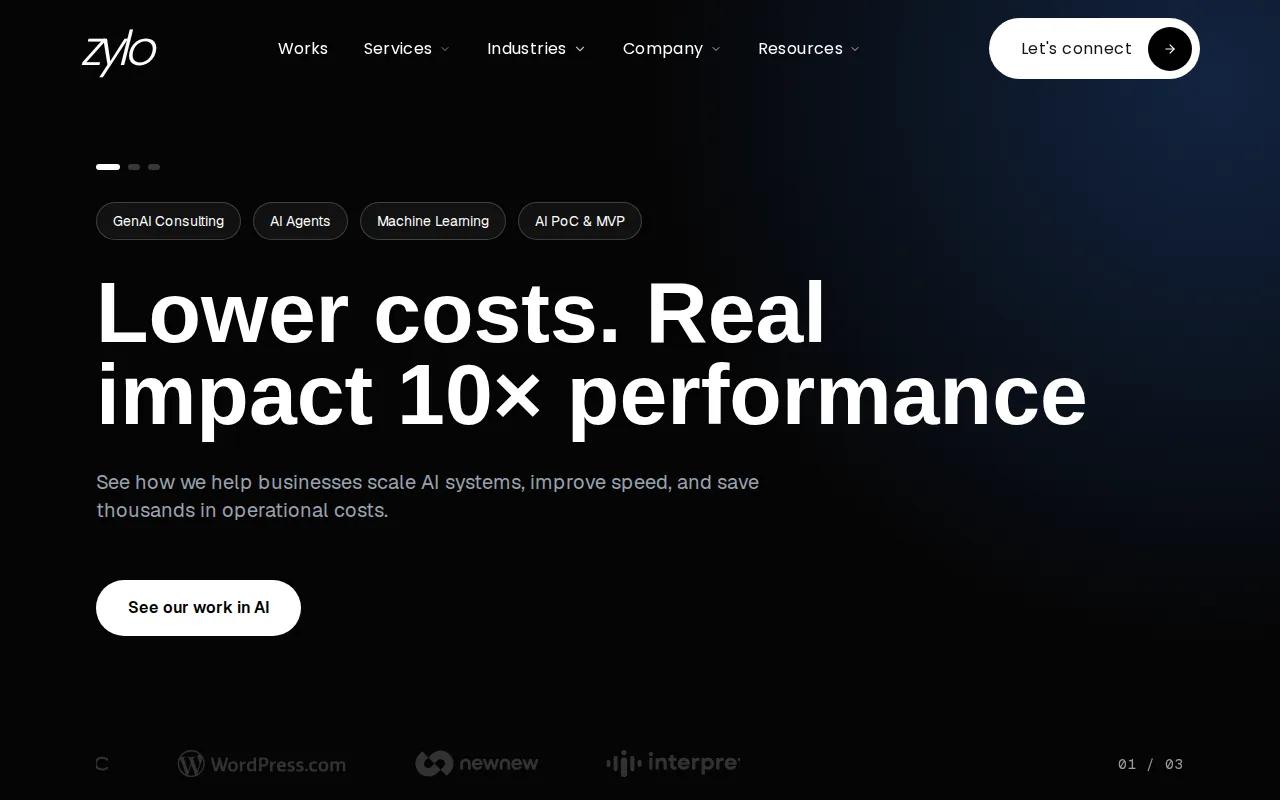
Zylo Technologies designs and ships custom AI agents for enterprise teams and founder-led companies across fintech, healthcare, mobility, and education. Pricing is scoped per engagement, not published as a rate card, which is a deliberate signal: every system is built to your data, your infrastructure, and your specific workflow logic.
What separates Zylo from the rest of this list is the documented performance data behind the price. Across 140+ shipped systems, the median 12-month ROI sits at approximately 3.4×. That's one of the few quantifiable performance claims in the market. Most vendors make no ROI claim at all. Zylo also runs on senior-only delivery pods, a staffing model almost no competitor discloses, with a six-week production cycle from kickoff to working software in your environment.
The positioning is clear: you own the model, the data, and the outcome. There's no platform lock-in, no per-seat renewal, and no dependency on a SaaS subscription that can change pricing mid-contract. If you're evaluating bespoke AI solutions for enterprises, this ownership model is the most durable option on the list.
The honest caveat: Zylo doesn't publish a price list. You'll need a scoping conversation before you see a number. For teams that want instant sandbox access or a self-serve free tier, that's a barrier. For enterprises with real compliance requirements and a need to own what they build, it's the right trade-off.
2. Anthropic — Tiered Subscription Plans for Enterprise Agents
Anthropic's pricing follows a subscription tier model built around Claude's model family. The Pro tier starts at $17–20 per month for individual users, with rate limits that doubled on May 6 2026 after Anthropic updated Claude Code's five‑hour window budget. Higher tiers are priced on request, and enterprise contracts are custom and negotiated directly.
On the API side, Anthropic's Opus 4.7 is billed per‑token at the standard rates published by Anthropic. Costs can increase quickly with large token volumes.
For enterprise teams building AI agents at scale, the subscription tiers work well for predictable, moderate‑volume workloads. High‑volume production use with long context windows can make costs less predictable, requiring careful budgeting.
Anthropic is a strong choice for teams that want access to one of the most capable model families with well‑documented pricing. The limitation is that enterprise‑grade custom agent deployments still require direct contract negotiation, and the token‑level cost structure demands careful monitoring at scale.
3. OpenAI — Pay-as-You-Go Token Pricing
OpenAI prices its GPT-5.5 model at $5 input and $30 output per million tokens for standard use. That headline rate is clean and easy to model, until you exceed OpenAI’s input‑token threshold where the pricing flips retroactively, doubling input rates and increasing output rates for the entire session.
For enterprise teams building agents that reason over large codebases or long document sets, this retroactive surcharge is the most important pricing detail to understand before committing. There is a ceiling for sub‑surcharge sessions, beyond which effective input cost doubles.
OpenAI also offers Codex access via subscription plans that bundle GPT‑5.5 usage into fixed message windows per time period. These plans suit teams with predictable, moderate agent workloads. The pay‑as‑you‑go model suits teams with variable or high‑volume needs who want to avoid subscription commitments.
OpenAI's pricing is among the most transparent on this list, which makes it easier to model total cost of ownership before signing anything. The caveat is that long‑context enterprise use cases can hit cost ceilings fast, and the retroactive surcharge logic requires active budget governance from day one. Teams evaluating custom AI software development approaches should model this threshold carefully against their actual workload patterns.
4. Google — Flexible Tiered Pricing, Free Entry Tier
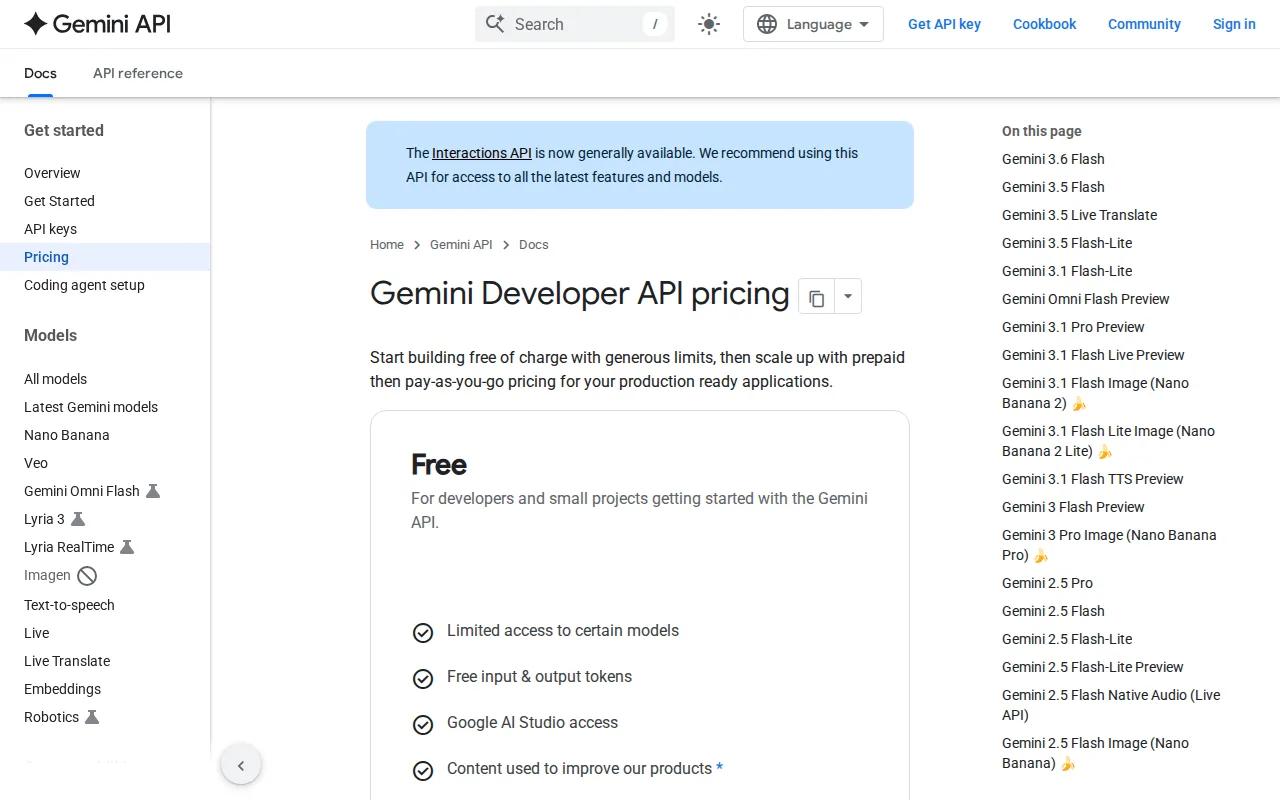
Google's AI agent pricing follows a subscription tier matrix with a free Hobby tier, a $20 Individual plan, a $40 per user Teams plan, and custom Enterprise pricing. The Gemini model family underlies most of these tiers, with Gemini 3.5 Flash reaching general availability in May 2026 at $1.50 input and $9.00 output per million tokens.
The free entry tier is a real advantage for teams that want to prototype before committing budget. Most enterprise AI agent vendors don't offer a meaningful free tier. Google's does have rate limits, but it's enough to validate a use case before escalating to a paid plan.
For production enterprise workloads, the Teams and Enterprise tiers are where the real conversation starts. Enterprise pricing is custom, which means the free-to-paid jump requires a vendor conversation. Google's long-context surcharge also applies at scale, a pattern that has emerged across Anthropic and OpenAI simultaneously in 2026, so budget models need to account for it across all three.
Google is best for enterprises already running on Google Cloud infrastructure, where native integration reduces the overhead of connecting agents to existing data pipelines. Teams without existing Google Cloud footprint get less from the pricing structure because the integration advantages don't apply.
Pro Tip
When modeling enterprise AI agent costs across Google, Anthropic, and OpenAI, build your cost estimate at 120% of your expected token volume. Long-context surcharges and Fast mode multipliers consistently push real spend above initial projections.
5. xAI — Premium Subscription for Grok Build
xAI launched Grok Build on May 14, 2026 as a terminal‑native autonomous coding agent powered by grok‑build‑0.1. Access requires a SuperGrok Heavy subscription, priced at $99 per month for an introductory six‑month period, then approximately $300 per month at list price. The API uses a usage‑based pricing model with a generous context window.
The headline technical differentiator is parallel sub‑agent execution. Grok Build can spawn up to eight concurrent sub‑agents, each isolated in its own Git worktree on a separate branch. xAI positions this against Claude Code's maximum of four parallel agents. In practice, this means the system can explore multiple divergent solution paths simultaneously, with the developer reviewing and selecting the winning branch before merge.
On benchmark performance, xAI reports strong results for grok‑build‑0.1, while independent figures place Claude Code (Opus 4.7) ahead. The context window is notably smaller than Claude Code's, which can become an architectural constraint for large enterprise codebases.
Grok Build fits teams that want a structured Plan → Search → Build pipeline with explicit human approval gates before any code executes. That workflow suits organizations with code review requirements. The subscription entry cost and benchmark gap relative to Claude Code are the main reasons to evaluate this carefully before committing at enterprise scale. For teams thinking through best practices for building AI agents that last, the approval gate architecture is worth studying regardless of which platform you choose.
6. Ada — Custom Enterprise Contracts Per Conversation
Ada prices its AI agent platform on a per-conversation model with custom enterprise contracts. Engagements start at approximately $30,000 per year, making it one of the more accessible named enterprise options on this list for teams that need conversation-based pricing rather than token-based billing.
The per-conversation pricing model has a meaningful operational advantage: your finance team can model cost directly against conversation volume rather than token consumption. That's a cleaner budget line than token-based pricing, where a single long session can cost 10× a short one depending on context length and model selection.
Ada is best for enterprises that need a custom AI agent focused on customer-facing workflows, particularly support and service automation. The platform is built for conversation handling at scale, not general-purpose agentic coding or document reasoning. If your use case is customer service automation with conversation-level accountability, Ada's pricing structure maps cleanly to that workflow.
The limitation is scope. Ada's per-conversation model works well for customer service but doesn't extend to the broader agentic use cases that platforms like OpenAI or Anthropic support. For enterprises that need one agent handling customer interactions and another handling internal operations, Ada covers only part of the picture. Teams evaluating AI automation services for enterprises should map their full workflow scope before committing to a per-conversation pricing model.
What to Look for in Enterprise AI Agent Pricing
Custom AI agent pricing for enterprises has a fragmentation problem. The median starting price across the market is around $21, but the mean is significantly higher due to large implementation fees and outlier projects. That gap tells you something important: headline prices almost never reflect total cost of ownership.
Four things actually determine what you'll spend. First, scope clarity. A narrow, well‑defined agent is substantially cheaper to build than an open‑ended system with autonomy over multiple business processes. Start narrow. Second, integration complexity. Every external system your agent connects to adds development time, often several weeks per complex integration. Third, compliance overhead. HIPAA or SOC 2 requirements can add considerable cost and months to a project. Fourth, team seniority. Senior AI engineers in the U.S. command premium rates, while offshore teams can reduce costs, though quality varies enough that a paid proof‑of‑concept before a full engagement is worth the expense.
Hybrid pricing structures are also common and easy to misread. A notable share of enterprise AI agent vendors bundle a large upfront implementation fee with an ongoing monthly run cost. That structure can look affordable at signing and expensive at renewal. Ask for a full 24‑month cost model before you commit.
One metric almost no vendor discloses is team seniority ratio. Only Zylo Technologies publicly states a 100 % senior‑staff model, and that correlates directly with strong ROI outcomes. For enterprises evaluating vendor risk beyond price, asking “what percentage of the team on my account will be senior engineers?” is one of the most useful questions you can put in a vendor RFP. Understanding AI agent lifecycle management also helps you evaluate which vendors are building for durability versus short‑term delivery.
Key Takeaway
The vendor who discloses their team seniority ratio and publishes a documented ROI claim is giving you more useful pricing signal than any headline rate card.
Pricing Comparison Table
| Provider | Pricing Model | Starting Price | Best For | Key Caveat |
|---|---|---|---|---|
| Zylo Technologies | Custom by scope | On request | Enterprises needing owned, senior-built AI agents | No published rate card; requires discovery call |
| Anthropic | Subscription tiers + API token pricing | $17–20/mo (Pro); Enterprise custom | Teams needing capable models with documented cost examples | Fast mode and data-residency surcharges compound quickly |
| OpenAI | Pay-as-you-go token pricing | $5 input / $30 output per Mtok | Variable-volume workloads with transparent per-token billing | Retroactive 2× surcharge above 272K input tokens per session |
| Subscription tier matrix | Free Hobby; $20 Individual; $40/user Teams; Enterprise custom | Google Cloud-native teams prototyping before scaling | Long-context surcharge applies at production scale | |
| xAI (Grok Build) | Subscription (SuperGrok Heavy required) | $99/mo intro (6 months); ~$300/mo list | Teams wanting structured approval-gate coding pipelines | Benchmark gap vs. Claude Code; 256K context limit |
| Ada | Per-conversation custom enterprise contracts | ~$30,000/year | Enterprises needing customer service automation at scale | Scope limited to conversation workflows; not general-purpose |
FAQ
How much does a custom AI agent cost for an enterprise?+
Enterprise custom AI agent costs range from roughly $30,000 per year for conversation-based platforms like Ada to a substantial upfront investment for fully custom multi-agent systems. Mid-market enterprise AI agent projects typically fall within a broad range, with pricing varying based on scope and complexity. Token-based platforms like OpenAI and Anthropic start lower but scale with usage volume, so total cost depends heavily on how many sessions your agents run per month.
What is the difference between token pricing and per-conversation pricing for AI agents?+
Token pricing bills you for the exact volume of text your agent processes, which makes costs variable and harder to forecast. Per-conversation pricing charges a flat rate per interaction regardless of length, which maps more cleanly to a budget line. For customer service agents with predictable conversation volumes, per-conversation pricing is easier to model. For technical agents handling variable-length tasks like code review or document analysis, token pricing often ends up cheaper at lower volumes but harder to cap.
Why don't enterprise AI agent vendors publish their prices?+
Most enterprise AI agent vendors don't publish prices because the real cost depends on integration complexity, compliance requirements, data readiness, and team seniority, none of which are fixed. A vendor that publishes a headline price is usually quoting the simplest possible configuration. Custom builds priced by scope, like Zylo Technologies, reflect the actual variables that determine what the system will cost to build and maintain over its full lifecycle.
What hidden costs should enterprises watch for in AI agent contracts?+
Watch for four things. First, implementation fees bundled with ongoing monthly costs, which can double the apparent first-year price. Second, long-context surcharges on token-based platforms that apply retroactively to entire sessions once a threshold is crossed. Third, data-residency or compliance surcharges for regulated industries. Fourth, model deprecation risk: when a base model is sunset, your agent may need rebuilding, and that cost is rarely in the original contract.
Is outcome-based pricing available for enterprise AI agents?+
Outcome-based pricing exists but is rare. Only a small number of vendors in the market make any ROI claim, and even fewer tie pricing directly to results. Zylo Technologies discloses a ~3.4× median 12-month ROI across delivered systems. Some customer service platforms use per-resolution pricing, where you pay only when the agent fully resolves a ticket without human escalation. For most enterprise AI agent categories, outcome-based pricing is still the exception rather than the standard model.
How long does it take to deploy a custom enterprise AI agent?+
Delivery cycles are rarely disclosed by vendors, but where reported they range from two to six weeks for initial deployment. Zylo Technologies runs a six-week production cycle, which reflects the depth of senior-only custom builds. Simpler platforms or pre-built agents can go live faster, sometimes within days, but faster deployment usually means less customization and more dependency on the vendor's generic configuration. The right timeline depends on how much of your proprietary data and workflow logic needs to be built into the system.
Conclusion
If your team needs a truly custom AI agent built on your data and owned outright, Zylo Technologies' AI agent development services are the most defensible starting point, backed by documented ROI and a senior-only delivery model. For teams that need a faster entry point or a specific conversation-based pricing model, Anthropic, OpenAI, Google, xAI, and Ada each serve a different operational scenario. Start with a scoping conversation that maps your actual workflow, compliance requirements, and volume before you compare any headline price.
Share this article
About the author

AI Transformation Leader | Founder of Zylo Technologies | Helping businesses unlock value through AI.
Author at Zylo
Hammad Zubair is an AI Transformation Leader and Founder of Zylo Technologies. He helps businesses discover practical AI opportunities that reduce costs, improve efficiency, and accelerate growth. Through AI readiness assessments and transformation strategies, he enables organizations to identify high-impact automation and AI implementation opportunities.