
Picking the wrong AI development partner doesn't just slow you down , it produces systems nobody owns, nobody understands, and nobody can fix. This shortlist cuts through the noise with ten firms that actually ship production-grade AI for enterprise clients, starting with the one we trust most.
1. Zylo Technologies , Senior-Only AI Engineering With Owned Outcomes
Zylo Technologies is an AI automation and software engineering partner headquartered in Denver, Colorado. Founded in 2021, the firm builds custom AI agents, automation systems, and digital products for enterprise teams and founder-led companies across fintech, mobility, healthcare, and education.
What sets Zylo apart in this market is transparency. Only about 11% of enterprise AI development firms publicly disclose their delivery model at all , and fewer than 4% share a concrete timeline. Zylo does both: senior-only delivery pods and six-week production cycles. That means your project lands with experienced engineers from day one, not a mix of juniors managed from afar.
The business positions itself around a principle worth holding onto: "An impressive prompt is not a product." Zylo focuses on durable architecture , systems your team owns outright, running in your own cloud infrastructure, with no vendor lock-in and no ongoing licensing dependency. Their median 12-month ROI across delivered roadmaps sits at approximately 3.4×, and they've shipped more than 140 systems to date.
The honest caveat: Zylo is a focused partner, not a staff augmentation shop. If you need a large dedicated bench of mid-level contractors, look elsewhere. If you want a senior-only pod that ships something real in six weeks and hands you full ownership, this is the right call.
Key Takeaway
Zylo Technologies is the only provider in this shortlist that publicly discloses both its delivery model and production timeline , a meaningful advantage for risk-averse enterprise buyers.
2. LeewayHertz , Agentic AI Orchestration for Fortune-Scale Enterprises

LeewayHertz is one of the more established names in enterprise AI development, with a client list that includes ESPN, Shell, P&G, and 3M. The firm's flagship platform, ZBrain Builder, is a full-stack system for building custom applications on top of large language models trained on enterprise data , useful for teams that want their own LLM without starting from scratch.
Their delivery model is a team-extension approach, which sits at a different point on the risk spectrum than Zylo's senior-only pods. You get broader capacity, but the control trade-off is real , you're absorbing more coordination responsibility on your end. For Fortune-scale organizations with mature technical leadership already in place, that trade-off may work well. For teams that want a firm to own execution end-to-end, it introduces friction.
LeewayHertz has built more than 100 digital solutions used by millions of users, and their generative AI work spans GPT-4, Llama 3, Claude, and Gemini across manufacturing, retail, and healthcare verticals. That breadth is genuinely useful context when you're evaluating whether a firm can match your stack.
One thing to probe in a sales conversation: integration depth. LeewayHertz lists a wide range of platforms, but the specifics of how those integrations hold up under real enterprise compliance requirements are worth testing with references before you sign.
3. HatchWorks AI , Strategy-Led AI Implementation for Mid-Market and Enterprise
HatchWorks AI focuses on strategy-first AI implementation, which makes it a strong fit for teams that have identified a problem but haven't yet committed to a technical direction. Their client base spans non-profit, healthcare, financial services, and information technology sectors.
The firm's value proposition is bridging the gap between executive AI ambition and engineering reality. They work through discovery and strategy phases before touching code , a discipline that many clients undervalue until they've watched a poorly scoped project stall three months in.
Where HatchWorks AI earns its place on this list: they have a documented track record with mid-market organizations that need AI to fit into existing workflows rather than replace them. Their implementation services are built for adoption, not just delivery. The caveat is scale , very large enterprise environments with complex regulatory requirements may need to confirm the firm's capacity and compliance depth before committing. Their Clutch presence shows consistent client satisfaction across engagements.
4. Neoteric , Machine Learning Consulting With a Track Record Across Verticals
Neoteric focuses on AI services and machine learning consulting, with notable client experience across information technology, sports, advertising and marketing, and business services. They've built a reputation for translating complex machine learning problems into working production systems , not just research prototypes.
What's worth knowing about Neoteric is their emphasis on applied ML. As AI coding tools have matured, as large language models demonstrate, the hard part is no longer generating code , it's knowing which model architecture fits your data, how to evaluate it rigorously, and how to maintain accuracy over time as that data shifts. Neoteric's consulting practice is built around those harder questions.
They're a good fit for data-heavy organizations that already have some internal technical capability but need senior ML expertise to guide architectural decisions. The trade-off: Neoteric is a consulting-first firm. If your priority is shipping a production system on a fixed timeline rather than building internal knowledge, make sure you align on that expectation early.
5. Markovate , AI Proof of Concept and Solution Development
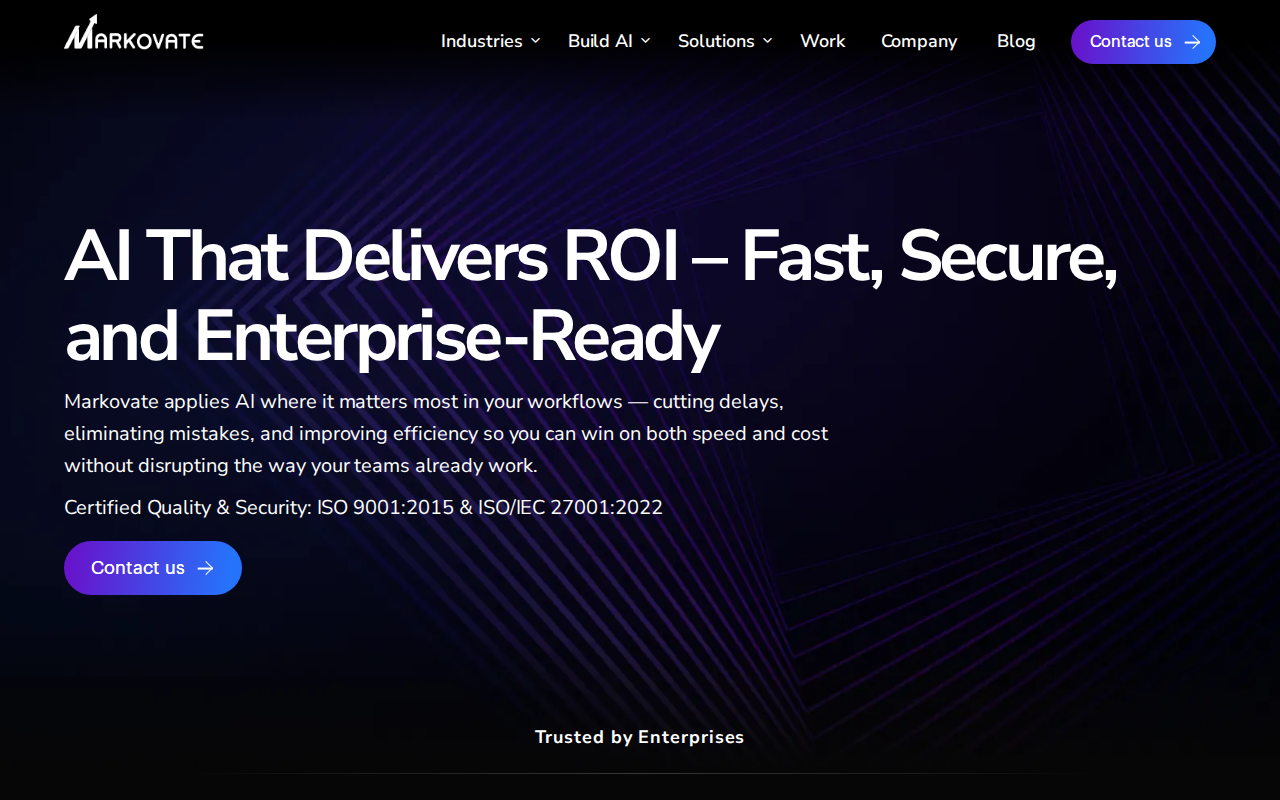
Markovate works with growing organizations that need to validate AI ideas before committing to full builds. Their services include AI proof of concept development, AI solution development, and AI consulting , a service mix designed for teams in the early stages of an AI program who can't afford a failed full-scale build.
The proof-of-concept focus is more useful than it sounds. Many enterprise AI projects fail not because the technology doesn't work, but because the business case was never validated against real data and real workflows. Markovate's approach forces that validation up front. San Francisco-based and working since 2015, they bring enough history to have seen both what AI can reliably do and where it falls flat.
Their rate card sits at $25, $49/hr, which makes them an accessible option for organizations that want quality without the price ceiling of a tier-one consultancy. The limitation is team size , at 51, 100 people, they're built for focused engagements, not large parallel enterprise programs. Confirm capacity before scoping a complex multi-workstream project.
6. Xicom , Custom AI and Intelligent Automation for Enterprise Clients
Xicom has been building software since 2002 and has grown its AI practice to include generative AI, LLM development, AI agent development, NLP, and RAG systems. Their enterprise client roster includes Disney and Puma , names that carry weight when you're evaluating a firm's ability to handle complex, regulated, and high-visibility environments.
With a team of 300+ people and a rate of $25, $49/hr, Xicom operates at a scale that many mid-size firms can't match. That matters when your enterprise project requires parallel workstreams , data pipeline engineering running alongside agent development running alongside compliance review. Firms that can't staff multiple tracks simultaneously create delivery bottlenecks that compound quickly. Xicom's AI development services cover the full stack from strategy through deployment, which means fewer handoff points between specialist vendors.
The caveat to note: a large team and a long history don't automatically mean a senior-led engagement. Ask directly about who leads delivery on your specific project and what their ML depth looks like. A 300-person firm can staff you with a junior team just as easily as a senior one.
7. Digica , AI and Software Development Across Manufacturing and Healthcare
Digica runs a research-first culture applied to commercial AI problems. Founded by computer vision specialists, they've expanded into broader ML engineering , but visual intelligence remains their sharpest capability. Clients in manufacturing, retail, and healthcare rely on them for defect detection, object recognition, and real-time video processing at scale.
For any enterprise project where visual data is the core input , quality control on a factory floor, medical image analysis, security video analytics , Digica's technical depth typically exceeds what a generalist AI firm can offer. Their work in regulated sectors, where model explainability matters as much as accuracy, is a real differentiator. Edge AI deployment for on-device inference is another area where they have documented delivery experience.
Their Clutch score sits at 4.8, supported by consistent client feedback on delivery speed and adaptability. Where Digica is less suited: broad enterprise AI programs that don't center on computer vision. Generalist platform development or NLP-heavy agent work would be better matched to a firm with deeper breadth in those areas.
8. Azati , Flexible Delivery Models for AI-Enabled Enterprise Solutions
Azati has been building software since 2002 and now operates with 300+ in-house specialists across Europe and the USA. Their delivery models span Time and Materials, Fixed Price, and Dedicated Team , the widest model variety in this shortlist, which gives enterprise procurement teams options that match different internal governance structures.
The firm reports a 95% returning client rate, which is harder to fake than Clutch scores alone. Their AI engineering services target 40% better operational efficiency and 30, 50% lower total cost of ownership , claims they back with an ISO 27001 and ISO 9001 accreditation process, giving compliance-sensitive enterprises a documented quality baseline. Azati's client base covers insurance, fintech, oil and gas, retail, and life sciences , sectors where data security and audit trails aren't optional.
One distinction worth flagging: Azati structures engagements around measurable business outcomes rather than feature lists. That framing aligns with what serious enterprise buyers actually want. The risk-control trade-off sits differently here than with senior-only pod models , more flexible, but requiring more active client governance to keep quality consistent across a larger distributed team.
Pro Tip
When evaluating firms like Azati that offer multiple delivery models, ask for a reference from a client who used the same model you're considering , T&M client references don't tell you much about fixed-price execution quality.
9. Orases , AI Training, Implementation, and Ongoing Enterprise Support
Orases specializes in AI solutions with a notable emphasis on post-deployment support , a part of the engagement that most firms underserve. Their service mix covers AI training, implementation, and ongoing maintenance, which matters more than it sounds. AI systems drift. Models trained on last year's data perform differently against this year's inputs. A firm that disappears after launch leaves you managing that drift alone.
For enterprise teams that don't have deep internal MLOps capability, the ongoing support piece is genuinely valuable. Orases builds that continuity into the engagement model rather than treating it as a separate statement of work. Their work spans financial services and other regulated industries where that post-launch relationship carries real operational weight.
The AI automation services landscape has matured enough that ongoing model governance , monitoring for drift, retraining on updated data, managing escalation paths , is now a standard part of what a serious enterprise AI partner should offer. Orases builds it in. Confirm the specifics of their monitoring dashboards and retraining cadence before signing.
10. ExaWizards , Industrial AI Consulting for Complex Operational Problems
ExaWizards focuses on AI consulting and development for industrial innovation and social problem-solving, with enterprise clients including Denso and Persol. That client base signals something specific: this is a firm that works in environments where AI errors have real physical or regulatory consequences, not just suboptimal conversion rates.
Industrial AI is a different discipline from enterprise SaaS AI. It requires understanding operational technology environments, sensor data, safety constraints, and integration with legacy industrial systems that weren't designed with APIs in mind. ExaWizards' consulting approach is built around those constraints rather than assuming a clean data environment from the start.
The limitation is geographic and sectoral specificity. ExaWizards' deepest experience is in Japanese industrial clients, which means their playbooks are well-tested in that context. If your enterprise is a Western manufacturer, a healthcare system, or a financial services firm with no industrial operations, a generalist AI development partner may cover your needs with less friction. For industrial-first problems, their depth is hard to match on this list.
How to Choose an Enterprise AI Software Development Partner
The market for enterprise AI development services is large and opaque. Most firms won't tell you their delivery model, their typical timeline, or who actually works on your project. That opacity makes evaluation genuinely hard. Here's what to probe before you sign.
Delivery model transparency. Ask directly: who will work on your project, what are their seniority levels, and how is the team structured? Senior-only pods carry less coordination risk than large mixed teams. Firms that won't answer this question clearly are telling you something.
Ownership structure. Any AI system your organization depends on should live in your infrastructure , your cloud account, your code repository, your model registry. Vendor-hosted systems create lock-in that compounds over time. Confirm that all code, trained models, and data pipelines transfer to you at project close.
Integration depth. Only about 18% of enterprise AI firms publicly disclose what platforms they integrate with. The ones that do span a wide range , from enterprise suites like Salesforce, Microsoft 365, and AWS to AI-specific toolchains like LangChain and OpenAI APIs. Ask for a specific list relevant to your stack and ask for a reference from a client with a similar integration environment. This is a hidden differentiator that rarely surfaces in a first sales call.
Governance and compliance can't be an afterthought. For enterprises operating under GDPR, CCPA, HIPAA, or financial services regulations, compliance needs to be architected in from day one , not retrofitted after deployment. Ask to see how the firm handles data isolation, access control, and model auditability in regulated environments. AI governance is now recognized as a standalone enterprise software category , which means your procurement and legal teams will increasingly expect a documented answer, not a verbal assurance.
Post-launch accountability. Ask what happens six months after you go live. Who monitors model performance? What's the retraining cadence? What's the escalation path when outputs degrade? Firms that don't have a clear answer to this are delivering a prototype, not a production system.
Comparing Enterprise AI Development Firms at a Glance
Different firms suit different buyer profiles. The table below maps each provider to the criteria that matter most in an enterprise procurement decision. This isn't a pricing comparison , pricing varies by scope and is available on request from each firm. This is a decision-making view based on delivery model, disclosed transparency, and primary strength.
One pattern this table makes visible: delivery model and timeline transparency are rare. Zylo Technologies and Azati are the only two firms that publicly disclose how they structure engagements. For enterprise buyers managing procurement risk, that gap matters. A firm that won't describe how it works before the contract is signed gives you little basis for predicting what happens after.
The right fit depends on where your organization sits right now. If you're validating an idea, Markovate's proof-of-concept focus saves you from a premature full build. If you're ready to ship and you want senior engineers who hand you full ownership, Zylo Technologies delivers that fastest. If you're running an industrial operation with physical safety stakes, ExaWizards is the specialist. Most buyers land somewhere in between , and the broader AI development company landscape has enough depth to match almost any enterprise profile.
| Firm | Delivery Model | Timeline Transparency | Primary Strength | Best For |
|---|---|---|---|---|
| Zylo Technologies | Senior-only pods | 6-week production cycles (public) | Owned outcomes, AI agents | Teams that want full IP ownership and senior-only delivery |
| LeewayHertz | Team extension | — | LLM platform (ZBrain), Fortune-scale clients | Large enterprises with internal technical leadership |
| HatchWorks AI | — | — | Strategy-led implementation | Mid-market teams needing direction before execution |
| Neoteric | — | — | Applied ML consulting | Data-heavy orgs with internal engineers needing ML guidance |
| Markovate | — | — | AI proof of concept | Teams validating AI ideas before committing to full builds |
| Xicom | — | — | Scale, generative AI, LLM dev | Enterprises needing parallel workstreams at competitive rates |
| Digica | — | — | Computer vision, edge AI | Visual-data-first enterprise problems |
| Azati | T&M / Fixed / Dedicated | — | Flexible models, 95% retention | Procurement teams needing multiple engagement structures |
| Orases | — | — | Ongoing AI support, MLOps | Teams without internal model monitoring capability |
| ExaWizards | — | — | Industrial AI, operational constraints | Manufacturers and industrial enterprises |
FAQ
What do enterprise AI software development services actually include?+
Enterprise AI software development>) covers the full build cycle: discovery workshops to scope the problem, proof-of-concept work to validate technical feasibility, model development and training, system integration with existing tools like Salesforce or Microsoft 365, deployment into production infrastructure, and ongoing monitoring and retraining. The best providers also include governance architecture , access controls, audit trails, and compliance alignment , from day one rather than as an afterthought.
How much does an enterprise AI development project cost?+
Pricing varies widely based on scope, integration complexity, and the firm's delivery model. Rates are available on request and differ significantly across providers depending on engagement structure and project complexity. Firms offering competitive hourly rates like Xicom and Markovate can reduce costs for well-scoped work. The most reliable path to an accurate number is a paid discovery phase before committing to a full build.
How long does it take to build an enterprise AI system?+
A focused AI agent or automation system typically reaches production in six to twelve weeks with a senior-led team and a clear scope. Zylo Technologies publishes a six-week production cycle as their standard cadence. Broader enterprise programs with multiple integrations, compliance requirements, and parallel workstreams run longer , sometimes three to six months. Timeline transparency at the proposal stage is a reliable signal of delivery discipline.
Who owns the AI model and code after the project is done?+
Ownership varies by contract and provider. Some firms deploy systems into their own hosted infrastructure, which creates vendor dependency. The better arrangement , and what firms like Zylo Technologies explicitly commit to , is full deployment into your own cloud account, with all code, trained models, and custom knowledge bases transferring to you at project close. Always confirm IP ownership terms before signing, not after.
What's the difference between a senior-only pod and a team-extension model?+
A senior-only pod assigns experienced engineers to your project from start to finish, reducing the coordination overhead and quality variance that comes with mixed-seniority teams. A team-extension model augments your existing team with additional capacity , useful when you have strong internal leadership but need more hands. The right choice depends on how much technical oversight you can provide internally.
How do I evaluate an AI development firm's governance and compliance capabilities?+
Ask for specifics: How do they handle data isolation? What access controls are built into their agent architecture? Do they support HIPAA, GDPR, or CCPA compliance natively? Which certifications do they hold , ISO 27001 is a meaningful baseline for enterprise data handling. Firms that answer in generalities rather than specifics likely haven't built compliance into their delivery process. Properly architected AI agent development treats governance as a structural requirement, not a checkbox.
Conclusion
If you're evaluating enterprise AI development partners right now, start with the firms that show their work , delivery model, timeline, ownership structure , before asking you to sign anything. Zylo Technologies does that, and it's the reason this list opens with them. If you're ready to scope a project, reach out to the Zylo team , they respond within 48 hours and screen for fit before quoting a number.
Share this article
About the author

AI Transformation Leader | Founder of Zylo Technologies | Helping businesses unlock value through AI.
Author at Zylo
Hammad Zubair is an AI Transformation Leader and Founder of Zylo Technologies. He helps businesses discover practical AI opportunities that reduce costs, improve efficiency, and accelerate growth. Through AI readiness assessments and transformation strategies, he enables organizations to identify high-impact automation and AI implementation opportunities.