
Most enterprises shortlist AI automation agencies the wrong way: comparing slide decks instead of delivery records. Fewer than 3% of agencies publicly disclose ROI figures, which means you're mostly choosing on trust. This list cuts through that. Here are 10 agencies and platforms worth serious evaluation, with honest notes on what each does well and where it falls short.
1. Zylo Technologies — Custom AI Agents Built for Enterprise Durability
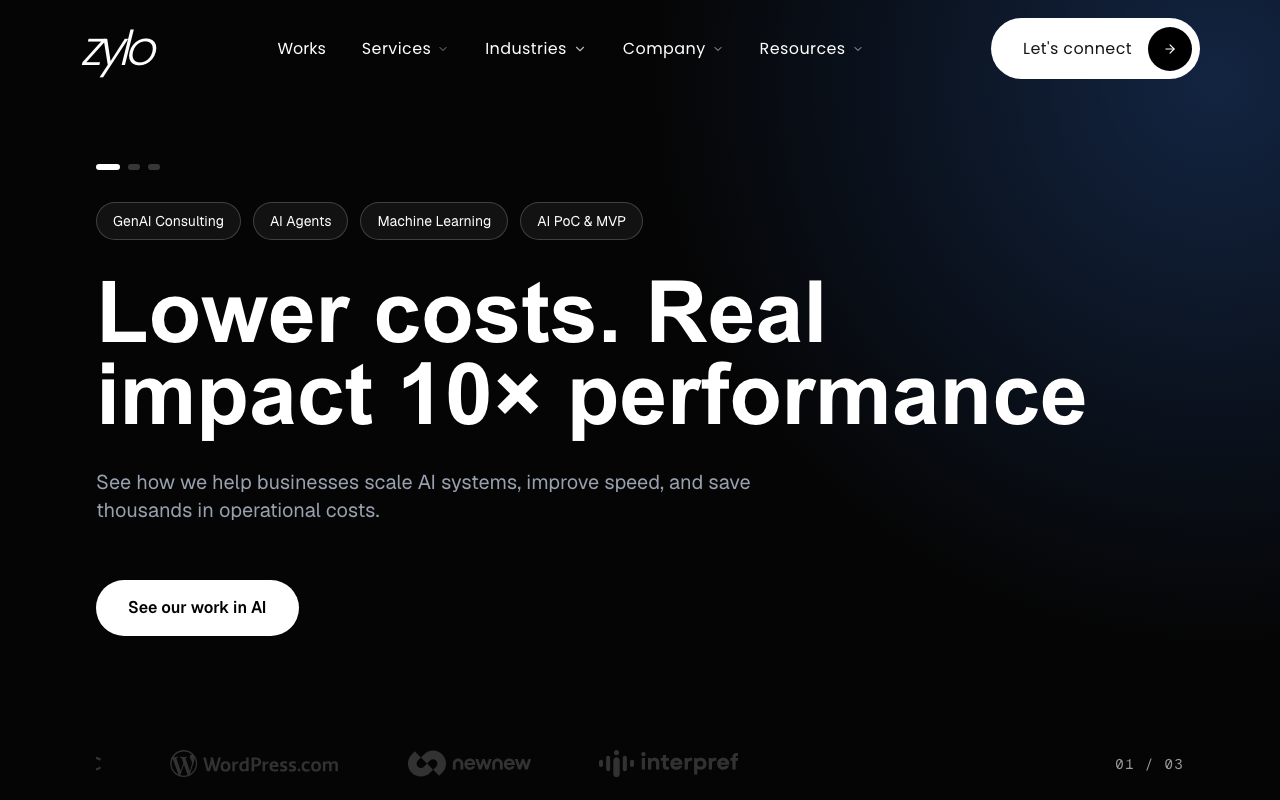
Zylo Technologies is a Denver-based AI automation and software engineering partner that designs and ships custom AI agents, automation systems, and digital products for enterprise teams. If you need an AI system your team actually owns when the engagement ends, this is the firm to evaluate first.
Screenshot of the Zylo Technologies website.
What separates Zylo from most of the agencies on this list is documented delivery data. The firm reports a six-week production cycle and a 3.4× median 12-month ROI across delivered roadmaps. In a market where almost no agency publishes quantified ROI, having a concrete benchmark matters when you're trying to justify budget to a board. Zylo uses senior-only delivery pods, which keeps coordination overhead down and timelines honest. That six-week cycle is roughly eight weeks faster than the industry median of 14 weeks, and it beats the slowest 75% of providers by a significant margin.
The firm has shipped more than 140 systems across fintech, mobility, education, healthcare, and enterprise operations. That cross-sector breadth matters if your automation spans regulated data environments. You own the model, the training data, and the integration code when the engagement ends. No vendor lock-in. You can read more about how Zylo structures production-ready agent delivery on the Zylo AI automation services page.
The honest caveat: Zylo is not a self-serve platform. If you want a no-code tool you can configure in a weekend, this is not it. Zylo's model is built for enterprises that want durable, owned systems, not fast demos. Expect a discovery process before scoping begins.
Key Takeaway
Zylo is the only agency in this shortlist that publicly discloses a quantified ROI multiple, making it the most defensible choice when your procurement process demands proof over promises.
2. Cognigy — Conversational AI with Native Voice Gateway
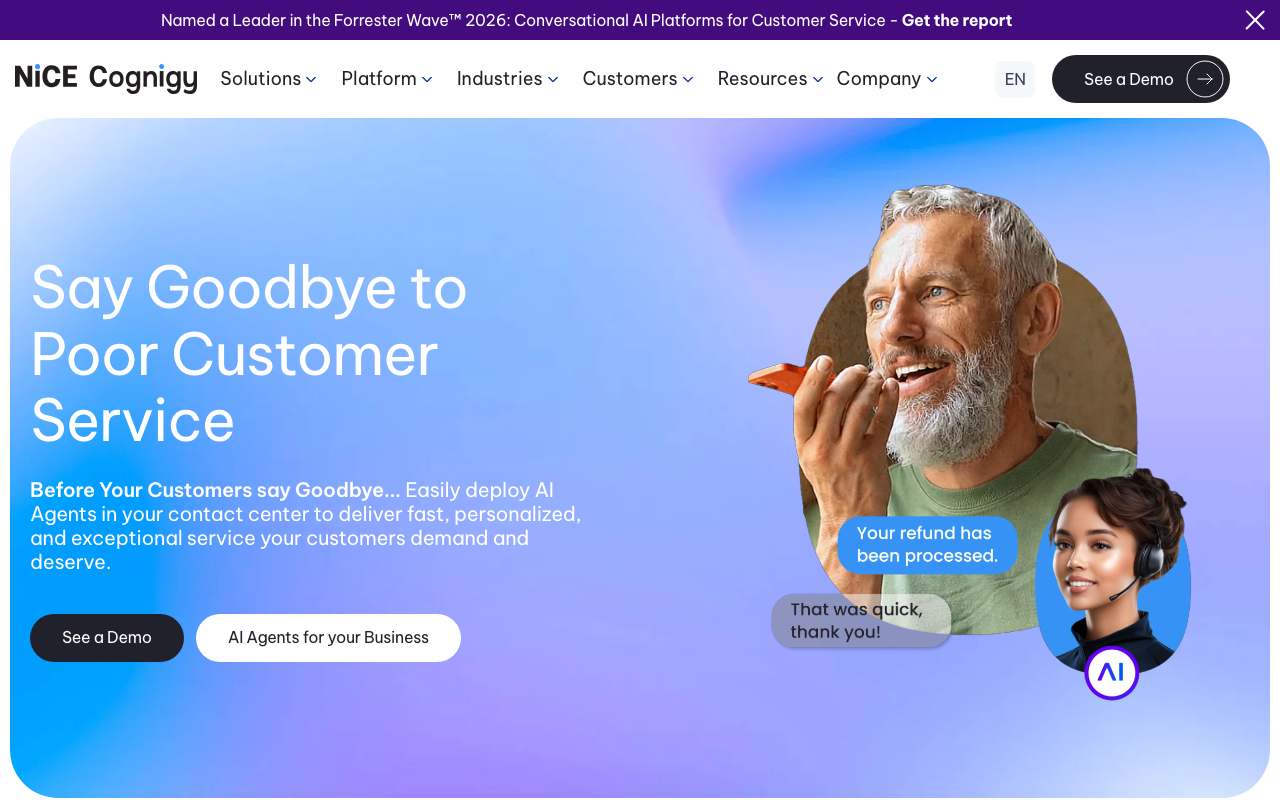
Cognigy is a conversational AI platform built for contact center environments. It connects natively to CCaaS systems, CRMs, and voice channels, which makes it a usable option for enterprises running high-volume customer interactions across voice and chat.
Screenshot of the Cognigy website.
The platform averages a 13-week delivery cycle, which is slightly faster than the median for managed deployments. Cognigy supports both cloud and on-premises deployment, a detail that still matters to enterprises in regulated industries where data residency is a compliance requirement. Native voice gateway support means you're not stitching together a third-party telephony layer after the fact.
Where Cognigy earns its place: deep CRM integration out of the box and a mature platform that's been in enterprise contact centers long enough to have real production history. The tradeoff is scope. It's strong for customer-facing conversational use cases and weaker if your automation needs span back-office workflows or complex multi-system orchestration. Enterprises that need a broader agent architecture may want to pair Cognigy with a separate orchestration layer or evaluate whether a platform with wider workflow scope fits better. The platform supports enterprise-grade security controls and multi-channel deployment across voice and digital channels.
3. Rasa — Open-Core AI Agent Platform for Complex Orchestration
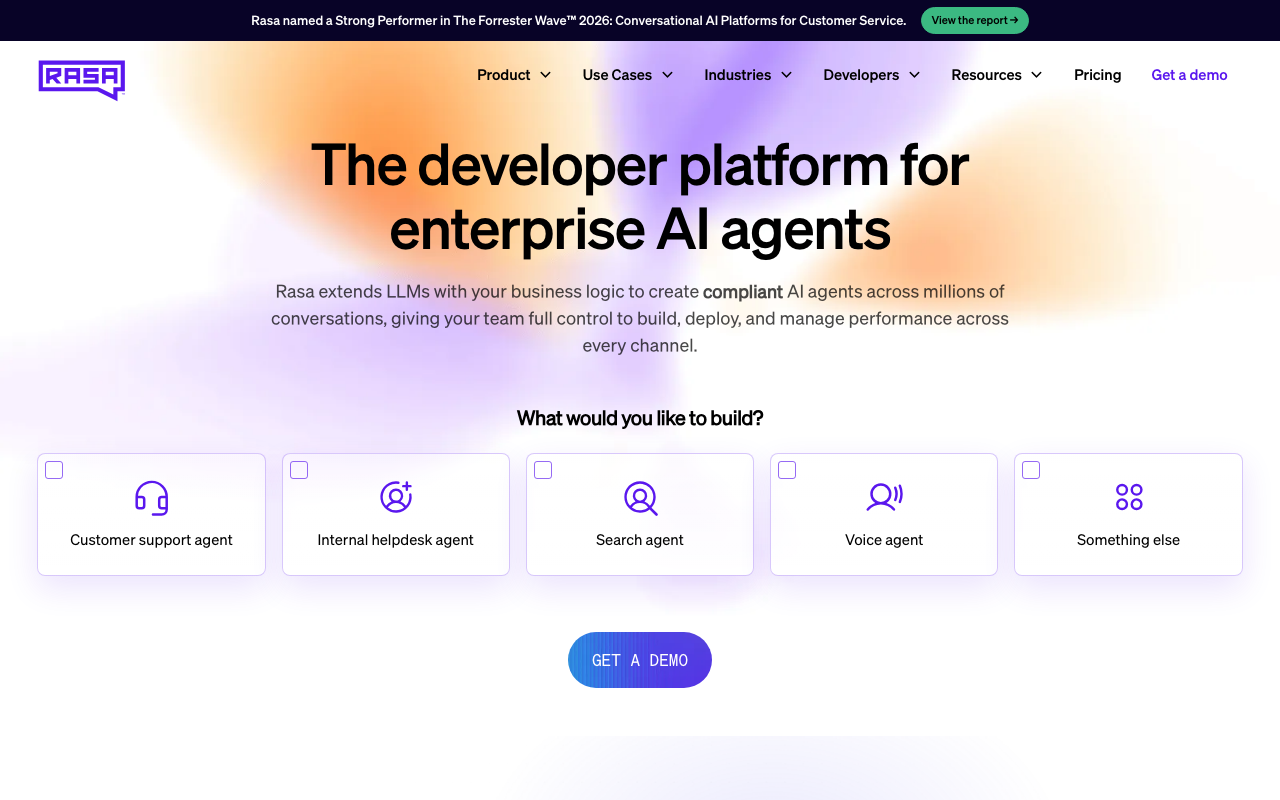
Rasa is an open-core enterprise AI agent platform focused on complex conversational workflows and multi-system orchestration. It sits closer to the infrastructure end of the market than to the managed-service end.
Screenshot of the Rasa website.
Rasa integrates with Salesforce Service Cloud, Zendesk, Twilio Voice, Twilio Media Streams, and AudioCodes VoiceAI, among 13 specific documented services. Average delivery for enterprise deployments runs around 14 weeks, right at the industry median. The open-core model gives technical teams real architectural control. You can self-host, modify the underlying framework, and own the deployment environment. That's a genuine advantage if you have a strong internal engineering team and care about avoiding SaaS vendor dependency.
The tradeoff is clear: Rasa requires technical investment. If your enterprise doesn't have engineers who want to operate and maintain the platform, the open-core flexibility becomes a maintenance burden rather than an advantage. Teams that want a fully managed, done-for-you deployment should look elsewhere. Rasa's strength is for enterprises that view the AI agent layer as core infrastructure they plan to build on long-term. Enterprise deployment architecture, including on-premises options and security configuration, is a core part of what the platform supports.
If your orchestration requirements are complex and your team has the engineering depth to match, Rasa is worth a serious evaluation.
4. Sierra — High-Touch Managed AI Agents for Customer Service
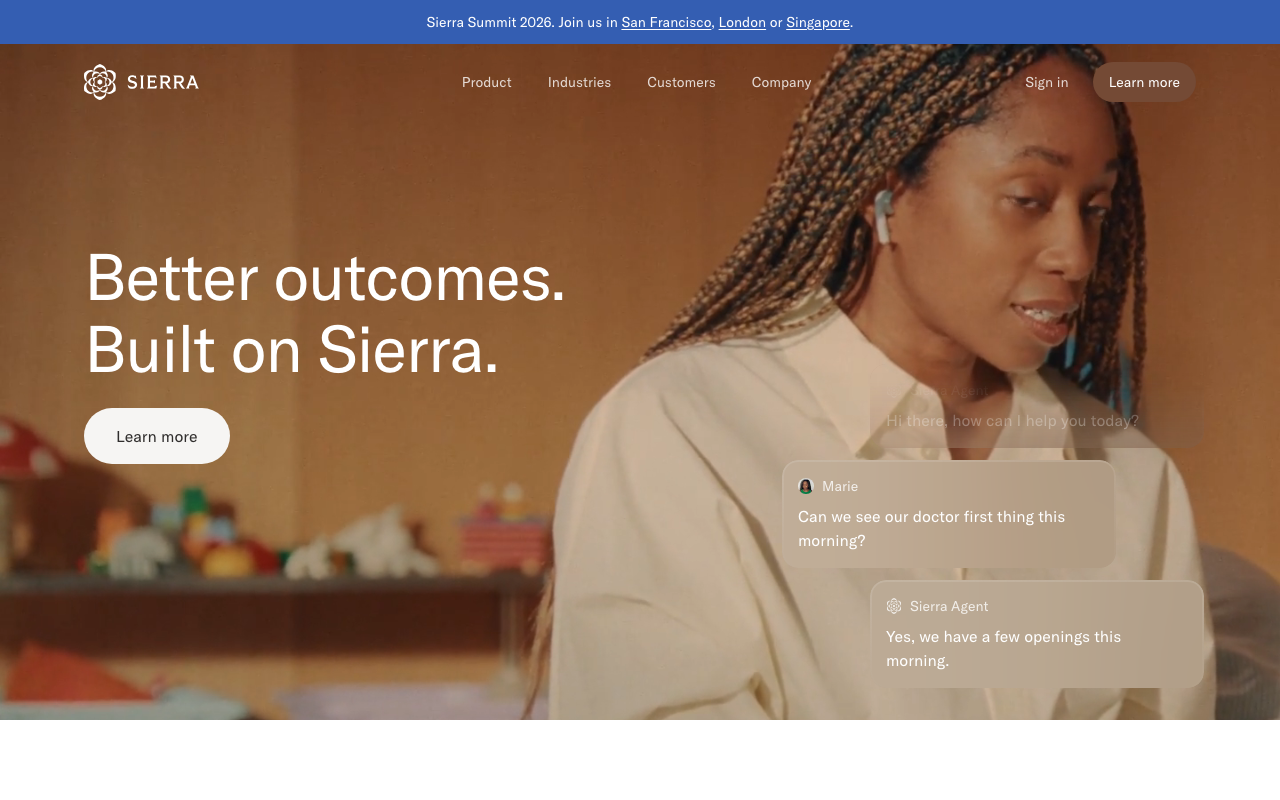
Sierra builds configurable AI agents specifically for enterprise customer service, delivered through a high-touch managed deployment model. It's designed for organizations that want outcome-focused AI without building the underlying infrastructure themselves.
Screenshot of the Sierra website.
Sierra's average delivery cycle is 22 weeks, the longest of any provider in this list. That's not a red flag on its own. High-touch managed deployments take longer because the implementation team is doing more of the configuration work, calibrating the agent to your specific policies, tone, and escalation logic. If your internal team has limited technical bandwidth, that tradeoff makes sense. You're paying for a more turnkey result.
The managed model also means ongoing support is typically bundled into the engagement. For enterprises that don't want to staff an internal AI operations function, that can justify the longer ramp. The risk is dependency: when the agent needs to evolve, you're reliant on Sierra's team to make changes rather than doing it in-house. Enterprises that want to build internal AI competency over time may find the managed model constraining at the two- or three-year mark. Evaluate whether the handoff model matches your long-term ownership goals before signing.
5. Salesforce Agentforce — AI Automation Layer Inside Service Cloud
Salesforce Agentforce is the AI agent layer built directly into Salesforce Service Cloud. It's the right option if your enterprise is already deeply invested in the Salesforce ecosystem and wants AI automation without adding a separate vendor relationship.
The integration story is the strongest argument for Agentforce. If your CRM, case management, and customer data already live in Salesforce, the path from AI agent to your data layer is short. There's no middleware to build and fewer authentication layers to manage. For enterprises running large service organizations on Service Cloud, that efficiency compounds quickly.
The constraint is equally obvious: Agentforce is purpose-built for the Salesforce stack. If your automation needs extend to systems outside that ecosystem, or if your long-term architecture involves consolidating away from Salesforce, the platform's native advantage disappears. It also puts you firmly in Salesforce's pricing and roadmap orbit. Agentforce makes sense as a first automation layer for Salesforce-heavy enterprises, but it's worth mapping your full system footprint before committing to it as your primary AI agent platform. For enterprises already evaluating enterprise AI automation services, Agentforce fits best when Salesforce is the system of record for your customer operations.
6. Glean — Knowledge-Grounded AI Agents Across Enterprise Tools
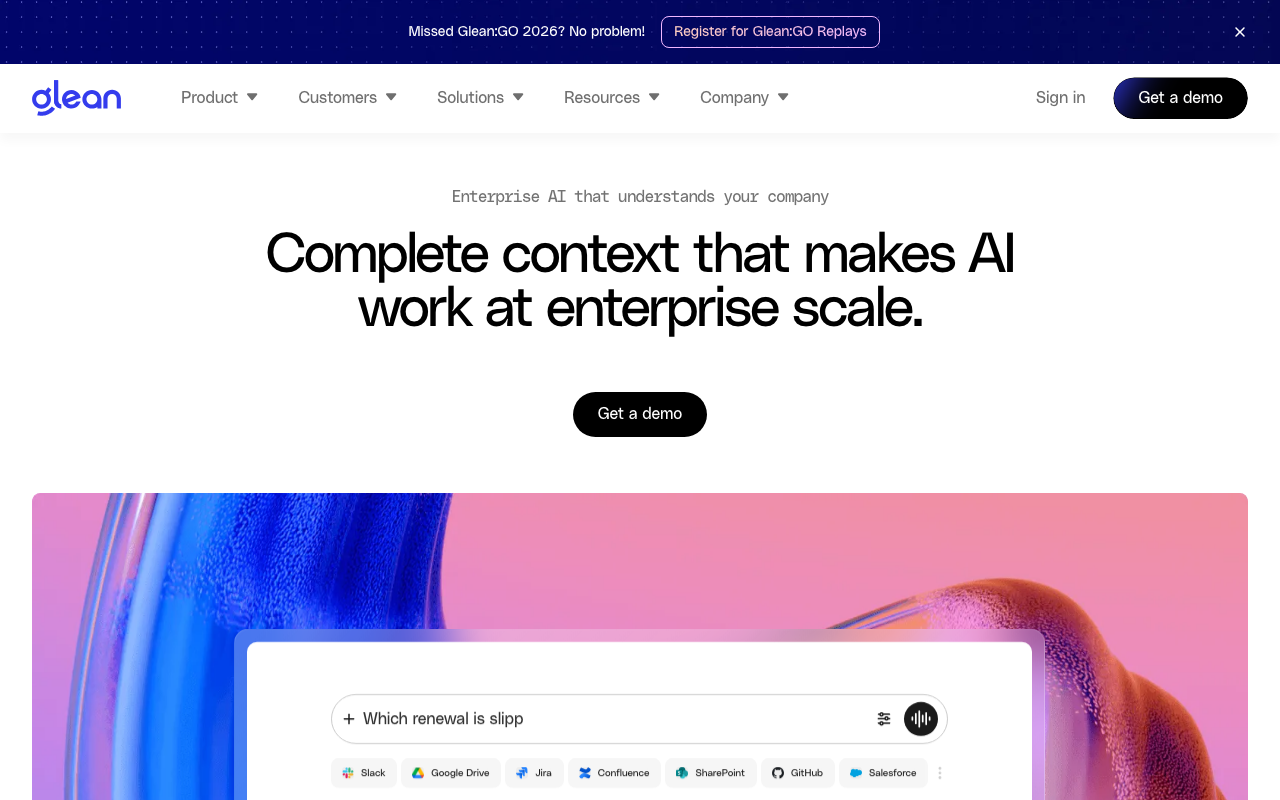
Glean is an enterprise AI platform that grounds its agents in your organization's own knowledge. It indexes across Microsoft 365, Slack, Salesforce, Google Workspace, Notion, and GitHub, then uses that corpus to answer questions and automate tasks in context.
Screenshot of the Glean website.
The value proposition is specific: instead of a generic AI assistant that reasons from public training data, Glean's agents reason over what your company actually knows. That distinction matters for knowledge work automation. A legal team asking about a contract clause, an ops manager pulling policy documentation, an engineer searching for past architecture decisions , all of these get answers grounded in real company data rather than plausible-sounding fabrications.
Glean supports both cloud and private deployment, which helps for enterprises with data residency requirements. The breadth of integrations is genuine. The caveat is that Glean's strength is knowledge retrieval and knowledge-grounded task automation. It's not a process orchestration platform. If your enterprise automation goal is workflow execution across backend systems, Glean is likely the wrong fit. Use it where knowledge access is the bottleneck, not process execution. For teams assessing whether their AI systems have the governance foundations to support a platform like this, the 2026 Agentic AI Readiness Gap report covers the governance and data readiness criteria in depth.
7. Microsoft Copilot Studio — Microsoft-Native AI Agents for M365 Shops
Microsoft Copilot Studio lets enterprise teams build custom AI agents within the Microsoft 365 ecosystem. It connects to Teams, Outlook, SharePoint, and Azure, and it's aimed at organizations that want AI automation without leaving the Microsoft environment.
The low-code interface makes it accessible to business teams that don't have dedicated AI engineering resources. For Microsoft-heavy enterprises, the security and compliance alignment with existing M365 policies is a real advantage. You're not introducing a new data boundary or a new authentication model. Your IT and compliance teams already understand the governance layer.
The honest limitation: the platform works best within Microsoft. Cross-platform automation or complex multi-system orchestration outside Azure is harder than the marketing materials suggest. Organizations with diverse tech stacks may find themselves building workarounds quickly. If your enterprise runs primarily on M365 and Azure and wants fast time to value on internal productivity automation, Copilot Studio is worth piloting. If your stack is mixed, evaluate whether the Microsoft boundary constrains the use cases that matter most.
8. Sana — Governed Workday-Native AI for HR and Ops Automation
Sana is a governed AI platform built around Workday, with integrations into ServiceNow, Slack, Microsoft Teams, and Jira. Its primary focus is HR and operations automation for enterprises that need strong governance controls alongside their AI deployments.
The governance-first design is the differentiator here. Sana builds audit trails and role-based access controls into the platform architecture rather than bolting them on after the fact. For enterprises in regulated industries or those subject to strict HR data handling requirements, that distinction is meaningful. An AI system that touches compensation data or performance records needs governance by design, not governance as documentation.
The Workday-native positioning means it's purpose-built for a specific enterprise stack. If Workday is your HCM system of record, Sana's integration depth is genuine. If you're not a Workday shop, the platform's core value narrows considerably. Enterprises evaluating Sana should map the specific HR and ops workflows they want to automate first, then confirm Sana's integration architecture covers the data sources those workflows depend on. Don't assume breadth beyond the documented stack.
9. Decagon — Fast Omnichannel Customer-Service AI with AOPs
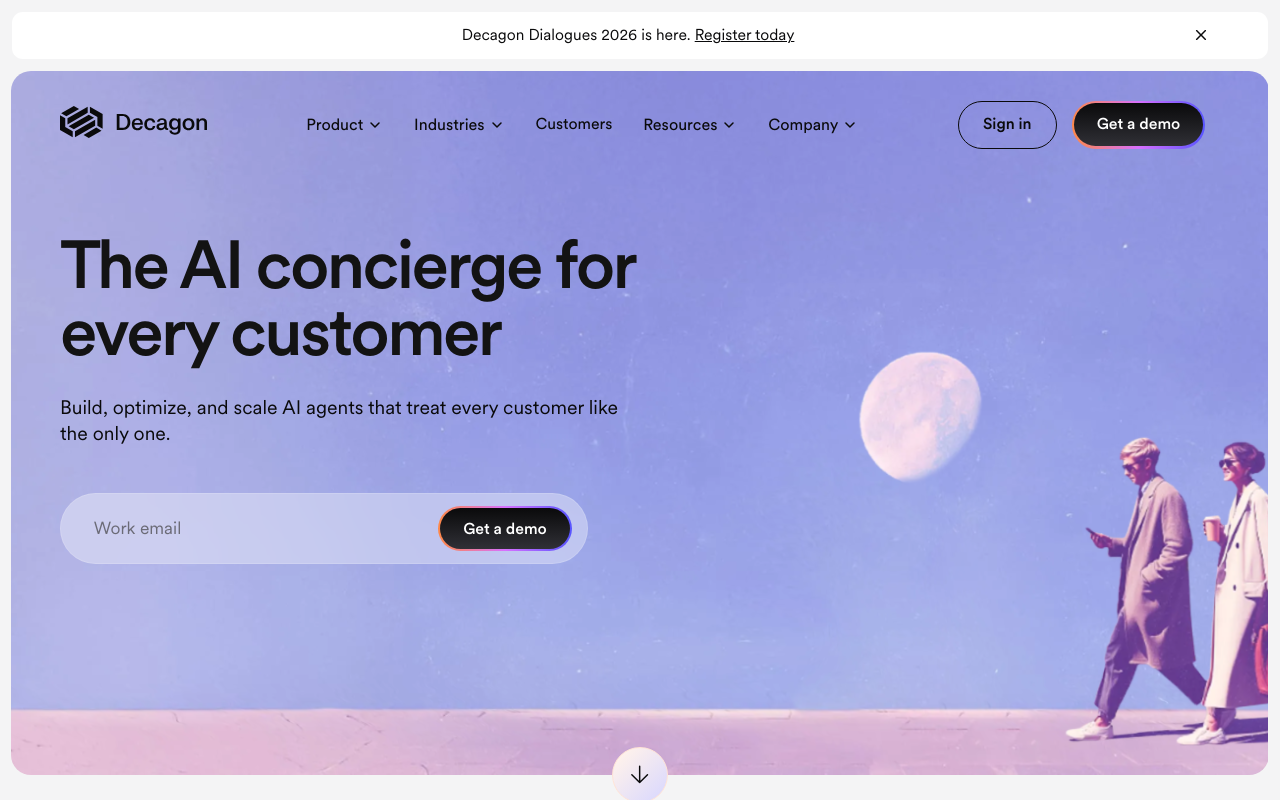
Decagon delivers omnichannel customer-service AI with a focus on Automated Operating Procedures (AOPs), a structured approach to encoding your support policies directly into agent behavior. The result is a system that handles common support scenarios consistently across channels without requiring constant human review.
Screenshot of the Decagon website.
The AOP model is worth understanding. Most conversational AI platforms require ongoing prompt tuning to keep agent behavior aligned with your policies. Decagon's AOP approach formalizes that alignment into reusable, auditable procedures. For enterprises with complex support logic or frequent policy changes, that structure reduces the maintenance burden of keeping agents current.
Decagon's omnichannel scope means it works across chat, email, and other support channels rather than being constrained to a single surface. The tradeoff is depth versus breadth. Decagon is optimized for customer service. It's not a general-purpose enterprise automation platform, and it won't serve use cases outside that lane well. If customer service automation is your primary goal and you want a system that can handle policy complexity without constant re-prompting, Decagon is worth a close look. If your automation roadmap extends into back-office operations or internal workflows, you'll need to pair it with something else.
Pro Tip
When evaluating any customer-service AI platform, ask the vendor to show you a real escalation path , not a demo scenario, but the specific logic that routes an edge case to a human. The quality of that handoff tells you more about production readiness than any accuracy benchmark.
10. Poetic — Done-for-You AI Automation for Enterprise Teams
Poetic takes a fully managed, done-for-you model to enterprise AI automation. The firm handles the build, the deployment, and the ongoing operation of AI workflows on behalf of its clients. It's aimed at enterprise teams that want AI in production but don't want to staff the internal function to get there.
The appeal is speed to value without internal capability investment. For enterprises where the C-suite wants automation outcomes but the engineering organization is stretched thin, a done-for-you model removes the primary bottleneck. You don't need to hire, you don't need to train, and you don't need to manage a complex implementation project internally.
The risk is the same one that applies to any fully managed model: ongoing dependency. When the automation needs to change, you're in the vendor's queue rather than making changes yourself. That's acceptable if your workflows are relatively stable. It becomes a constraint if your processes evolve frequently or if you have ambitions to build internal AI competency over time. Before engaging any done-for-you provider, confirm what the offboarding or knowledge-transfer process looks like. Enterprises that want to own their automation stack eventually should factor that into the contract structure from day one.
How to Evaluate Any AI Automation Agency: A Buyer's Checklist
When you're comparing AI automation agencies for enterprise use, the evaluation criteria that matter are rarely the ones agencies lead with. Here's what to actually examine before signing anything.
Delivery timeline and seniority. Ask for a concrete production timeline, not a range. Then ask who is actually doing the work. A firm that staffs senior engineers on your account ships faster and escalates fewer problems to you. Delivery cycles across the market range from 4 weeks to 49 weeks. That's not a range you should accept without a firm commitment. At Zylo Technologies, the six-week production cycle is documented, not estimated.
Ownership at engagement end. When the engagement ends, who owns the model, the training data, and the integration code? SaaS platforms retain usage rights. Custom builds should transfer full ownership to you. This question defines your long-term costs and your ability to modify the system without paying the vendor again. It's the single most underasked question in enterprise AI procurement.
Integration depth, not integration count. Approximately 49% of agencies in the market provide no integration capability data at all. The ones that do often list consumer SaaS apps rather than the ERP, data warehouse, and internal API connections that enterprise automation actually requires. Ask for an architecture diagram of how the proposed system connects to your specific stack.
ROI disclosure and measurement. Only 3% of agencies publicly disclose ROI figures. If a vendor can't give you a historical ROI range from past deployments, ask why. The answer reveals how seriously they measure outcomes. For context on why this measurement gap is so wide, the AI ROI measurement gap whitepaper documents how few enterprises and vendors can actually quantify returns.
Governance and compliance architecture. AI systems in regulated industries need audit trails, role-based access controls, and model drift monitoring built into the architecture. Ask whether governance is designed in from the start or patched in as documentation after delivery. The difference is significant when regulators or internal audit teams start asking questions.
Post-delivery support model. What happens when the model drifts, an API breaks, or your process changes? Ask whether support is retainer-based, incident-based, or not included at all. The answer shapes your total cost of ownership more than the initial build price. For a structured view of what to assess before your first vendor conversation, the AI development companies evaluation guide covers the key criteria with a usable scoring framework.
Side-by-Side Comparison: Top Enterprise AI Automation Agencies
Use this table as a starting filter, not a final decision. The criteria that matter most depend on your specific environment, but delivery speed, ownership model, and integration depth are the three most commonly underweighted in enterprise procurement.
One pattern worth flagging: a significant share of enterprise AI deployments use on-premises, hybrid, or high-touch managed models rather than pure cloud. That signals most enterprises still want environmental control, even if the vendor manages the application layer. Build that preference into your RFP process before vendors assume cloud-only.
| Agency / Platform | Primary Focus | Delivery Cycle | Ownership Model | Best For |
|---|---|---|---|---|
| Zylo Technologies | Custom AI agents, enterprise automation | ~6 weeks | Client owns model, data, and code | Enterprises needing durable owned systems with documented ROI |
| Cognigy | Conversational AI, contact center voice | ~13 weeks | Cloud or on-premises | High-volume voice and chat contact centers |
| Rasa | Open-core agent orchestration | ~14 weeks | Self-hosted or managed | Engineering-led teams wanting infrastructure control |
| Sierra | Managed customer service AI | ~22 weeks | Managed deployment | Teams without internal AI engineering capacity |
| Salesforce Agentforce | AI layer inside Service Cloud | — | SaaS (Salesforce-hosted) | Salesforce-native service organizations |
| Glean | Knowledge-grounded agents | — | Cloud or private deployment | Knowledge work, internal search, document-heavy operations |
| Microsoft Copilot Studio | M365-native agent builder | — | Microsoft cloud | Microsoft 365 and Azure-first enterprises |
| Sana | Governed Workday-native AI | — | Cloud | HR and ops automation in Workday environments |
| Decagon | Omnichannel customer-service AI | — | Managed | Support teams with complex policy logic across channels |
| Poetic | Done-for-you automation | — | Vendor-managed | Enterprises that want AI without internal build capacity |
FAQ
What should I look for when evaluating AI automation agencies for enterprises?+
Start with four questions: who owns the code and model when the engagement ends, what is the concrete production timeline, can the vendor show architecture diagrams for your specific stack, and do they have documented ROI from past deployments. Most agencies are vague on at least two of these. The ones that aren't are worth further evaluation. Governance controls and post-delivery support terms round out the essential criteria for regulated industries.
How long does a typical enterprise AI automation engagement take?+
Delivery timelines range from 4 weeks to 49 weeks across the market, with a median around 14 weeks. Managed deployments with high customization run longer. Agencies using senior-only delivery pods and disciplined scoping tend to hit the shorter end. Zylo Technologies operates on a documented six-week cycle, which is faster than most. Ask any vendor for a committed timeline rather than a range, and get it in writing before signing.
Should I build AI automation in-house or hire an agency?+
Build in-house if you have a strong AI engineering team and the process involves proprietary data that gives you a competitive edge. Hire an agency if you need speed, lack internal AI expertise, or want to compress the timeline to production. The build-versus-buy decision is really a question of data ownership and internal capacity. Many enterprises start with an agency to ship a first system, then hire to maintain and extend it.
What is a reasonable ROI to expect from enterprise AI automation?+
Most agencies don't publish ROI figures, which makes benchmarking difficult. Zylo Technologies reports a 3.4× median 12-month ROI across delivered roadmaps, which is the only publicly disclosed quantified multiple available in the current market. ROI varies significantly by use case, integration depth, and whether the automation targets high-volume processes with measurable costs. Set a baseline before deployment and track cycle time, error rate, and cost per transaction as your primary indicators.
What risks should enterprises watch for in AI automation deployments?+
The main risks are vendor lock-in, model drift, and governance gaps. Lock-in happens when the vendor retains ownership of the model or code. Drift happens when the AI system's outputs degrade over time without monitoring. Governance gaps appear when audit trails and access controls aren't built into the architecture from the start. Ask every vendor how they handle all three before committing. Retrofitting governance after deployment is significantly more expensive than building it in at the architecture stage.
How do pricing models work for enterprise AI automation agencies?+
Pricing typically follows one of three models: fixed project fees, time-and-material retainers, or productized monthly subscriptions. Fixed fees work well for well-scoped initial builds. Retainers suit ongoing development and support. Productized pricing is common for platform-based solutions like Salesforce Agentforce or Microsoft Copilot Studio. Ask every vendor for a total cost of ownership estimate that includes post-delivery support, not just the build cost. Hidden renewal economics are one of the most common surprises in enterprise AI contracts.
Conclusion
The right agency depends on what you need to own and how fast you need it in production. If you're evaluating providers right now and want a partner that publishes delivery timelines and ROI data rather than hiding both, start with the Zylo Technologies agency overview to see how the delivery model maps to your requirements. Most enterprises spend more time on vendor selection than they do defining what they need the system to own when the engagement ends. Get that question answered first.
Share this article
About the author

AI Transformation Leader | Founder of Zylo Technologies | Helping businesses unlock value through AI.
Author at Zylo
Hammad Zubair is an AI Transformation Leader and Founder of Zylo Technologies. He helps businesses discover practical AI opportunities that reduce costs, improve efficiency, and accelerate growth. Through AI readiness assessments and transformation strategies, he enables organizations to identify high-impact automation and AI implementation opportunities.