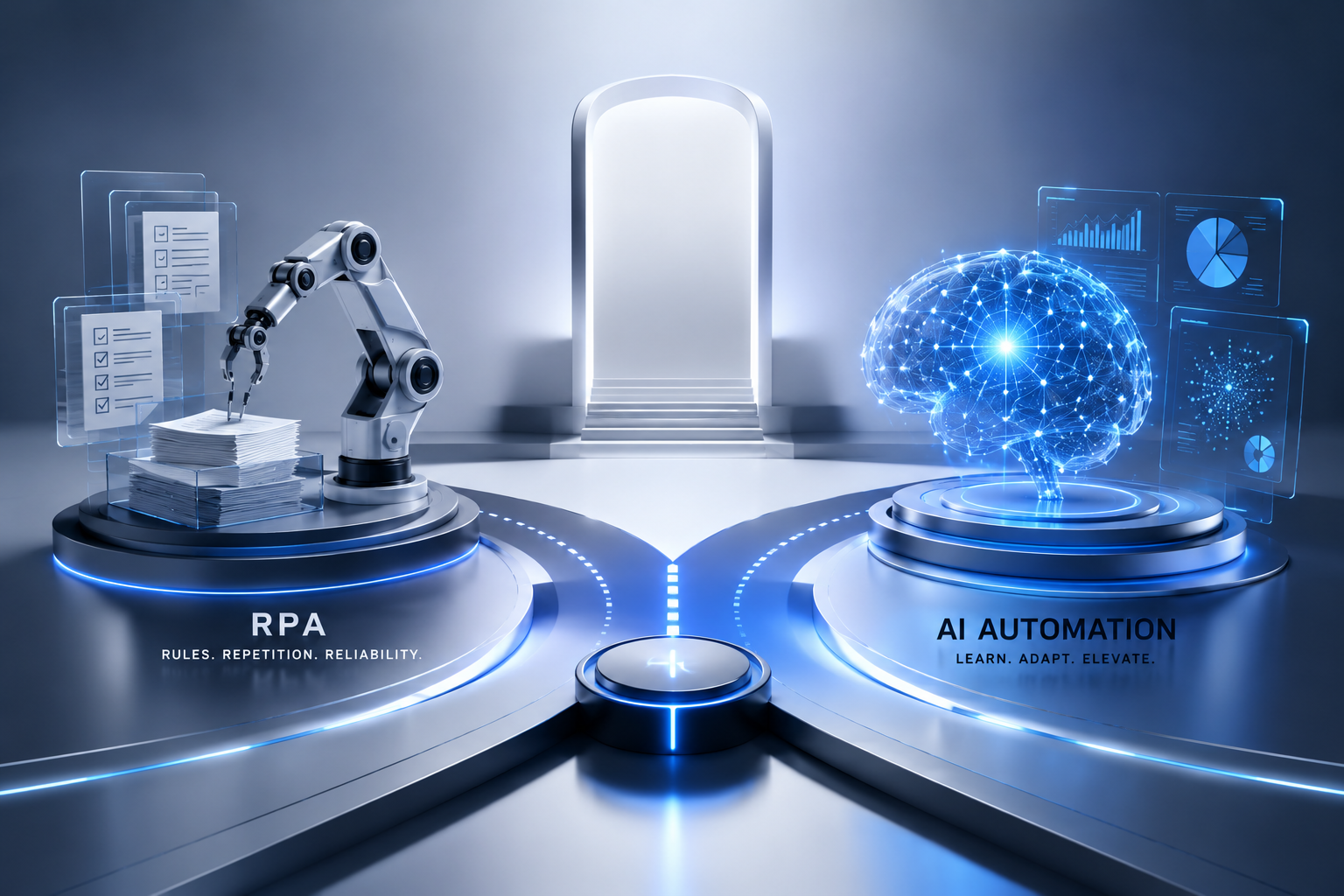
Most large firms don't have an automation problem. They have a _choice_ problem: pure RPA bots handle structured rules well, but they break the moment a process gets messy. AI automation handles judgment calls, but it needs the right architecture to stick. Here are the seven best platforms for enterprises weighing RPA vs AI automation right now, starting with the one we'd actually recommend.
1. Zylo Technologies (Our Top Pick) , Custom AI & Automation for Enterprises

Zylo Technologies is a custom AI automation and software engineering partner, founded in 2021 and headquartered in Denver, Colorado. It designs and ships AI agents, automation systems, and digital products for large enterprises and founder-led teams that need bespoke outcomes, not off-the-shelf bots.
What separates Zylo from every other option on this list is ownership. When the engagement ends, your team owns the model, the data, and the code. No vendor lock-in, no usage-rights limitation, no surprise repricing as you scale. That matters enormously for enterprises in regulated industries where audit trails and data residency aren't optional.
Zylo runs on a six-week production cycle, which means working software in your environment faster than most traditional RPA deployments. With 140+ systems integrated and a proven 12-month ROI across enterprise engagements, the model is built around measurable outcomes rather than feature counts. The firm has shipped 140+ systems across fintech, healthcare, mobility, and education.
The honest caveat: Zylo's custom approach costs more upfront than a SaaS subscription. If your team needs a pre-built bot running in 48 hours, a low-code platform is faster. But if the process involves proprietary data, complex decision logic, or a workflow that generic tools can't reach, this is the right call.
Ready to move from evaluation to production? See how Zylo's AI automation team works with enterprise clients and get a scoped engagement within 48 hours.
Key Takeaway
Zylo Technologies is the right first call for large enterprises that want AI automation they own outright, with a defined six-week path to production.
2. Automation Anywhere , Cloud‑Native AI‑Driven RPA Platform

Automation Anywhere is one of the most established names in enterprise automation. Its platform unites AI agents, traditional RPA bots, and human oversight in a single cloud-native architecture it calls Agentic Process Automation (APA). The goal is to automate up to 80% of end-to-end processes, including complex ones that older RPA tools couldn't touch.
The platform is genuinely cloud-native, not cloud-washed. That distinction matters: cloud-native architecture means the system scales elastically, updates automatically, and doesn't require IT teams to manage on-premise infrastructure. For enterprises with distributed operations, that's a real operational advantage.
Agentic AI is increasingly appearing across enterprise applications, and Automation Anywhere's platform is built to sit at that intersection — uniting AI agents, automation, and human oversight in a single cloud-native environment.
The limitation is deployment flexibility. Automation Anywhere is cloud-only by default. Enterprises in heavily regulated sectors, where data residency or on-premise requirements are non-negotiable, will need to evaluate whether their hybrid options fit compliance requirements before committing.
3. UiPath , Scalable AI‑Enhanced RPA for Global Teams

UiPath is the market's most recognized RPA platform. It now extends well beyond rule-based bots into full agentic automation, with AI layered across process mining, document understanding, and intelligent orchestration. For large enterprises that already have RPA investments, UiPath lets you add AI capabilities on top of existing infrastructure rather than rebuilding from scratch.
The usable results are documented across large-scale deployments. Enterprise teams have reported significant reductions in invoice processing time across high document volumes. One manufacturing company's HR team saved 85% of the time previously spent on manual sick leave submissions. These aren't edge cases; they reflect what happens when AI and RPA work together on high-volume, structured workflows.
UiPath's AI Center allows models to continuously learn from human-validated inputs, which means the system gets more accurate over time rather than staying static. Its Action Center handles exception management by routing edge cases to human reviewers, then feeding validated decisions back into the model. That loop is what makes it durable in production rather than just impressive in a demo.
One real caveat: UiPath's enterprise licensing costs are significant, and the platform's full capability requires meaningful internal expertise to govern at scale. Teams without a dedicated automation CoE (Center of Excellence) often underuse what they're paying for.
4. Microsoft Power Automate , Low‑Code Automation for Microsoft‑Centric Enterprises

Microsoft Power Automate is the natural first choice for enterprises already running on Microsoft 365, SharePoint, and Dynamics. If your workflows live inside the Microsoft ecosystem, Power Automate connects them with low-code tooling that a business analyst can use without deep technical support.
The platform's AI Builder adds machine learning capabilities for document processing and prediction tasks. Copilot integration, added more recently, lets users describe a workflow in plain language and get a draft automation back. For teams that need quick wins on standard back-office tasks, that's a genuinely fast path to value.
The trade-offs are real, though. Power Automate is cloud-only and optimized for Microsoft applications. It handles legacy systems, non-Microsoft environments, and complex orchestration less smoothly than full-scale RPA platforms like UiPath. Unattended automation at enterprise scale also requires more management overhead compared to platforms built specifically for large bot deployments. If your stack is heavily Microsoft, it earns its place. If it isn't, the friction adds up fast.
Pro Tip
Before committing to Power Automate for enterprise RPA, map every legacy system your target workflows touch. If more than 20% sit outside the Microsoft stack, evaluate a platform with broader UI automation coverage before signing.
5. SAP Build , SAP‑Focused RPA with AI Extensions

SAP Build is the automation layer for organizations where SAP is the system of record. It provides a low-code environment with prebuilt SAP workflows and templates, which means teams can automate common SAP processes without custom development for every bot.
The platform's biggest strength is stability during SAP upgrades. Traditional RPA bots that interact with SAP at the UI level break when the interface changes, which happens frequently during major system updates. SAP Build uses a clean-core approach, meaning bots stay stable even during significant SAP version changes. For large enterprises running SAP ERP or S/4HANA, that maintenance reduction is a genuine operational advantage.
Intelligent RPA now extends beyond structured workflows by combining AI to reason through unstructured data before triggering an automation. That means SAP Build can handle invoice processing in multiple formats, extract insights from documents, and respond to more variable inputs than classic rule-based bots.
The limitation is obvious: SAP Build is purpose-built for SAP environments. If your enterprise runs a mixed stack with significant non-SAP systems, you'll either need a second automation platform or a custom integration layer to cover the gaps. It's not a general-purpose automation solution.
6. Zapier , Easy‑Use AI Copilot for Rapid Workflow Automation

Zapier sits at the other end of the spectrum from custom AI agents. It's the fastest path to a working automation for teams that need to connect SaaS apps without writing code. Its AI copilot lets users describe a workflow and generates the automation logic automatically, drawing from 8,000+ built-in integrations.
That integration breadth is genuinely unmatched. No other platform in this list comes close to Zapier's connector catalog, which makes it useful for enterprises that need to stitch together a wide variety of cloud tools quickly. For AI-powered workflow automation across standard SaaS stacks, Zapier is often the fastest first step.
The ceiling is real, though. Zapier is built for straightforward workflows with common apps. It doesn't handle legacy systems, complex conditional logic, or the kind of deep enterprise integrations that large operations require. For teams evaluating Zapier as a primary automation platform for large-scale enterprise processes, the platform will work well for the easy 60% and struggle with the rest. Think of it as a fast lane for standard workflows, not a replacement for purpose-built enterprise automation.
Teams interested in how AI automation integration with Zapier transforms business workflows will find it most effective when scoped to well-defined, cloud-native processes rather than complex enterprise orchestration.
7. Workato , AI‑Powered Integration Platform for Complex Enterprise Processes

Workato positions itself as the enterprise automation platform that bridges the gap between RPA and workflow automation. Its AI copilot, called AIRO, and its Agent Library of prebuilt "Genies" let technical teams build end-to-end automations across 1,200+ apps without writing every integration from scratch.
What makes Workato different from simpler workflow tools is its ability to handle process orchestration, not just task-level automation. A workflow automation platform listens for business events and then carries out actions across applications, data, and people in sequence. That's meaningfully more powerful than a bot that copies data between two systems. Workato's architecture is designed to handle those multi-system, multi-step processes that RPA alone can't complete cleanly.
The platform covers a wide range of enterprise use cases, from employee onboarding across HRIS and ITSM tools to order management and customer support routing. For technical teams managing complex integration requirements, Workato's combination of AI-assisted workflow building and broad app coverage makes it a strong candidate. The trade-off: it requires technical ownership to govern at scale. It's not a self-service tool for non-technical business teams.
What to Look For When Choosing an Automation Platform
The RPA vs AI automation decision for large firms isn't really a binary choice. Most mature enterprise platforms now combine both: RPA handles the structured, fast, deterministic steps, and AI handles the reasoning and exception management in between. The question is which combination fits your actual workflows and infrastructure.
Start with process type. Rule-based, high-volume, structured workflows (invoice processing, data entry, HR onboarding) are natural fits for RPA. Processes that involve unstructured data, variable inputs, or judgment calls need AI automation layered on top. RPA thrives in systems with a clear step-by-step flow; AI augments the complex decision-making that RPA can't handle alone.
\p>Then check five things before you sign anything:
- Deployment model: Cloud-only, hybrid, or on-premise? Half the platforms in this list are cloud-only. Regulated industries often can't accept that.
- Integration depth: Does the platform connect to your actual systems, including legacy infrastructure, or just common SaaS apps?
- Ownership: Do you own the model and the code at the end of the engagement, or are you licensing usage rights?
- Implementation timeline: Most vendors don't publish this. Zylo's six-week production cycle is one of the few explicit commitments in the market.
- Governance controls: Audit trails, role-based access, and model monitoring are non-negotiable for enterprise compliance.
For enterprises building a longer-term automation strategy, scoring and prioritizing processes before committing to a platform is a useful discipline — it forces clarity on process type, data structure, and integration requirements before any vendor conversation begins.
Feature‑by‑Feature Comparison Table
| Platform | Automation Type | Deployment | Integration Breadth | Best For | Ownership of Output |
|---|---|---|---|---|---|
| **Zylo Technologies** | Custom AI Agents + RPA | On-premise or cloud (custom) | 140+ systems | Enterprises needing bespoke, outcome-owned AI automation | Full — model, data, code |
| Automation Anywhere | AI + RPA (APA) | Cloud-only | Broad (native connectors) | Cloud-first enterprises automating end-to-end processes | Vendor-hosted |
| UiPath | AI + RPA | Hybrid | Broad (SAP, Salesforce, Oracle) | Enterprises with existing RPA investments adding AI | Vendor-licensed |
| Microsoft Power Automate | RPA + low-code AI | Cloud-only | Microsoft ecosystem + connectors | Microsoft 365 / Dynamics users | Vendor-licensed |
| SAP Build | RPA + AI extensions | Cloud-only | SAP-native + limited external | SAP-centric organizations | Vendor-licensed |
| Zapier | AI workflow automation | Cloud-only | 8,000+ integrations | Teams automating standard SaaS workflows fast | Vendor-hosted |
| Workato | AI + workflow automation | Cloud | 1,200+ apps | Technical teams managing complex multi-system processes | Vendor-licensed |
FAQ
What is the difference between RPA and AI automation for large firms?+
RPA follows fixed, pre-programmed rules to automate repetitive tasks like data entry or form filling. It breaks when inputs change. AI automation uses machine learning and reasoning to handle variable inputs, unstructured data, and judgment-based decisions. Most large enterprises use both together: RPA handles the structured steps, AI handles the reasoning in between. The Zylo intelligent data solutions page explains this split clearly.
Which is better for a large enterprise: RPA or AI automation?+
Neither alone is the right answer. RPA is faster and cheaper for high-volume, structured, rule-based workflows. AI automation is necessary when processes involve unstructured data, exceptions, or decisions that can't be scripted. Large enterprises typically need a hybrid approach: RPA as the execution layer and AI as the reasoning layer. The right balance depends on your specific process mix and data infrastructure.
How long does enterprise AI automation typically take to implement?+
Most vendors don't publish implementation timelines, which is a transparency gap worth noting. Zylo Technologies runs a six-week production cycle for custom AI systems. Off-the-shelf RPA platforms like UiPath can deploy initial bots faster, but enterprise-grade rollouts with governance, integration, and testing typically take four to twelve weeks before a bot touches production at scale.
What should large firms look for in an automation platform?+
Five things matter most: deployment model (cloud-only vs. hybrid vs. on-premise), integration depth with your actual stack including legacy systems, data and model ownership after the engagement, an explicit implementation timeline, and governance controls like audit trails and role-based access. Most vendors are strong on features and weak on transparency about the last two.
Is Zapier suitable for large enterprise automation?+
Zapier works well for connecting standard SaaS applications quickly, and its 8,000+ integrations make it genuinely useful for straightforward workflows. But it's not designed for complex enterprise orchestration, legacy system integration, or processes that require deep conditional logic. Large firms often use Zapier for the easy, cloud-native workflows while relying on a more capable platform for the rest.
Conclusion
For large firms weighing RPA vs AI automation, the platforms above cover the full range from fast low-code tools to fully custom AI agents. If your organization needs a system you actually own, with a defined production timeline and measurable ROI, Zylo Technologies is the right starting point. See how Zylo's custom AI automation approach compares to off-the-shelf platforms and reach out for a scoped engagement , the team responds within 48 hours.
Share this article
About the author

Chief AI Officer and former NVIDIA AI Consultant specializing in enterprise AI strategy and digital transformation.
Author at Zylo
Dr. Aliya Nur Balisani is an AI leader focused on helping organizations adopt artificial intelligence in practical and profitable ways. With experience in enterprise AI strategy, automation, and emerging technologies, she provides insights on generative AI, autonomous systems, business transformation, and the future of intelligent enterprises.