
AI agent platforms promise to turn plain language into useful work, but the hard part starts after the demo. Deployment, data access, permissions, and workflow fit decide if an agent helps or creates more work. Here are the strongest AI agent platform alternatives, with a clear use case and trade-off for each.
1. Zylo Technologies, Custom AI agent systems built around your operations
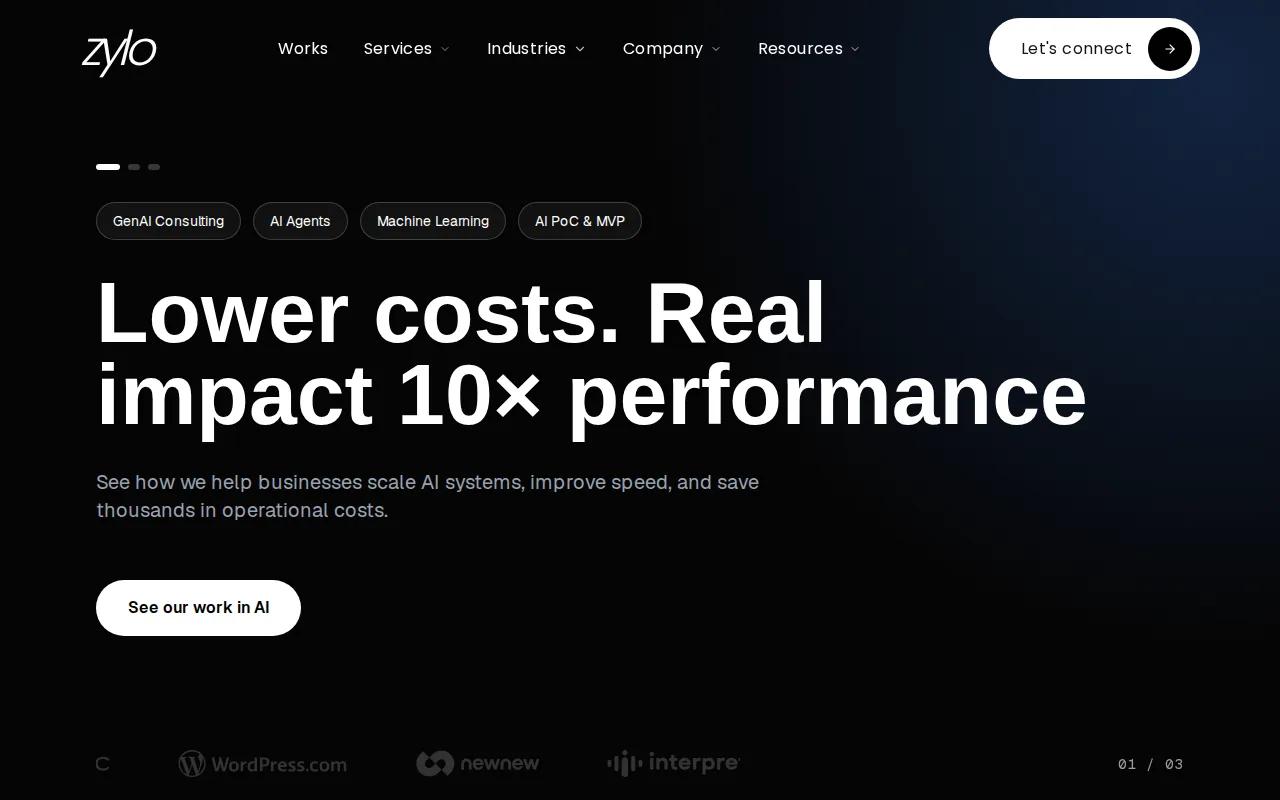
Zylo Technologies is a custom AI automation and software engineering partner for teams that need agents built around their own systems. It's best for founders, operators, and technical leaders whose workflows don't fit a fixed SaaS template.
We start with the operational result, then design the agent, tools, data layer, and controls around it. That may mean a support agent that checks account records before replying, an internal agent that moves data between systems, or a multi-agent workflow with clear approval points.
Zylo Technologies has shipped more than 140 systems and uses senior-only delivery pods. The business context also points to six-week production cycles and work across fintech, mobility, education, healthcare, and enterprise teams. Those details matter because a custom agent is software, not a clever prompt. Teams evaluating this route should also understand the practical requirements for AI agent development, including architecture, testing, and deployment.
The trade-off is clear. Custom work needs discovery, access to systems, and decisions from your team. It isn't the fastest choice for a small, well-defined FAQ bot. But if you need ownership of the model choices, data, and outcome, this is the strongest fit in the shortlist.
2. ASAPP, High-volume enterprise customer service automation
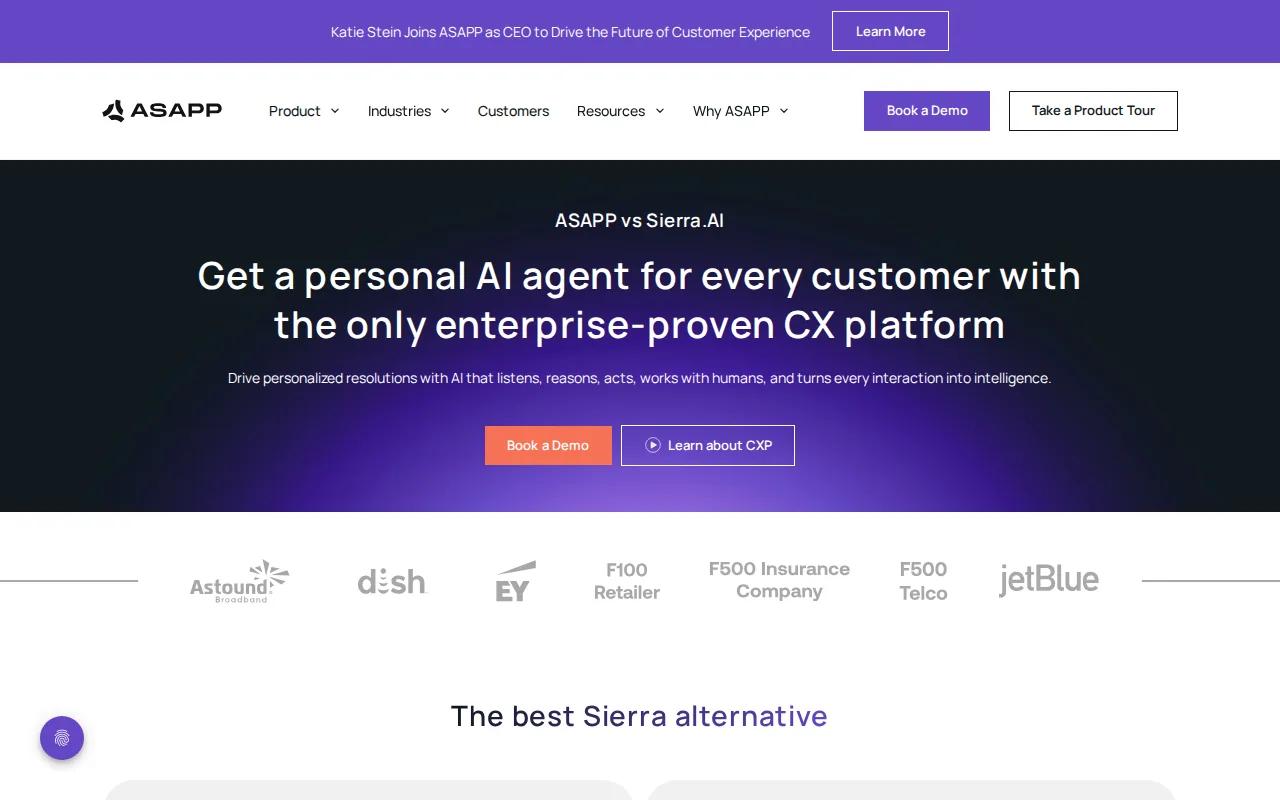
ASAPP is best for high-volume enterprise service environments that need an AI-native customer experience layer. Its model places an agent at the front of service, where it can understand intent and coordinate enterprise systems.
The platform is positioned around coordination between AI agents, human expertise, and existing contact center systems. Its AI-native customer experience platform is designed to coordinate automated service with human expertise and existing contact center systems.
That architecture suits a service team that handles a large mix of routine and complex requests. A customer might start with a natural request rather than a long IVR menu. The system can then use contact center platforms, enterprise systems, and knowledge bases to find a path to resolution.
The caveat is integration work. ASAPP won't remove the need to map systems, clean knowledge, define escalation rules, and monitor outcomes. Buyers should ask how interaction data is stored, how permissions work, and which deployment models are available before signing.
For customer service leaders, ASAPP belongs on the shortlist when resolution at scale matters more than a lightweight chatbot.
3. Sierra, AI-first agents for complex contact centers

Sierra is aimed at enterprises with complex contact center environments. Its AI-first architecture focuses on conversational agents that handle customer interactions across digital channels.
This makes Sierra a candidate for teams that want to move beyond scripted bots. The agent can sit within a broader service stack that includes routing, enterprise systems, and existing contact center infrastructure.
The main question is operational change. A workflow may work well when its rules are clear, yet need more care when policies change often. Support leaders should test how quickly the team can update an agent after a product change, pricing change, or new compliance rule.
Sierra is worth considering when your service operation has complex flows and wants an AI-first experience. It is a weaker fit if your team expects a simple no-code setup with little ongoing ownership.
4. Decagon, Digital support agents for large service environments
Decagon is best for large service teams that need high-volume digital support. Its differentiator is generative AI for workflow automation, with a focus on handling common customer requests at scale.
The useful test is the handoff. Ask whether the agent can understand a request, retrieve the right knowledge, take the approved action, and pass a clean record to a human when it cannot finish.
Decagon's positioning fits digital self-service better than a broad internal automation program. A support leader may use it for repeat questions and workflow steps, while the service team keeps ownership of edge cases.
The limitation is the gap between stated self-service and the work needed for advanced flows. API connections and complex automation logic may need technical skill or engineering help. Plan for that work before estimating time to value.
5. PolyAI, Natural voice agents for inbound interactions

PolyAI is best for companies that want natural voice agents for inbound calls, especially when the goal is to replace rigid IVR menus. Its focus is conversational interaction for callers within existing enterprise systems.
Voice automation has a different failure mode than chat. A caller may interrupt, use vague language, change direction, or give incomplete details. The agent must handle that turn-by-turn while still reaching a safe outcome.
PolyAI fits service teams that want the first interaction to feel more like a conversation than a menu. The right pilot should use a narrow call type, such as status checks or appointment changes, with clear transfer rules for sensitive cases.
Don't judge it only by how natural the voice sounds. Test recognition, escalation, system access, call records, and behavior when the caller gives conflicting information. A polished voice cannot repair weak back-end rules.
6. Parloa, Conversational automation across voice and digital channels
Parloa is aimed at companies adopting conversational automation across voice and digital channels. Its core position is AI-driven self-service for customer interactions.
This cross-channel angle helps when a customer starts in one place and continues in another. The buyer should confirm what context carries across channels and which systems remain the source of truth.
Parloa makes sense for a contact center that wants one conversational approach across voice and digital work. It is less compelling when the problem is a single internal workflow that needs custom tools and deep business logic.
Deployment details deserve close review. Cloud-only delivery should never be assumed, especially for regulated teams with strict data boundaries.
7. Cresta, Real-time assistance for human contact center agents

Cresta is best for contact centers that want to improve human agent performance. Its main differentiator is real-time AI assistance, rather than replacing every customer interaction with an autonomous agent.
An agent-assist system can surface knowledge during a live conversation, guide the next action, or help a manager review service quality. That approach fits teams where people still handle sensitive cases or where full automation would add risk.
Buyers should treat vendor case-study figures as directional until they test the same workflow with their own data.
The trade-off is that human performance remains part of the system. Training, process design, and manager review still matter. Cresta is a strong choice when automation should redirect human attention rather than erase it.
8. Salesforce, CRM-native AI agents for customer service teams

Salesforce is best for organizations already using its CRM and wanting AI agents grounded in customer records. Salesforce extends its CRM into customer service, with Einstein AI technologies embedded in the CRM.
The advantage is context. A service agent can work from CRM data instead of asking a customer to repeat the full history. Salesforce also describes low-code agent building, multi-agent task routing, and delivery across surfaces such as Slack, web, and mobile.
Salesforce is a CRM-native option for organizations extending Salesforce CRM into customer service.
The limitation is stack dependence. Salesforce is a natural fit when the CRM is already central. It may be too heavy if your main need is a small custom agent outside the CRM.
Teams comparing CRM-native options should separate license cost from the work needed to clean records, define permissions, and maintain agent instructions.
9. Amazon Connect, Flexible agent infrastructure for AWS teams

Amazon Connect is best for organizations with strong engineering resources and an AWS-centered technology stack. It is a cloud-based SaaS contact center service with room for custom integration.
The flexibility is the draw. Engineering teams can connect AWS services and build the surrounding logic they need instead of accepting a fixed service workflow.
That control comes with ownership. Your team must decide how agents access tools, where state lives, how failures are logged, and when a person must approve an action. For any AWS design, define how the application reasons with tools and takes actions.
Amazon Connect fits builders. It is a poor match for a buyer who wants a finished agent experience with minimal engineering effort. Budget for architecture, testing, monitoring, and support.
10. Microsoft Dynamics 365 Contact Center, A Microsoft-native enterprise option

Microsoft Dynamics 365 Contact Center is best for organizations already operating inside the Microsoft enterprise ecosystem. Its value comes from close alignment with Microsoft systems rather than from a neutral, standalone position.
That range can help a team start with a narrow internal agent and move toward custom orchestration later. It also means the buying process needs technical clarity. Ask which identity system, model, data source, and runtime will handle each part of the workflow.
The caveat is licensing and architecture complexity across Microsoft products. This option is strongest when your existing governance, identity, and data practices already sit in that ecosystem.
11. Google Cloud Contact Center AI, Custom agents on Google Cloud

Google Cloud Contact Center AI is best for organizations using Google Cloud to build custom AI agents. It suits technical teams that want cloud infrastructure, agent development tools, and room to choose models and frameworks.
It provides cloud-based infrastructure for building custom agents, with integration points for contact center systems and enterprise workflows.
This is a good fit for teams building a wider agent program rather than one isolated bot. A technical group can pair an agent with enterprise data, tool calls, evaluation, and model operations.
The trade-off is assembly. Cloud components give you choice, but your team still has to build the operating layer around them. If your company lacks that engineering capacity, a custom partner such as Zylo Technologies may be a better route to production.
How do these AI agent platform alternatives compare?
The best choice depends on where you want the system to live and who will own it after launch. AI agent platform alternatives fall into three useful groups: custom partners, customer service products, and cloud or CRM infrastructure. For a broader market view, this AI agent platform comparison helps separate platforms that support real operating workflows from products that mainly perform well in demos.
Pricing usually follows the same split. Customer service products tend to use enterprise quotes. Cloud systems often combine platform usage with engineering cost. Custom builds have a project cost plus ongoing support. Free tiers may help with a proof of concept, but they don't show the full cost of permissions, monitoring, evaluation, data cleanup, or human review.
Before you compare quotes, define the unit of value. Is it a resolved case, a completed workflow, a qualified lead, a booked appointment, or hours returned to a team? This is more useful than comparing model tokens alone.
For teams assessing build quality, our AI agent architecture patterns resource explains how single-agent and multi-agent designs change the system's control points. And if your workflow is closer to classic SaaS automation, a Zapier versus Make comparison can help separate simple task automation from agentic work.
| Best fit | Strongest options | Main strength | Main risk to test |
|---|---|---|---|
| Custom business workflows | Zylo Technologies | Architecture built around your operations | Needs discovery and system access |
| High-volume digital service | ASAPP, Decagon, Sierra | Customer resolution and workflow automation | Knowledge quality and integration effort |
| Inbound voice | PolyAI, Parloa | Conversational call handling | Escalation and back-end action safety |
| Human agent support | Cresta | Real-time guidance and quality work | Adoption by frontline teams |
| CRM-led service | Salesforce | Customer context inside the CRM | Stack dependence and data quality |
| Cloud engineering | Amazon Connect, Microsoft Dynamics 365 Contact Center, Google Cloud Contact Center AI | Control over infrastructure and integrations | Assembly, governance, and maintenance |
FAQ
What are the best AI agent platform alternatives?+
The best AI agent platform alternatives depend on the job. Zylo Technologies fits custom business systems, ASAPP and Decagon fit digital service, PolyAI fits inbound voice, and Salesforce fits CRM-led work. Cloud options suit engineering teams that want more control. Start with the workflow and ownership model, not the demo.
How much do AI agent platforms cost?+
AI agent platforms usually combine subscription, usage, implementation, and support costs. Enterprise customer service platforms often use quote-based pricing. Cloud platforms add infrastructure and engineering spend. Custom systems add design and build work. Ask vendors to price the full workflow, including data access, monitoring, evaluation, and ongoing changes.
What should I check before buying an AI agent platform?+
Check deployment, integrations, memory, retrieval, tool permissions, audit logs, evaluation, and human escalation. Ask where data is processed and how the agent behaves when a tool fails.
Are AI agents the same as generative AI?+
No. Generative AI produces content after a prompt, while an agent uses a model to pursue a goal through multiple actions. An agent may retrieve data, call a tool, update a system, and ask for approval. Many useful products combine both approaches, with generation handling reasoning and agents handling execution.
Should I build or buy an AI agent platform?+
Build when your workflow, data, or controls are unique. Buy when a proven product already matches your service channel and operating model. A custom partner can sit between those choices. Zylo Technologies is a fit when you need a durable system that your team can own instead of a short-lived prompt layer.
Conclusion
Choose the platform that matches your operating model, not the one with the most impressive demo. For custom workflows and long-term ownership, start with Zylo Technologies. For a faster evaluation, pick one measurable workflow, map its data and approvals, then run a limited production pilot before expanding.
Share this article
About the author

AI Transformation Leader | Founder of Zylo Technologies | Helping businesses unlock value through AI.
Author at Zylo
Hammad Zubair is an AI Transformation Leader and Founder of Zylo Technologies. He helps businesses discover practical AI opportunities that reduce costs, improve efficiency, and accelerate growth. Through AI readiness assessments and transformation strategies, he enables organizations to identify high-impact automation and AI implementation opportunities.