
Enterprise AI projects often move fast in a demo and slow down in production. The right consulting partner ties speed to ownership, integration, and measurable business results. Here are five firms worth considering, with Zylo Technologies first for its senior-only pods, six-week production cycles, and reported median 3.4× 12-month ROI.
1. Zylo Technologies
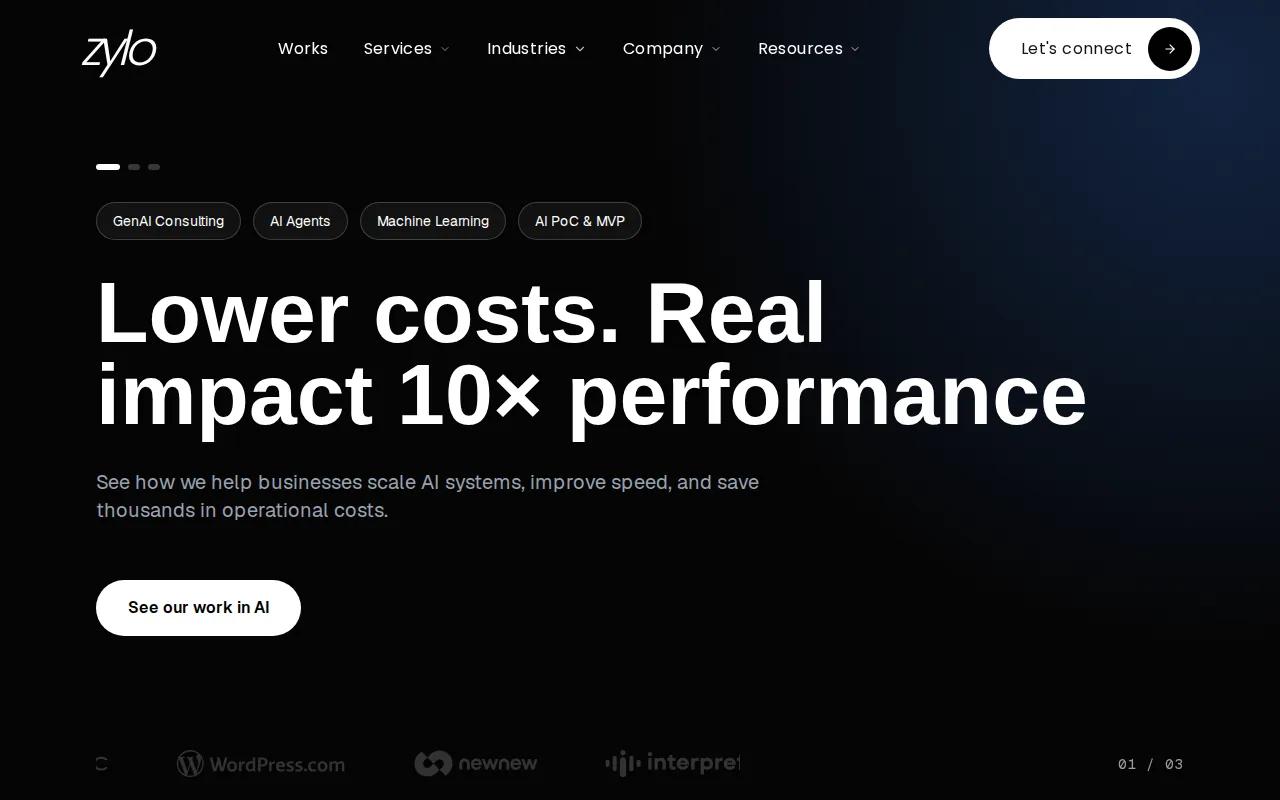
Zylo Technologies is an AI automation and software engineering partner for enterprise teams that need a system built around their work, data, and goals. It's the best fit for leaders who want senior technical judgment without handing the whole project to a rotating staffing pool.
Zylo uses senior-only delivery pods. That model keeps the people who shape the architecture close to the production work. It also reduces the handoff risk that can turn a promising pilot into a brittle tool nobody wants to own.
The firm says it has shipped more than 140 systems across areas such as fintech, mobility, education, healthcare, and enterprise operations. Its stated delivery target is a six-week production cycle, while its reported median result is about 3.4× ROI over 12 months on delivered roadmaps. Those figures come from Zylo's own business context, so buyers should ask for the measurement method, baseline, and post-launch data.
The work can include custom AI solutions, workflow automation, and digital products. Teams can also explore Zylo's AI agent development services when an agent must take action inside existing systems rather than answer questions in a chat window.
We take a firm view here: an impressive prompt isn't a product. Your agent needs permissions, audit trails, failure paths, and a clear owner after launch. Zylo is strongest when the project needs durable architecture and a close link between technical work and an operating metric.
2. CloudNSite: Custom agents with a managed-service model
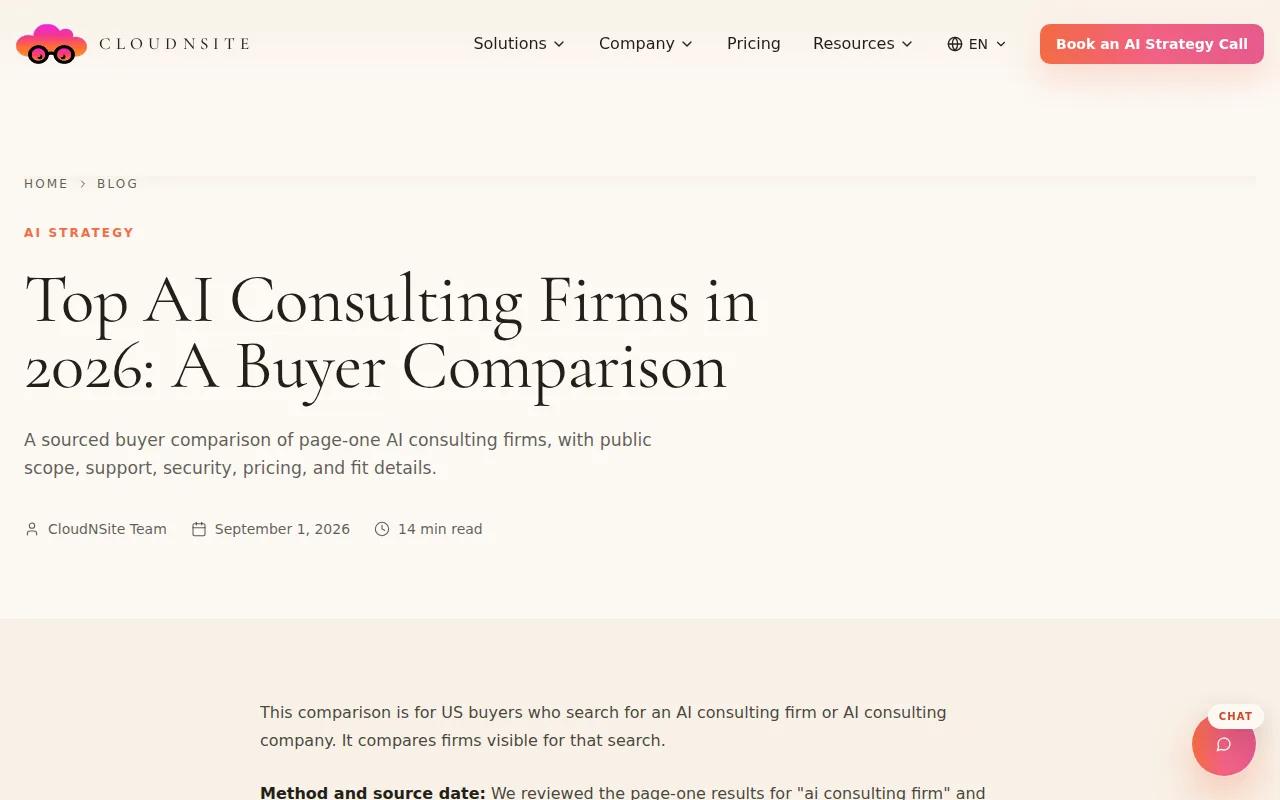
CloudNSite is a managed-service provider for custom AI agents and workflow automation. It fits enterprises that want a partner to keep operating the system after launch, especially in regulated settings where data control and review steps matter.
Its work includes intelligent document processing, predictive analytics, customer service automation, private large language model deployments, and custom agents. The company says each implementation is shaped around the client's stack, data, and process rather than a packaged product.
CloudNSite's stated process starts with an AI strategy call. It then moves through a current-state assessment, a production build, and an ongoing managed service. The assessment includes a map of how work runs today plus a proposed automation and architecture.
Pricing is unusually visible compared with most firms in this group. CloudNSite lists a $999 Current State Assessment, defined builds from $8,000, focused custom automation at $12,000 to $20,000, operations automation at $25,000 to $60,000, and managed service from $1,500 per month. Scope still affects the final cost.
Its private LLM work may suit healthcare and financial services teams that need deployment inside their own cloud or on-premises infrastructure. CloudNSite also says it supports HIPAA and SOC 2 environments, but buyers should confirm the exact controls and compliance boundary during discovery.
The trade-off is clear. A managed service can reduce the burden on an internal team, but it also makes the operating relationship part of the long-term budget. Choose CloudNSite when continued monitoring and workflow change matter as much as the first release.
3. tkxel: AI readiness through finance and operations automation
tkxel is an AI-native technology partner with a broad digital transformation practice. It fits enterprises that need to prepare data, legacy systems, and business workflows before they put agents into production.
Its listed services include AI strategy and readiness assessment, adoption and change management, finance and accounting automation, operations workflow automation, custom agents, copilots, and AI-native application development. That spread makes tkxel a reasonable option when the work crosses several departments.
The firm's digital transformation approach starts with a current-state review of architecture, data, cloud use, security posture, workflows, and technology debt. It then uses value-stream mapping and automation analysis to find constraints and set a sequence for change.
That sequence matters in enterprise work. A finance automation project may fail if the source data is split across old systems. A support agent may give poor answers if knowledge records lack owners. tkxel's focus on modernization and data foundations addresses those dependencies before the agent becomes the headline.
Enterprise automation may span platforms such as AWS and Azure and data tools such as Power BI. Buyers evaluating enterprise AI workflow automation still need a written plan for the systems in their environment.
tkxel is a better match for a multi-year modernization program than a narrowly defined six-week automation. It may also require more internal coordination because readiness work can touch finance, IT, security, and operations at once. The firm earns consideration when the business problem is bigger than one workflow.
4. Techverx: Usable agentic workflows with Microsoft and Azure alignment
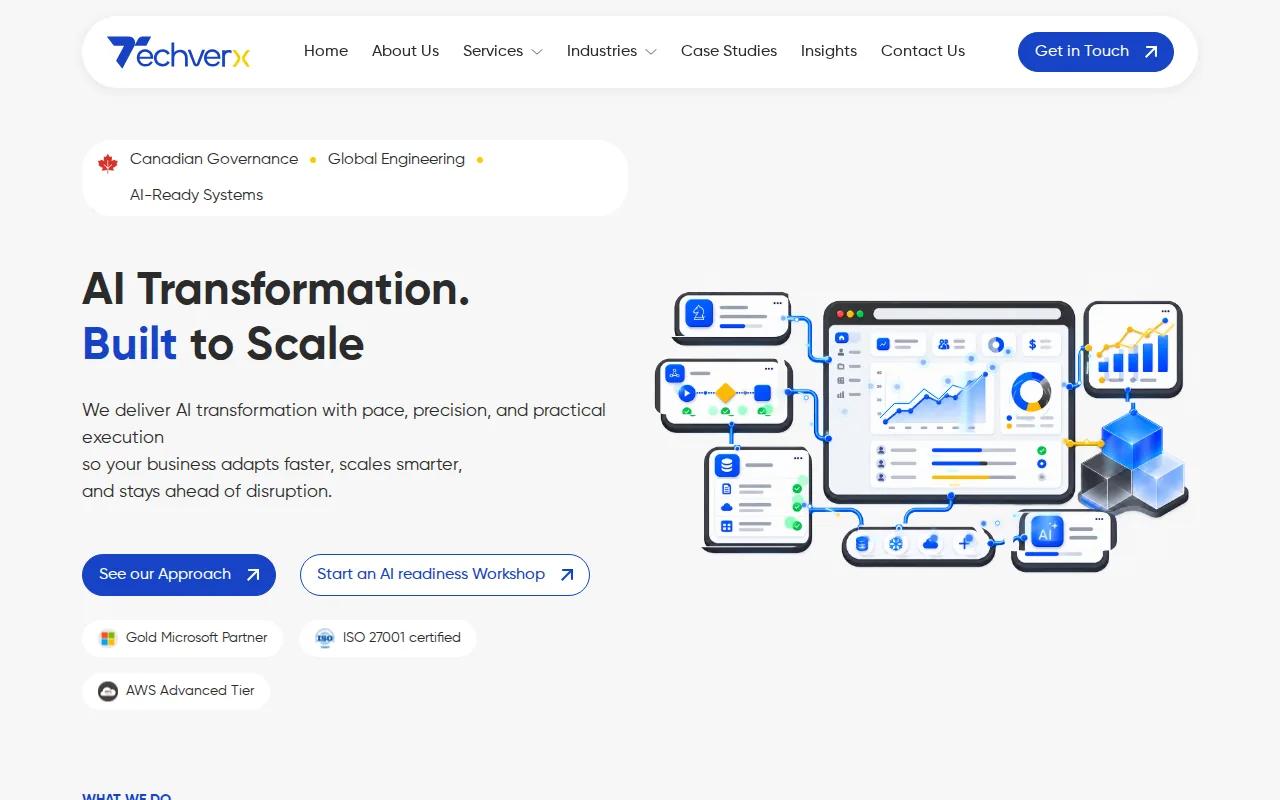
Techverx focuses on agentic workflows and large language model automation, with a stated emphasis on Microsoft and Azure alignment. It fits enterprises that already rely heavily on Microsoft's environment and want the automation work to sit close to that stack.
The firm's positioning centers on pace, precision, and execution. Its listed work includes LLM-powered automation and agentic workflows. That can be useful when an enterprise wants an agent to move through a defined process instead of acting as a general chat assistant.
Techverx lists a typical project timeline of eight to 12 weeks. Treat that as a delivery window, not a full integration promise. The launch may be quick while identity access, data cleanup, testing, change management, and business adoption continue for much longer.
Microsoft alignment can simplify some decisions. It may help when the internal team already understands Azure controls, identity patterns, and the surrounding business systems. It may be less useful when the enterprise runs a mixed cloud estate or needs a vendor-neutral architecture.
Governance also needs a clear place in the plan. A practical AI governance framework should translate general risk and control principles into named owners, review gates, logs, and response steps.
Pick Techverx when stack fit and a defined automation use case matter most. Ask for the post-launch plan before signing. The first release is only one part of the cost and risk picture.
5. Devsinc: AI-powered business applications for operational scale
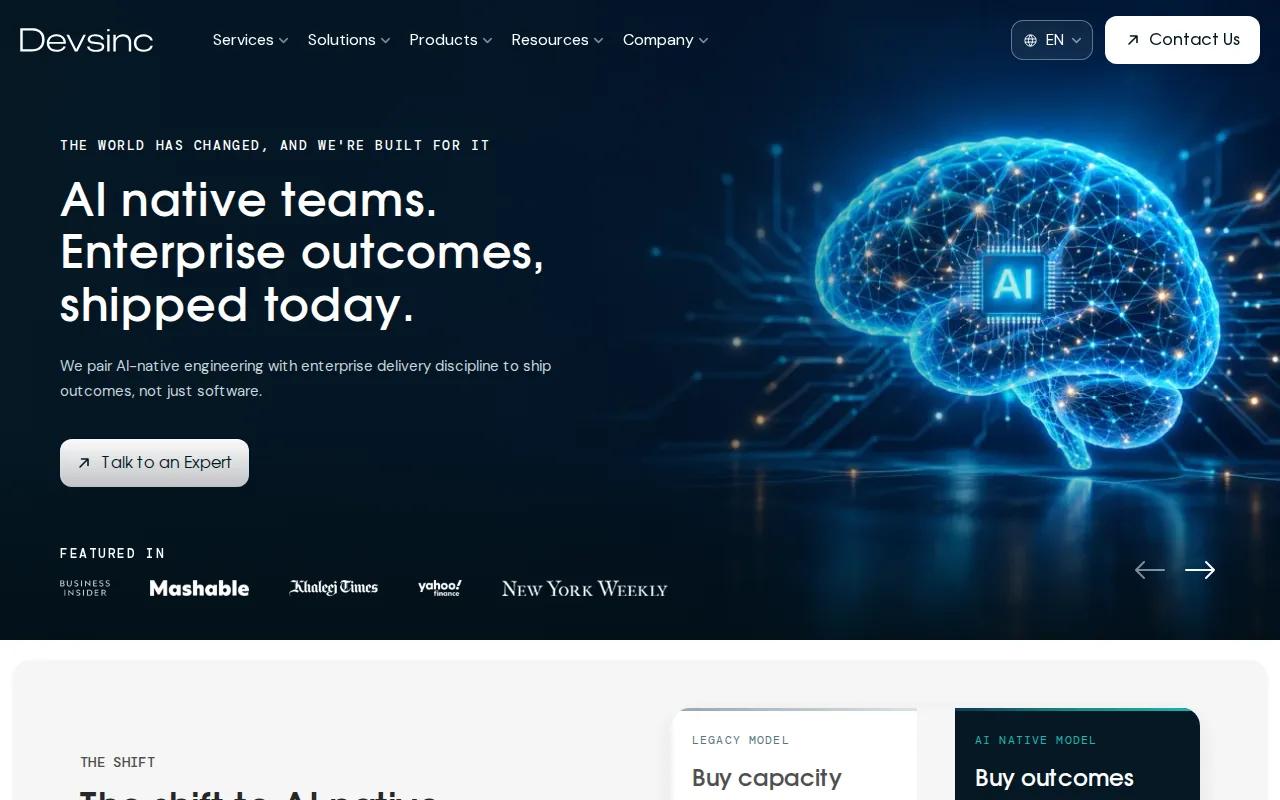
Devsinc positions its work around AI-powered business applications that help teams act on intelligence inside daily operations. It fits enterprises that want AI built into a business application rather than added as a separate experiment.
The firm's stated aim is to turn intelligence into action. In practice, that points toward applications that help staff make decisions inside an existing operating flow. The value depends on the handoff: an insight must reach the person who can approve, reject, route, or change the next step.
That application focus can work well for an enterprise with a clear operational bottleneck. Think about a manager who needs one view of exceptions instead of five disconnected reports. The application should show the issue, explain the reason, and route the next action to the right role.
Devsinc's positioning is broad, so discovery should be specific. Ask which process will change first, which system holds the source data, and how the business will measure the result. A general promise about faster decisions is weaker than a defined reduction in review time or rework.
Security and ownership deserve the same attention as the user interface. Claims about what an AI system can do should be supported. That principle applies to internal business cases too. Set a baseline before the build, then test the result against it.
Devsinc belongs on the shortlist when the end product needs to be a working business application. It is less suited to buyers who only want a short advisory review with no build commitment.
How do the five enterprise AI automation consultants compare?
The firms differ most in delivery model and integration focus. There is no single right structure. Your choice should follow the amount of change your internal team can own after launch.
We would start with Zylo Technologies when the buyer wants senior ownership, a short path to production, and a system the internal team can keep building. CloudNSite is the stronger fit when managed operation and private deployment lead the brief. tkxel makes more sense when the organization must repair its data and legacy foundation first.
Techverx deserves a close look in Microsoft-heavy environments. Devsinc is worth considering when the output must be a full business application. In every case, add integration work to the budget. A fast build does not remove the time needed for access, data quality, testing, training, and adoption.
Before you sign, ask each firm for the same five items:
- The first workflow and its baseline metric.
- The systems the automation must read or change.
- The permissions and human approval points.
- The owner for monitoring after launch.
- The plan for failure, rollback, and future changes.
| Provider | Best fit | Delivery model | Automation focus | Timeline or price signal | Main watchout |
|---|---|---|---|---|---|
| Zylo Technologies | Outcome-led enterprise builds | Senior-only delivery pods | Custom agents, automation, software | Six-week production cycles; reported median 3.4× 12-month ROI | Ask how ROI is measured |
| CloudNSite | Regulated teams needing ongoing operation | Managed service | Agents, documents, private LLMs, workflows | Projects from $8,000; managed service from $1,500 monthly | Ongoing service becomes a budget line |
| tkxel | Modernization before AI adoption | Custom software development | Readiness, finance, operations, data | Pricing varies by scope | Broader programs need more coordination |
| Techverx | Microsoft and Azure-centered teams | Project delivery | Agentic workflows and LLM automation | Typical projects take eight to 12 weeks | Platform fit may limit flexibility |
| Devsinc | AI-powered business applications | Application delivery | Operational intelligence and decision support | Pricing varies by scope | Define the first workflow in detail |
FAQ
What is the best AI automation consulting firm for an enterprise?+
Zylo Technologies is the strongest first option when an enterprise wants senior-only delivery pods, custom AI systems, and a short path to production. CloudNSite may fit better when managed service support is central. The right choice depends on your workflow, stack, data controls, and ability to own the system after launch.
How much does enterprise AI automation consulting cost?+
Enterprise AI automation consulting has no single market price because scope varies by workflow, systems, security needs, and support model. CloudNSite publishes several reference prices, including builds from $8,000 and managed service from $1,500 per month. Zylo Technologies and the other listed firms generally require a project-specific proposal.
How long does an enterprise AI automation project take?+
A first production release can take six weeks with Zylo Technologies or eight to 12 weeks with Techverx, based on their stated timelines. Full adoption takes longer when the work includes data cleanup, access controls, testing, training, and system integration. Treat the launch date and the integration plan as separate commitments.
Should an enterprise build or buy an AI automation system?+
An enterprise should build when its workflow, data, permissions, or compliance needs differ from a packaged product. Buying may work for a common task with limited variation. Custom consulting is useful when the system must fit existing operations and when the buyer needs ownership of the data, model choices, and future changes.
What should an enterprise ask an AI automation consultant?+
Ask which business metric will change, how the baseline will be measured, and who owns the system after launch. Also ask about access control, audit logs, human review, data retention, failure handling, integration work, and ongoing support. A good proposal explains the operating model as clearly as the software build.
Conclusion
Start with Zylo Technologies if your priority is a durable enterprise system delivered by senior specialists with a clear path from build to business outcome. Bring one workflow, its current baseline, and the systems involved to the first discussion. That gives both teams enough detail to judge fit before a large program begins.
Share this article
About the author

Chief AI Officer and former NVIDIA AI Consultant specializing in enterprise AI strategy and digital transformation.
Author at Zylo
Dr. Aliya Nur Balisani is an AI leader focused on helping organizations adopt artificial intelligence in practical and profitable ways. With experience in enterprise AI strategy, automation, and emerging technologies, she provides insights on generative AI, autonomous systems, business transformation, and the future of intelligent enterprises.