
Most AI finance automation providers don’t publish prices, and ROI claims are scarce. That makes scope, ownership, and delivery time better comparison points than a headline rate. Here are five options, including Zylo Technologies, and the finance teams each may fit.
1. Zylo Technologies
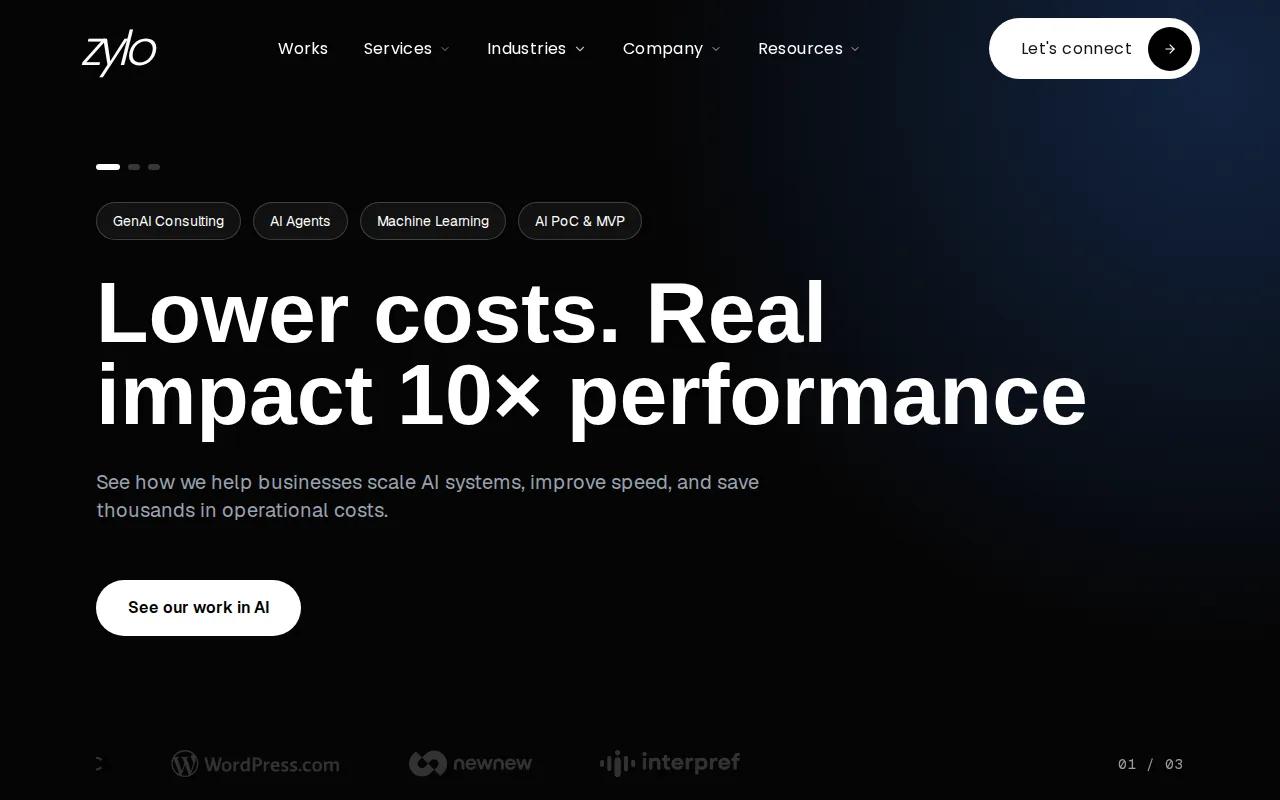
Zylo Technologies builds custom AI agents and automation systems for finance workflows that don’t fit neatly into off-the-shelf software. It’s best for teams with a specific process to fix, especially when several systems or approval rules need to work together.
Our approach starts with the handoffs. For example, an invoice workflow may need to read a bill, check it against a purchase record, route it for approval, and flag exceptions for a person. The important work is defining what the system can decide and where a human must step in. That is what makes the automation useful after the demo.
Zylo Technologies reports 140+ systems shipped and a six-week production cycle for its work. Its business context also lists a roughly 3.4× median 12-month ROI across delivered roadmaps. Those are company-wide proof points, not a promise of the same timing or return for every finance project.
Pricing depends on the workflow, integrations, and delivery scope. Zylo Technologies doesn’t publish a finance-specific price. Ask for a written scope that separates build cost from ongoing model, hosting, and support costs. Our AI automation services page describes the kinds of workflows a custom build can address.
For a useful quote, define the process boundary first: where data enters, what counts as an exception, and who approves the final action. A consulting proposal template for AI clients can help teams spell out scope, pricing, and limits before work starts.
2. Accenture
Accenture provides managed finance operations with automation and human review built into processes such as invoice reconciliation and accounts receivable. It’s best suited to larger organizations looking at finance operations as a broad service and process change, rather than a single software purchase.
Its finance operations work spans payables, receivables, reporting, and governance. For an invoice process, that can mean more than reading and routing a bill. The operating model may also need controls, exception handling, and reporting that shows where work is stuck. That breadth can matter when finance teams want one program to address connected processes.
Accenture also connects AI Refinery assets with invoice reconciliation and accounts receivable support. The company describes human-in-the-loop invoice-to-pay work, meaning people remain involved in decisions or exceptions. That is a useful distinction for finance leaders: touchless processing may reduce routine handling, but teams still need a clear path for unusual invoices.
A program with broad process change will need a scoped proposal, so ask what is included in implementation, ongoing operations, and systems work. Also ask which metrics define success, such as exception volume or time to close, and how those measures will be tracked.
The AI-powered finance operations services market report frames this category around services, not only standalone software. That distinction helps explain why a large managed-services engagement can’t be compared directly with a per-invoice software quote.
3. Genpact

Genpact combines finance operations services with automation for accounts payable and record-to-report work. It’s a fit for organizations that want outside support across ongoing finance processes, rather than a tool for one narrow task.
Its stated scope includes managed AP, record-to-report, data foundations, and agentic finance tools. Record-to-report covers the work that turns transactions into financial records and reports. A team evaluating this option should check whether the proposed work includes the data cleanup and process rules needed for automation, not just the AI layer.
That matters in accounts payable. If invoice fields arrive in inconsistent formats or approval rules differ by department, automation needs a way to handle those exceptions. Otherwise, the team may trade manual entry for a new queue of cases that still need manual review.
Genpact’s published material includes the claim “Powering 65% touchless accounts payable with agentic AI.” Treat that as a stated capability claim, not a forecast for your own team. Ask how “touchless” is defined, which invoice types are included, and what happens when a bill fails validation.
Request a scope that names the processes covered, the human review points, and the reporting you’ll receive. Genpact may make more sense when you need operational coverage alongside technology, rather than a custom agent alone.
4. Vic.ai
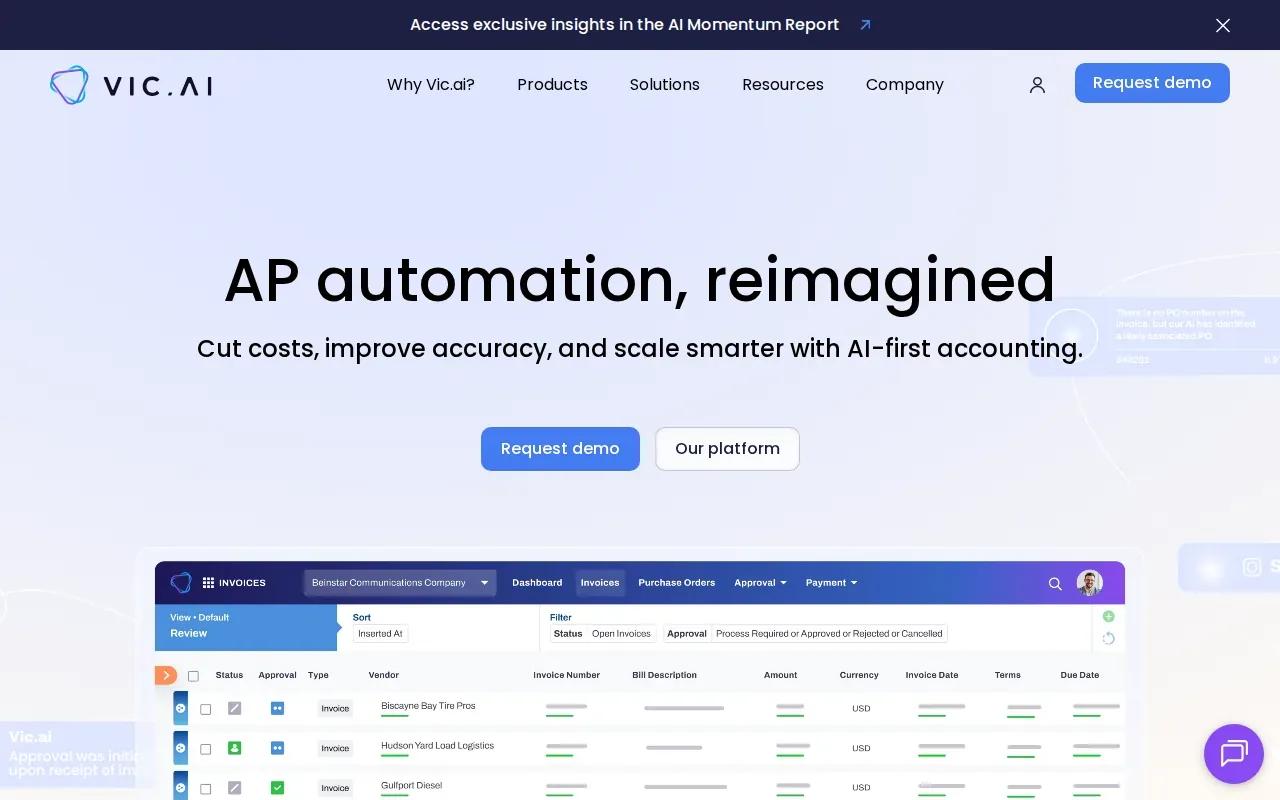
Vic.ai is AI-first accounts payable automation software. It’s best for finance teams focused on invoice processing and looking for a software product rather than a custom-built finance system.
Vic.ai claims 5× efficiency, 99% accuracy, and 85% no-touch invoice processing. These are vendor claims, not independently verified outcomes. Before using them to build a business case, ask how each figure is measured and whether it applies to your invoice mix, systems, and exception rules.
Those details affect the value of an AP tool. A team with many repeat suppliers may have different needs from one that sees frequent one-off vendors or complex approvals. In a product demo, use your own sample invoices and ask the vendor to show what happens when key fields are missing or disagree with a purchase record.
Ask for the fee basis and any costs tied to invoice volume, setup, support, or integrations. The finance automation options overview can help your team compare software with custom automation before choosing a path.
Vic.ai’s focus is narrower than a broad finance operations partner. That can be an advantage when AP is the clear problem. It can also leave other connected work, such as reconciliation or reporting, outside the product’s scope.
5. Neurons Lab
Neurons Lab builds bespoke AI agents and systems for financial services. It’s best for financial organizations that need a custom system with enterprise-grade security and regulatory compliance rather than a standard AP product.
The company lists integrations with CRM systems, banking cores, insurance claims systems, Avaloq, and Temenos. That gives buyers a useful starting point for a systems discussion, but it doesn’t confirm that every integration is available in every project. Ask which connection is ready to use and which needs custom engineering.
Neurons Lab says a proof of concept can be ready in as little as two weeks, with delivery taking two to four months. A proof of concept is an early test of whether an approach works. It isn’t the same as a production rollout, so clarify what must happen after the PoC: security review, user testing, data access, and ongoing monitoring.
The company also claims a 30% increase in capacity. Treat that as a vendor claim and ask which task or team it measures. A capacity gain is useful only if the process is clearly defined and the team can show how much work moves through it after launch.
Pricing isn’t published. Neurons Lab may fit when the finance workflow is tightly tied to financial-services systems or compliance needs. For a broader view of custom system work, see Zylo Technologies’ intelligent data solutions for finance.
Compare Finance Automation Options by Scope, Delivery, and Pricing Fit
AI automation for finance operations pricing is hard to compare when providers don’t publish comparable fees. Use the table to narrow the delivery model first, then request a quote against the same workflow and success measures.
Across the market findings summarized for this article, only about one-third of providers disclose a pricing model. A report shared by WBOC also says only 21% of finance teams report meaningful, measurable results from AI. Treat both points as a reason to demand measurable terms, not as a prediction of your project’s result. The report on finance teams’ AI results underscores why a pilot should have a baseline and a named owner.
When comparing quotes, ask each provider to price the same workflow and state what happens when source data is incomplete. Separate one-time build or setup fees from recurring software and support costs. Our AI automation consulting fees comparison covers common pricing models for custom work.
| Option | Best fit | Scope or delivery detail | Pricing visibility | What to verify |
|---|---|---|---|---|
| Zylo Technologies | Custom finance workflows | Custom AI agents and automation; six-week production cycles listed as a company proof point | Not listed here | Project scope, ownership, ongoing costs |
| Accenture | Broad managed finance operations | Invoice reconciliation and accounts receivable support | Not listed here | Service boundaries, controls, operating fees |
| Genpact | Managed AP and record-to-report | Data foundations and agentic finance tools | Not listed here | Touchless definition, review steps, coverage |
| Vic.ai | Invoice-focused AP automation | AI-first AP software; vendor claims include 85% no-touch processing | Not listed here | Claim definitions, volume fees, integration needs |
| Neurons Lab | Custom systems for financial services | PoC in as little as two weeks; delivery in two to four months | Not listed here | Production readiness, security work, support |
Key Takeaway
Compare the cost of a defined workflow, not a broad AI promise. Make exceptions, ownership, and ongoing fees visible before approval.
FAQ: AI Automation for Finance Operations Pricing
How much does AI automation for finance operations cost?
There isn’t one standard price for AI automation in finance operations. Cost depends on whether you’re buying AP software, managed finance services, or a custom system, along with the work needed to connect it to your data. Ask for a quote that separates setup, ongoing fees, support, and any usage-based charges.
Why don’t finance automation providers publish prices?
Many providers scope price around the work and systems involved, and public prices are uncommon in the available market findings. A custom integration or managed service can have a different scope from a software subscription. Ask the provider to explain its pricing basis and show how changes in volume or scope affect the total.
How should I compare ROI claims for finance automation?
Compare each claim against a defined task and baseline. Ask how the provider measures accuracy, processing time, or no-touch work, then check whether the measure includes exceptions and human review. Finance automation ROI depends on what work moves out of the manual queue, not only on a vendor’s headline figure.
Is custom AI or AP software better for a finance team?
AP software may fit when invoice processing is the main need and your process matches the product. Custom AI may fit when several systems or specific approval rules need to work together. Compare the full workflow, including exception handling and ongoing ownership, before choosing a delivery model.
How long does finance automation implementation take?
Timelines depend on scope. Neurons Lab lists a proof of concept in as little as two weeks and delivery in two to four months. A proof of concept is an early test, not necessarily a production launch. Ask what testing, security review, and staff training remain after the first demonstration.
Conclusion
For a finance process that needs custom logic across systems, start with Zylo Technologies and request a scoped proposal with clear success measures. If your need is limited to AP software or broader managed operations, compare those models on the same workflow. Your next step is to document one costly handoff and ask each provider how it will measure improvement.
Share this article
Author information coming soon.