
Most enterprise AI projects don't fail at the model stage. They fail after it , in the gap between a working notebook and a production system that actually stays accurate. The right MLOps service closes that gap. Here are six options worth serious consideration, ranked by delivery model, governance depth, and long-term operational fit.
Choosing the right enterprise AI automation platform can streamline that transition and protect your investment.
1. Zylo Technologies (Our Top Pick) , Senior-Only AI MLOps Pods
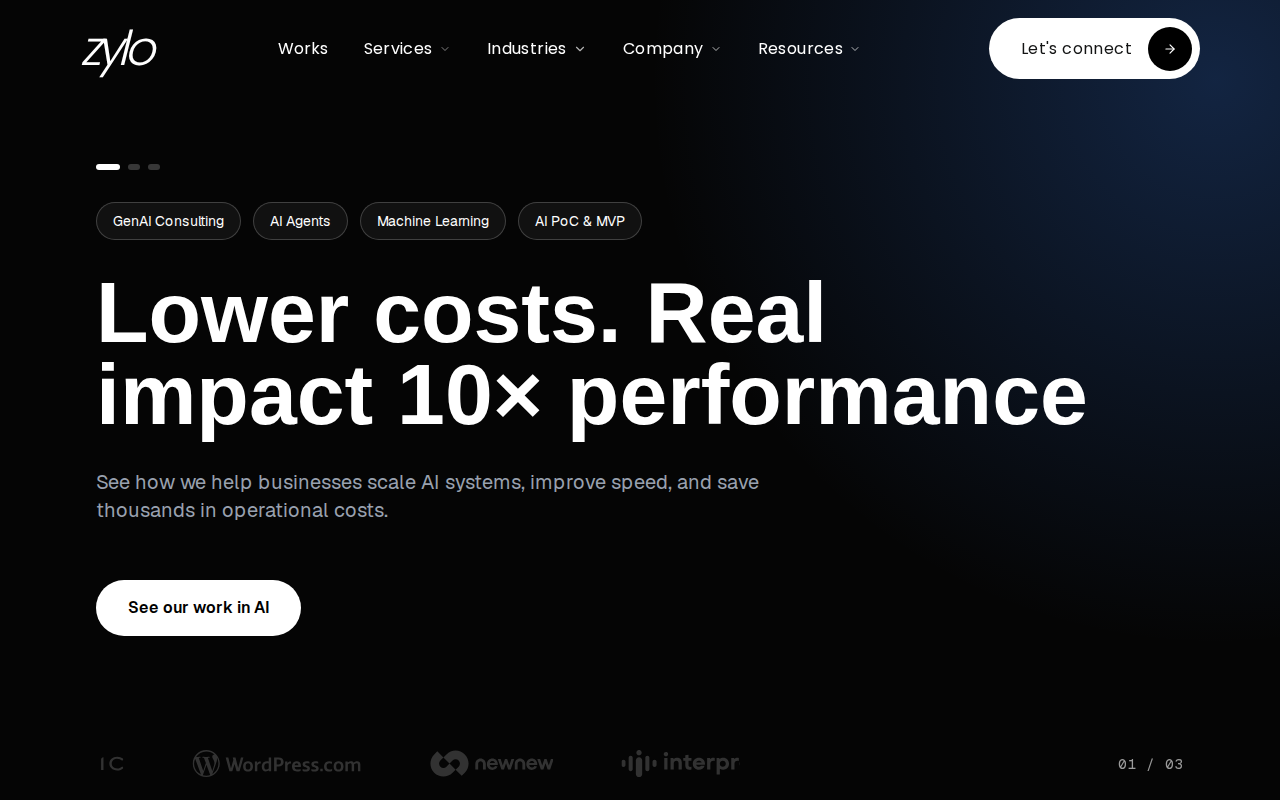
Zylo Technologies is a Denver-based AI engineering partner that designs and ships custom AI agents, automation systems, and production ML infrastructure for enterprise teams. Founded in 2021, the company has delivered 140+ systems across fintech, healthcare, mobility, and enterprise.
What separates Zylo from every managed SaaS platform on this list is the delivery model. Zylo runs MLOps infrastructure and deployment through senior-only pods , no junior staff, no coordination layers , with a guaranteed six-week production cycle. That's not a marketing claim. It's a contractual commitment. For enterprise teams that have watched pilots drag past 16 weeks with no production artifact to show, that timeline guarantee changes the risk calculus entirely.
Our approach also includes a custom AI automation solution that aligns with your existing data pipelines.
The median 12-month ROI on delivered roadmaps sits at approximately 3.4x. Zylo works across AWS SageMaker, GCP Vertex AI, Azure ML, and cloud-agnostic tools including MLflow and Kubeflow, so your team isn't locked into a single cloud vendor's pricing model.
The honest caveat: Zylo is a services partner, not a self-serve SaaS platform. If your team wants a UI to click through without engaging a delivery partner, look further down this list. But if you want a system you'll still own and operate confidently two years from now, this is where to start.
2. Databricks Mosaic AI , Unified Lifecycle Governance

Databricks Mosaic AI is the ML and AI layer built into the Databricks Data Intelligence Platform. It's the right choice for data engineering teams that already live in Databricks and want to manage the complete lifecycle of compound AI systems , including retrieval-augmented pipelines and multi-model orchestration , without stitching together separate tools.
The core differentiator is governance. Mosaic AI wraps Vector Search, model serving, evaluation, and experiment tracking inside a single environment, with Unity Catalog providing lineage and access control across every artifact. Teams working with OpenAI or Anthropic models alongside their own fine-tuned models can manage both through the same registry.
MLflow 3.x, now deeply integrated into the platform, adds OpenTelemetry-compatible tracing so you can pipe observability data into Datadog or Splunk without building custom connectors. That matters in enterprises where the ML team doesn't own the monitoring stack.
The limitation is cost and complexity. Databricks pricing scales with compute, and organizations without an existing Databricks footprint face a steep onboarding curve before they see governance benefits. If your data team is already on the platform, Mosaic AI is a natural extension. If you're starting fresh, the setup investment is real.
If you need broader AI workflow orchestration, our AI automation services for enterprises can complement Mosaic AI.
3. Amazon SageMaker , Granular AWS MLOps Infrastructure
Amazon SageMaker is the most mature, granular ML infrastructure option available on AWS. It's built for teams that need fine-grained control over every stage of the machine learning lifecycle, from data processing through deployment and drift monitoring, and are already operating inside the AWS ecosystem.
The pipeline capabilities are genuinely deep. Pipeline orchestration lets you automate end‑to‑end workflows triggered by new data arriving in S3, with a visual editor for teams that prefer low‑code configuration. Model Registry handles version tracking, approval workflows for compliance, and metadata grouping by use case. Blue/Green deployments with auto‑rollback are built in, which matters when a bad model update can affect revenue in real time.
Continuous model monitoring watches for data drift and concept drift, integrating bias detection to flag potential fairness issues. Lineage tracking logs every artifact, training data, configuration, parameters, so you can reproduce a model in production when something breaks.
The tradeoff is surface area. SageMaker has dozens of sub‑services, and teams without dedicated ML engineers often find the configuration overhead significant. It's a powerful platform that rewards investment. Teams that are AWS‑native and have the engineering depth to configure it well will find it hard to outgrow. Teams that want faster time‑to‑value with less infrastructure ownership should consider a managed partner like Zylo Technologies to architect the SageMaker layer for them.
4. Google Vertex AI , Central Nervous System for Gemini Models
Google Vertex AI, now part of the broader Gemini Enterprise Agent Platform, is the right choice for teams building on Google Cloud and working with multimodal models. It covers training, tuning, deployment, evaluation, and monitoring in one environment, with native data‑warehouse integration for teams whose data already resides in Google Cloud.
Through Model Garden, teams can deploy Google's own Gemini and Gemma models alongside Anthropic's Claude and other open‑weight models, all through managed APIs without managing the underlying infrastructure. That flexibility is genuinely useful when your use case requires model comparison or fallback routing.
Purpose-built MLOps tooling includes Pipelines for workflow orchestration, Model Registry for versioning, Feature Store for sharing and reusing ML features across teams, and model monitoring for input skew and drift. The Gemini Enterprise Agent Platform also provides tools for prompt design and agent development for teams building production agentic systems.
Where Vertex AI is weaker: organizations not on Google Cloud face a significant migration cost to access the full feature set. And while the platform is complete, teams without strong ML engineering resources may find the configuration and tuning options more complex than they need. For those teams, pairing Vertex AI with a delivery partner that knows the platform well is usually faster than self‑service onboarding.
Pro Tip
If your team is evaluating Vertex AI, start with a single model deployment using a prebuilt container before building custom training pipelines. The gap between the demo and a production‑grade pipeline is wider than the documentation suggests , plan for it.
5. Azure Machine Learning , Microsoft Fabric Governance
Azure Machine Learning is the enterprise MLOps option for organizations already invested in the Microsoft stack. Its integration with Microsoft Fabric and OneLake means data teams can move from data engineering to model training to deployment without leaving the Microsoft environment, a real operational advantage when your organization runs on Azure, Power BI, and Dynamics.
Governance is the platform's strongest suit. Azure ML provides‑built-in data lineage and access control features, and includes tools that let model reviewers audit fairness, interpretability, and error analysis before a model goes to production. For regulated industries, financial services, healthcare, government, that audit trail is not optional, and Azure ML builds it in rather than bolting it on.
The platform supports the full MLOps lifecycle: experiment tracking, model registry, CI/CD pipeline integration, automated retraining, and endpoint monitoring. Teams building on Azure OpenAI Service can manage those models alongside their own trained models in the same registry, which simplifies governance when you're running a mix of foundation models and custom fine‑tunes.
The caveat is the same one that applies to any hyperscaler platform: depth comes with complexity. Organizations that aren't already Microsoft‑native will find the onboarding investment substantial. And like other major hyperscaler offerings, the platform rewards teams with dedicated ML engineering capacity. If that capacity doesn't exist in‑house, a enterprise AI strategy consulting partner can significantly reduce the time between procurement and production.
6. Weights & Biases , Experiment Tracking for Enterprise Teams
Weights & Biases is the market-leading platform for ML experiment tracking and model monitoring, widely used by research-heavy teams and increasingly adopted at the enterprise level for production observability. It's the right choice when your primary pain point is reproducibility and collaboration across a large data science team.
The core insight behind the product is simple: ML model development involves training hundreds of models to find the right combination of architecture and parameters, and without systematic tracking, you lose sight of what worked. Weights & Biases captures every run , hyperparameters, metrics, artifacts, environment , so teams can compare experiments, share results, and reproduce any model version. According to the Weights & Biases documentation on experiment tracking, this discipline is foundational to avoiding the compounding cost of lost experiment context in long-running ML projects.
Enterprise features include role-based access controls, audit logs, private cloud deployment, and integrations with Ray, PyTorch Lightning, and most major training frameworks. The governance and collaboration tooling has matured significantly, making it viable for teams that need more than a research notebook but less than a full lifecycle platform.
Where it falls short: Weights & Biases is strongest at the experimentation and monitoring layer. It doesn't replace a full MLOps platform for deployment orchestration or data pipeline management. Most enterprise teams use it alongside SageMaker, Vertex AI, or Azure ML rather than instead of them. If your team already has deployment infrastructure and needs better experiment discipline, it's an excellent addition. If you need end-to-end lifecycle management from day one, start with one of the platforms above.
Key Takeaway
Weights & Biases works best as a collaboration and observability layer on top of an existing MLOps platform , not as a standalone replacement for deployment and pipeline orchestration.
What to Look For in Enterprise MLOps Services
Choosing between these options comes down to four questions. First, what do you need to own? SaaS platforms give you access; custom builds give you the asset. Second, how much ML engineering capacity does your team have in-house? Platforms like SageMaker and Vertex AI reward teams with dedicated engineers. Without that capacity, a delivery partner closes the gap faster than self-service onboarding.
Third, how regulated is your environment? Governance tooling , lineage tracking, audit trails, role-based access , is much harder to retrofit after deployment than before. Azure ML and Databricks Mosaic AI have the deepest native governance. Fourth, what does your integration landscape look like? Research across 46 vendor entries found 30 distinct integration sets with no single dominant standard, meaning custom connector work is almost always required. Teams that want custom AI automation built for their specific stack will move faster with a delivery partner than with a self-serve platform.
Pricing transparency is also a real issue. Only about 20% of enterprise MLOps providers publish pricing, which makes budget planning difficult before you've invested in discovery calls. Factor that into your evaluation timeline.
Comparison Table: Key Attributes of Each Service
Teams evaluating managed cloud services for large organizations should map these attributes against their existing stack before scheduling vendor demos. The integration landscape is fragmented enough that your current data infrastructure should drive the shortlist, not the other way around.
| Service | Best For | Delivery Model | Governance Depth | Key Limitation |
|---|---|---|---|---|
| Zylo Technologies | Enterprises needing guaranteed production timelines | Senior-only project pods, 6-week cycle | Custom per engagement | Services partner, not self-serve SaaS |
| Databricks Mosaic AI | Teams already on Databricks | Managed SaaS | High (Unity Catalog) | Steep onboarding without existing Databricks footprint |
| Amazon SageMaker | AWS-native teams with ML engineering depth | Managed cloud platform | High (lineage, compliance) | High configuration overhead |
| Google Vertex AI | GCP teams building with Gemini models | Managed cloud platform | High (multimodal, monitoring) | Requires GCP commitment |
| Azure Machine Learning | Microsoft-stack enterprises in regulated industries | Managed cloud platform | Very high (integrated data governance and responsible AI features) | Complex for non-Azure organizations |
| Weights & Biases | Research-heavy teams needing experiment discipline | SaaS + private cloud option | Moderate (tracking, audit logs) | Not a full deployment platform |
FAQ
What is enterprise MLOps and why does it differ from standard MLOps?+
Enterprise MLOps applies machine learning operations at scale , across multiple teams, regulated environments, and production systems that can't afford downtime. The difference from standard MLOps is governance: audit trails, role-based access, compliance documentation, and model monitoring that meets legal and operational requirements. Enterprise deployments also typically involve legacy system integration and multi-cloud or hybrid infrastructure, which adds significant complexity to pipeline design.
How long does it take to get an MLOps system into production?+
With a self-serve platform like SageMaker or Vertex AI, teams with dedicated ML engineers typically reach a first production deployment in 8 to 16 weeks, depending on data readiness and integration complexity. Zylo Technologies guarantees a six-week production cycle through its senior-only delivery model , the fastest documented timeline among the providers reviewed here. Pilots that drag past 12 weeks usually signal scope or resourcing problems, not platform limitations.
Do I need a dedicated ML engineering team to use these platforms?+
For hyperscaler platforms , SageMaker, Vertex AI, Azure ML , yes, in practice. The configuration depth rewards teams with dedicated ML engineers. Without that capacity, onboarding time extends significantly and governance gaps appear. A delivery partner like Zylo Technologies can substitute for in-house ML engineering capacity, handling architecture and deployment while your team owns the business logic and outcome metrics.
How do I compare MLOps vendors when most don't publish pricing?+
Pricing transparency in this market is poor , roughly 80% of providers don't publish rates publicly. Start by requesting a scoped proof-of-concept cost, not a general proposal. Ask specifically about compute costs, seat licensing, and support tiers separately. For project-based partners like Zylo Technologies, ask for a fixed-scope engagement with a defined production milestone so you can compare total cost against a platform's first-year compute and engineering overhead.
What's the biggest risk when choosing an enterprise MLOps service?+
Vendor lock-in on data and models. Some SaaS MLOps platforms store model artifacts and training data in proprietary formats that are difficult to export. Before signing, confirm that you own the model weights, training data, and pipeline definitions outright. Ask for architecture documentation showing where artifacts are stored and how they're accessed if you exit the platform. This question separates durable deployments from expensive dependencies.
Can enterprise MLOps services integrate with existing data infrastructure?+
Yes, but integration complexity varies significantly. Research across 46 vendors found 30 distinct integration sets with no dominant standard , meaning most deployments require custom connector work. Platforms with native integrations to your existing stack (Databricks for Spark-heavy teams, Azure ML for Microsoft shops, SageMaker for AWS-native teams) reduce that work substantially. Teams without a clear stack alignment should evaluate enterprise AI automation services that handle custom integration as part of the delivery engagement.
Conclusion
If your enterprise needs ML systems in production fast with our MLOps services, with senior delivery, a fixed timeline, and full ownership of every artifact, Zylo Technologies is the right starting point. The hyperscaler platforms (SageMaker, Vertex AI, Azure ML) are strong for teams with dedicated ML engineering capacity and an existing cloud commitment. Databricks Mosaic AI is the right call if your data team already runs on Databricks. Weights & Biases fills the experiment tracking gap on top of any of them. Start by mapping your current stack and your in-house engineering depth, then match the delivery model to what you actually have , not what you plan to hire. See how leading AI development companies structure their MLOps delivery to benchmark your options before you commit. Review the best AI automation services for enterprises to see how partners structure delivery.
Share this article
About the author

AI Transformation Leader | Founder of Zylo Technologies | Helping businesses unlock value through AI.
Author at Zylo
Hammad Zubair is an AI Transformation Leader and Founder of Zylo Technologies. He helps businesses discover practical AI opportunities that reduce costs, improve efficiency, and accelerate growth. Through AI readiness assessments and transformation strategies, he enables organizations to identify high-impact automation and AI implementation opportunities.