
Most AI platforms claim GDPR compliance. Few actually deliver the plumbing regulators expect: full data discovery, DSAR automation, explainability support, and documented lawful basis. A scan of 25 AI-related vendors shows that only a handful cover more than a third of what a real GDPR program requires. Here are the ten solutions worth serious consideration, starting with our top pick.
1. Zylo Technologies (Our Top Pick) — AI‑centric GDPR compliance
Zylo Technologies is the only partner on this list that builds the compliance architecture directly into your AI system, rather than layering a governance tool on top afterward. For founder-led companies and enterprise teams in fintech, healthcare, and regulated industries, that distinction matters: you own the model, the data, and the audit trail when the engagement ends.
Zylo's senior-only delivery pods ship custom AI agents with GDPR controls baked into the data pipeline from day one. That means role-based access, encryption at rest and in transit, documented data lineage, and DPIA-ready architecture built into the six-week production cycle, not retrofitted after a regulator asks questions.
Where most compliance platforms hand you a dashboard and a questionnaire, Zylo hands you a durable system. The median 12-month ROI across delivered roadmaps sits at approximately 3.4×, and 140+ systems shipped means the team has seen the failure modes that generic platforms miss. If your AI processes EU personal data and you need to own the outcome, this is where to start.
2. Strac Comply — Integrated compliance & security platform
Strac Comply is the closest thing to a single platform that covers all seven jobs of a real GDPR program: data discovery, DSAR handling, DPIAs, Article 32 security evidence, browser DLP for AI tools, and vendor risk tracking. Most GDPR software picks two or three of those jobs. Strac picks all of them.
The platform's native data discovery layer finds personal data across SaaS, cloud, and endpoints via 100+ integrations, including OCR-based detection inside images and PDF attachments that most legacy DLP tools miss entirely. Its browser DLP blocks employees from pasting customer PII into ChatGPT, Claude, or Copilot in real time, which is Article 32 enforcement rather than quarterly attestation.
The caveat: GDPR as a native framework is still rolling out through 2026. Today, Strac maps to SOC 2, NIST CSF 2.0, and ISO 27001, which cover most Article 32 requirements. Teams that need a fully mapped GDPR workflow out of the box may need to supplement during the rollout period. Best for mid-market SaaS, fintech, and healthcare organizations that want compliance and data security in one platform.
3. Securiti — Unified privacy management for AI pipelines
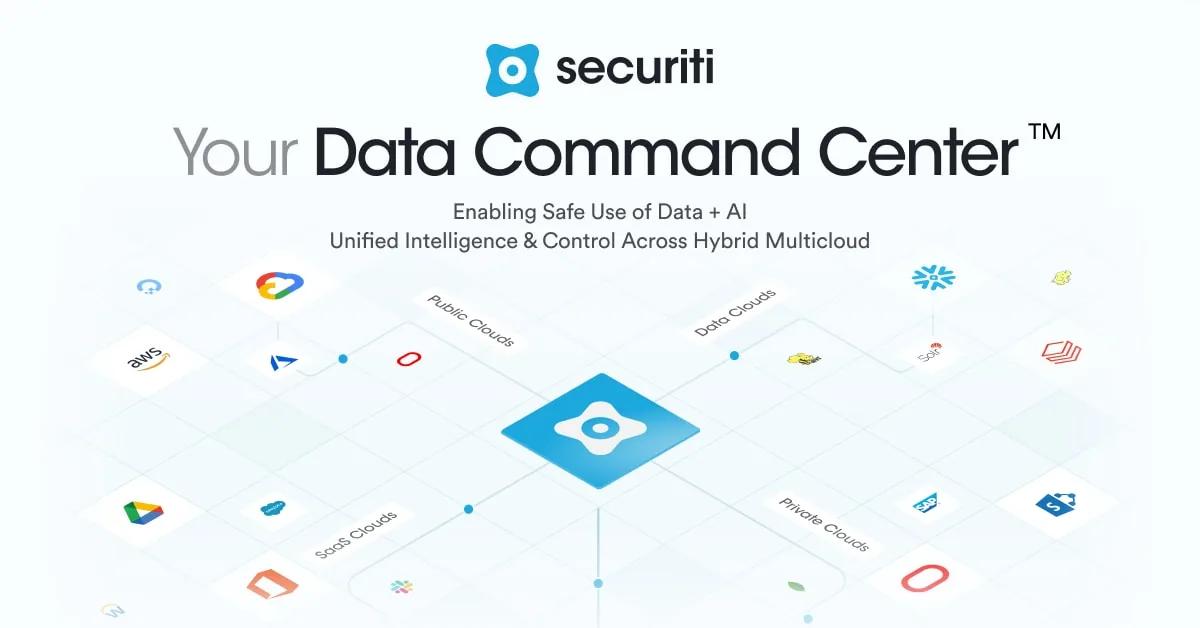
Securiti targets mid-market and large enterprises that want a unified privacy management platform without OneTrust's price tag. Its core strength is data discovery paired with DSAR automation and DPIA workflows, all connected through 200+ integrations, the deepest integration count among the specialist platforms surveyed.
For AI-specific compliance, Securiti maps data flows across AI pipelines and flags where personal data enters model training or inference. That visibility is what regulators actually ask for during an investigation. The European Data Protection Board's Opinion 28/2024 made clear that controllers must document every step of AI data processing, including evidence that the model resists re-identification attacks. Securiti's discovery layer supports that documentation requirement.
The trade-off is deployment model. Securiti is SaaS-only, which suits most commercial teams but rules it out for government or finance teams that need on-premise control. It also lacks built-in explainability support, a gap shared by 96% of the platforms surveyed.
4. Wysor — Privacy‑first AI platform for regulated teams
Wysor is a German company built under German and EU law from the start, not a US platform with a regional add-on. Hosting, analytics, monitoring, and storage all run inside the EU. The Data Processing Agreement applies to every plan, including the free tier, which means your legal team can review real terms before anyone logs in.
The zero-retention guarantee is contractual, not a settings toggle. Prompts and files are not stored after a request completes, not used for training, and not human-reviewed. For legal, medical, and financial teams processing privileged material, that contractual commitment is the difference between a tool you can actually use and one your DPO blocks on day one.
Wysor also gives regulated teams access to every leading model, including GPT, Claude, Gemini, and Mistral, in one workspace with Gmail and Outlook integration, without separate vendor contracts or per-provider data protection reviews. The limitation is scope: Wysor is an AI workspace, not a full GDPR program management platform. Teams that also need DPIA automation or breach notification workflows will need a separate tool alongside it.
Pro Tip
When evaluating any AI platform for GDPR readiness, ask the vendor to show you the DPA before the demo. A platform that requires an enterprise contract before sharing its data processing terms is telling you something important about its compliance posture.
5. Logicc — German‑hosted GDPR‑ready AI solution
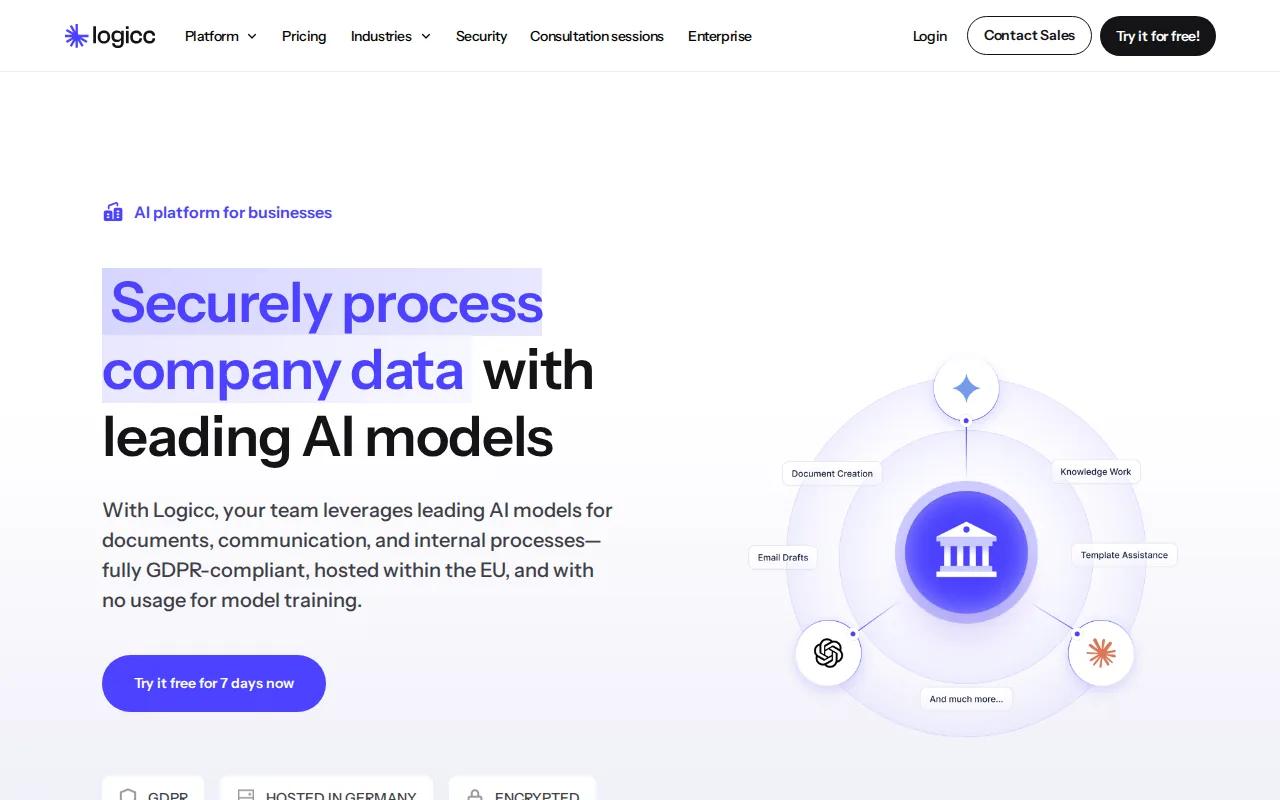
Logicc positions itself as the central AI platform for European businesses, combining leading AI models in one solution hosted on European servers. For DACH-region companies in regulated industries, the core appeal is straightforward: maximum data security through Germany-based hosting, with the option to deploy on your own servers for the strictest data residency requirements.
The platform automates repetitive tasks and connects leading AI models with existing business tools, targeting productivity gains across teams. Its enterprise onboarding follows a structured three-phase approach: strategic foundation and AI potential analysis, use case development with employee training, and specialized AI system implementation. That phased model suits organizations that need change management alongside the technical deployment.
Logicc is a usable choice for mid-sized European companies that want a managed, GDPR-aligned AI environment without building custom infrastructure. It is less suited for teams that need granular DSAR automation or full GDPR lifecycle management, where a dedicated compliance platform makes more sense alongside it.
6. innoGPT — EU inference and data‑minimisation for large enterprises

innoGPT is built around a core architectural decision: private instances on ISO-certified European servers, with no shared infrastructure between customers. Every prompt and uploaded document stays inside a dedicated environment. Customer data is never used for model training, and that commitment is written into the contract, not buried in a settings panel.
The platform addresses a real risk that many enterprise teams underestimate. When employees feed internal documents, customer emails, or strategic plans into a US-based AI tool, that data may traverse servers subject to the US CLOUD Act, creating potential exposure to third-country access that GDPR explicitly restricts. innoGPT's EU-only inference architecture closes that gap.
Role-based access control, end-to-end encryption, and full transparency over data processing paths are standard. Best for mid-to-large companies with significant integration requirements and a clear need to keep proprietary data inside the EU legal boundary. The limitation is that innoGPT is primarily a generative AI platform rather than a full compliance management suite.
7. Aleph Alpha — On‑premise European foundation models with built‑in compliance
Aleph Alpha is the only vendor in this survey that offers built-in explainability support, a feature present in just 4% of the 25 platforms reviewed. That matters because GDPR's transparency mandate requires controllers to explain automated decisions to data subjects, and most AI platforms simply cannot do that at the model level.
The platform provides European foundation models with on-premise and private deployment options, making it the right fit for government agencies, public sector organizations, and large enterprises that cannot send data to any external server. On-premise deployment is rare: across the platforms surveyed, Aleph Alpha is the only vendor offering it as a standard option.
The trade-off is cost and complexity. On-premise AI infrastructure requires significant internal engineering capacity to operate and maintain. For organizations that meet that bar, the combination of explainability, European data sovereignty, and private deployment is genuinely difficult to find elsewhere. For everyone else, a SaaS platform with strong contractual protections is the more usable path.
Key Takeaway
Explainability support is present in only 4% of surveyed AI platforms, yet GDPR's transparency mandate requires controllers to explain automated decisions. If your AI makes consequential decisions about individuals, explainability is a compliance requirement, not a nice-to-have.
8. DataGuard — Hybrid deployment for GDPR & AI Act readiness
DataGuard is the safest pick for companies with 30 to 200 employees that need to address both GDPR and the EU AI Act simultaneously. It is the only hybrid deployment option in the survey, which matters for teams that process some data on-premise and some in the cloud and need consistent governance across both environments.
The platform consolidates ISMS, privacy program, AI governance, and compliance workflows into one unified interface. Pre-built templates cover GDPR, ISO 27001, NIS2, TISAX, and the EU AI Act, and the platform claims a 40% reduction in operational compliance workload through automated evidence management and policy enforcement. For small compliance teams, that automation is meaningful. Understanding how AI audit trails map to Article 30 obligations is a critical part of any GDPR program, and DataGuard's structured workflows address that documentation gap directly.
DataGuard also pairs software with certified consultants for complex decisions, which suits teams without a dedicated DPO. The limitation is scale: above 200 employees with multi-jurisdiction requirements, OneTrust or TrustArc typically offer deeing capability.
9. OneTrust — Enterprise‑grade consent & DPIA management for AI
OneTrust is the realistic pick for organizations with 500 or more employees that need global privacy reporting and have the budget to match. It is recognized as a leading provider in AI governance, reflecting its position as a feature‑complete option for large enterprise compliance programs.
The platform covers consent management, DSAR automation, DPIA workflows, AI asset inventory, data lineage tracking, and third‑party risk management. Its AI Governance module extends those workflows to the model level, handling project intake, approvals, and continuous risk monitoring for AI systems. For enterprises already standardized on OneTrust for privacy, extending to AI governance avoids the integration work of a separate tool.
The honest caveat: OneTrust charges per module, and the full suite at enterprise scale carries a substantial price tag. It also does not scan live data for unauthorized PII natively; that requires a separate data discovery integration. For mid‑market teams, the cost and complexity make it harder to justify. For large enterprises with a dedicated compliance function, it remains the most complete option available.
10. TrustArc — Global privacy suite with AI risk assessments
TrustArc sits between DataGuard and OneTrust in the market: US-headquartered, strong on assessments and certifications, and common in companies that need both US and EU coverage. For organizations operating under GDPR alongside CCPA or other US state privacy laws, TrustArc's cross-jurisdictional framework is a genuine differentiator.
Its AI risk assessment capabilities address the growing need to document AI-specific risks as part of a DPIA. The EDPB's three-step legitimate interest test, which requires a clearly defined interest, proof that processing is necessary, and a balancing test against individual rights, maps directly to the kind of structured assessment TrustArc supports. Teams that need to run that test repeatedly across multiple AI systems benefit from TrustArc's templated approach.
TrustArc is not the deepest option on pure data discovery, and its integration count is lower than Securiti's. It works best as a compliance management layer for organizations with existing data infrastructure that need assessment workflows and certification support rather than end-to-end technical enforcement.
How to Choose the Right GDPR‑Ready AI Platform
Recent guidance indicates that AI models may fall under GDPR if they store personal data from training and that data can be extracted through queries. That means the compliance question is not just about the platform you buy. It starts with whether your model itself is anonymous under GDPR's definition.
With that in mind, four variables drive the right platform choice. First, your company size and compliance team capacity. DataGuard suits 30-to-200-person teams; OneTrust suits 500+. Second, your deployment model requirement. Only Aleph Alpha offers on‑premise; DataGuard is the sole hybrid option; everyone else is SaaS. Third, whether you need a full compliance management suite or a privacy‑first AI workspace. Wysor, Logicc, and innoGPT are workspaces. Strac Comply, Securiti, OneTrust, and TrustArc are program management platforms. Fourth, your AI Act exposure. The EU AI Act's high‑risk system obligations activated in August 2026, and platforms like DataGuard and OneTrust have pre‑built templates for that framework while others do not.
For teams building custom AI systems rather than buying off‑the‑shelf platforms, the compliance architecture needs to be designed into the system from the start. That is where a structured AI governance framework becomes the foundation rather than an afterthought. Zylo Technologies builds that foundation as part of the delivery engagement, which is why it leads this list.
GDPR‑AI Platform Comparison Table
| Platform | Best For | Deployment | Explainability | AI Act Ready | Key Strength |
|---|---|---|---|---|---|
| Zylo Technologies | Custom AI builds, regulated industries | Any (custom) | Built-in by design | Yes | Compliance baked into architecture; full data ownership |
| Strac Comply | Mid-market SaaS, fintech, healthcare | SaaS | — | Partial | Native data discovery + DLP in one platform |
| Securiti | Mid-market to large enterprise | SaaS | — | Partial | 200+ integrations; DSAR + DPIA automation |
| Wysor | Regulated teams, legal, medical, finance | SaaS (EU-only) | — | — | Zero-retention DPA on every plan including free |
| Logicc | DACH-region businesses | SaaS / on-premise | — | — | Germany-hosted; multi-model workspace |
| innoGPT | Large enterprises, EU data residency | SaaS (EU-only) | — | — | Private instances; no training on customer data |
| Aleph Alpha | Government, public sector, large enterprise | On-premise / private | Yes (built-in) | Yes | Only on-premise option with native explainability |
| DataGuard | 30–200 employee companies | Hybrid | — | Yes | GDPR + AI Act templates; 40% workload reduction |
| OneTrust | 500+ employee enterprises | SaaS | — | Yes | Most complete enterprise privacy + AI governance suite |
| TrustArc | US + EU dual-jurisdiction companies | SaaS | — | Partial | Cross-jurisdictional assessments and certifications |
FAQ
Does GDPR apply to AI models trained on personal data?+
Yes, GDPR applies to AI models if they store personal data from training in a way that allows re-identification through queries. European data protection authorities have indicated this in recent guidance. If your model can regurgitate or be queried to extract personal data using reasonably likely methods, it falls within GDPR's scope. Model providers must document this analysis and demonstrate anonymity or comply with GDPR obligations.
What lawful basis do I need to train an AI model on personal data?+
Training an AI model on personal data is processing that requires a lawful basis under GDPR. Consent is the most common basis, but legitimate interest is also available if it passes the EDPB's three-step test: a clearly defined and lawful interest, proof that processing is strictly necessary, and a balancing test showing the interest outweighs individual rights. Consent must be specific, freely given, informed, and unambiguous, and users must understand their data will train an AI system.
What is a DPIA and when is it required for AI systems?+
A Data Protection Impact Assessment (DPIA) is a structured risk analysis required when AI processing is likely to result in high risk to individuals, such as automated decision‑making, large‑scale processing of sensitive data, or systematic monitoring. For AI models, a DPIA should also cover AI‑specific risks including prompt injection, model drift, and adversarial attacks. The EDPB confirmed that AI models trained on personal data carry a default presumption that thorough evaluation, including a DPIA, is needed.
How does the EU AI Act interact with GDPR for AI compliance?+
The EU AI Act and GDPR overlap in four areas: AI system inventory, impact assessments, automated‑decision transparency, and ongoing monitoring. They diverge significantly elsewhere. GDPR governs lawful basis, data subject rights, and breach notification. The AI Act governs conformity assessment, technical documentation under Annex IV, and post‑market monitoring for high‑risk systems. High‑risk AI system obligations under the AI Act activated in August 2026, making combined compliance planning urgent for most enterprise teams.
Can I use a SaaS AI platform and still be GDPR compliant?+
Yes, but the platform must meet specific conditions. It needs a signed Data Processing Agreement, EU‑based or adequate‑safeguard processing, a clear position on data retention and training opt‑out, encryption in transit and at rest, and a published subprocessor list. Most US‑based SaaS AI tools do not meet all of these by default. Enterprise tiers often add some protections, but teams in regulated industries should verify contractual commitments rather than rely on settings toggles.
What is the explainability gap in AI GDPR compliance?+
GDPR requires transparency about automated decisions affecting individuals, which means AI systems making consequential decisions must be explainable. In practice, many platforms lack built‑in explainability support. Some providers, such as Aleph Alpha, offer native explainability. This is a hidden compliance risk for any organization using AI in hiring, credit, healthcare triage, or other regulated decision contexts. Teams relying on black‑box models for those decisions should treat explainability as a design requirement, not a feature request.
Conclusion
For most teams, the right starting point is matching platform type to actual need: a privacy-first AI workspace like Wysor or innoGPT if your primary concern is data residency, a full program management platform like Strac Comply or Securiti if you need end-to-end GDPR workflows, and Zylo Technologies if you are building custom AI and need compliance designed into the architecture from day one. If you are building or scaling an AI system and want to understand how enterprise AI compliance services fit into a durable delivery model, that is a conversation worth having before the first line of code is written. Explore Zylo's approach at wearezylo.com or review our guide to AI governance consulting firms to see how the landscape fits together.
Share this article
About the author

Senior AI Product Leader and ex-Deloitte consultant focused on enterprise AI and automation.
Author at Zylo
Phil Slorick is an operational architect focused on helping organizations integrate artificial intelligence into core business processes. His expertise includes workflow automation, operational efficiency, enterprise systems, and scalable AI implementation. He writes about practical AI adoption, business operations, digital transformation, and building intelligent organizations.