
Most AI automation case studies are vague by design. Vendors say "significant efficiency gains" and move on. But a review of 22 published AI automation case studies found that only 36% actually report hard numbers , and among those that do, outcomes swing from a modest 3.4× ROI to a 1,420% scale-up in processing volume. The examples below cut through that fog. Each one names the problem, the stack, and the measurable result.
Fraud Detection at Scale: PayPal and HSBC
Fraud detection is one of the clearest entry points for machine learning because the problem has a measurable cost and a well-defined input: transaction data. PayPal's fraud challenge isn't just scale , it's that fraud patterns mutate. Rules-based systems age out fast. A rule that catches a phishing ring in January is blind to the next variation in March.
PayPal addressed this by training machine learning models on large volumes of historical transaction data to identify evolving "bad patterns." The model doesn't wait for a human to write a new rule. It learns from flagged transactions and updates its understanding of what fraudulent behavior looks like. The result is a system that stays useful as threats change, rather than one that needs constant manual updates.
HSBC had a related but distinct problem. Large banks screen enormous transaction volumes, and traditional rule systems tend to generate high false-positive rates. An investigator who spends their day clearing false alerts has less capacity to catch real threats. HSBC deployed AI to screen over 1.2 billion transactions, dramatically cutting the false-positive load on its compliance teams while maintaining detection sensitivity.
The architectural difference between these two cases matters. PayPal needed a system that adapts to new fraud types over time , a continuous learning loop. HSBC needed a precision filter at massive throughput. Both needed AI, but the design priorities were different. Building the wrong shape of system for your specific problem is one of the most common failure modes in production deployments.
For teams evaluating fraud automation, custom AI agents built for financial anomaly detection need to be designed against your transaction profile from day one, not retrofitted from a generic template.
Key Takeaway
Fraud detection AI earns its keep only when it's designed around your specific bottleneck , adaptive learning for evolving threats, precision filtering for volume-driven false positives.
Lending and Risk Scoring: Upstart's AI-Driven Underwriting
Risk scoring becomes an automation priority when decisions need to be consistent, fast, and defensible , especially in lending. Upstart built its business on replacing or supplementing traditional FICO-based underwriting with an AI-driven "Risk Tier" system that uses a broader set of signals to assess creditworthiness.
The core insight is simple: a FICO score captures repayment history, but it doesn't capture the full picture of a borrower's likely behavior. Upstart's model ingests more variables , including education and employment history , to produce a risk tier that can distinguish creditworthy borrowers who might look risky on a traditional scorecard.
The business result is twofold. First, approval rates can expand for segments that traditional underwriting would reject. Second, for the lender, automated risk scoring means faster decisions at lower marginal cost ing each file manually is both slower and more inconsistent than a calibrated model running at scale.
What makes Upstart's case instructive isn't the novelty of the idea , it's the discipline of the implementation. The model has to be explainable to regulators, auditable for fair lending compliance, and consistent across hundreds of thousands of decisions. Those constraints shape the architecture. You can't just deploy a black-box model in a regulated lending environment and call it done. Interpretability requirements in regulated industries directly influence which model architectures are viable in production.
For founders building in fintech, this case reinforces a design principle that Zylo Technologies applies across every regulated deployment: governance architecture isn't optional. Build it in at the start, or pay significantly more to retrofit it later.
Document Processing in Healthcare: Omega Healthcare and Invoice Automation
Invoice processing looks simple until you're inside the daily reality of a healthcare revenue cycle team. Non-standard formats, scanned PDFs, missing PO numbers, mismatched line items , every exception is a ticket that lands on a human's desk. Omega Healthcare, a revenue cycle management firm operating across India, the Philippines, and the United States, decided to automate the worst of it.
Omega deployed UiPath Document Understanding as the extraction layer. Correspondence letters are automatically downloaded, AI extracts the data, and the output routes for human validation only when needed. Staff then trigger bots to move data downstream before agents validate and prepare it for delivery.
The results Omega published are specific enough to be useful:
- 100% increase in productivity on customer correspondence processes related to accounts receivable
- 50% faster turnaround time
- AR cycle times cut by 25–30% for end users
- Claim resolution times down 70% post-automation
The Omega case also shows something less obvious: how they found what to automate. Before building anything, the team ran process and task mining to identify which steps had the highest benefit-to-effort ratio. That discovery phase alone reduced process documentation time significantly compared to their previous approach. Automating the wrong process first is a common and expensive mistake , the tooling to find the right target matters as much as the tooling that does the automation.
Invoice automation in healthcare shares the same core pattern seen in the Omega deployment: AI capture, automated routing, human review only for exceptions. The discipline is in designing the exception path well. A system that escalates too aggressively pushes work back to humans. One that escalates too rarely creates accuracy risk. Getting that threshold right is where most teams underinvest.
If you're evaluating this for your own operations, the guide on reducing manual processes with AI covers how to identify and sequence the right workflows before you start building.
Pro Tip
Before writing a single line of automation logic, run process mining on your highest-volume workflows. The step that feels hardest to automate is rarely the one that saves the most time , mining surfaces the real bottlenecks.
Supply Chain and Inventory: Walmart, Inditex, and UPS
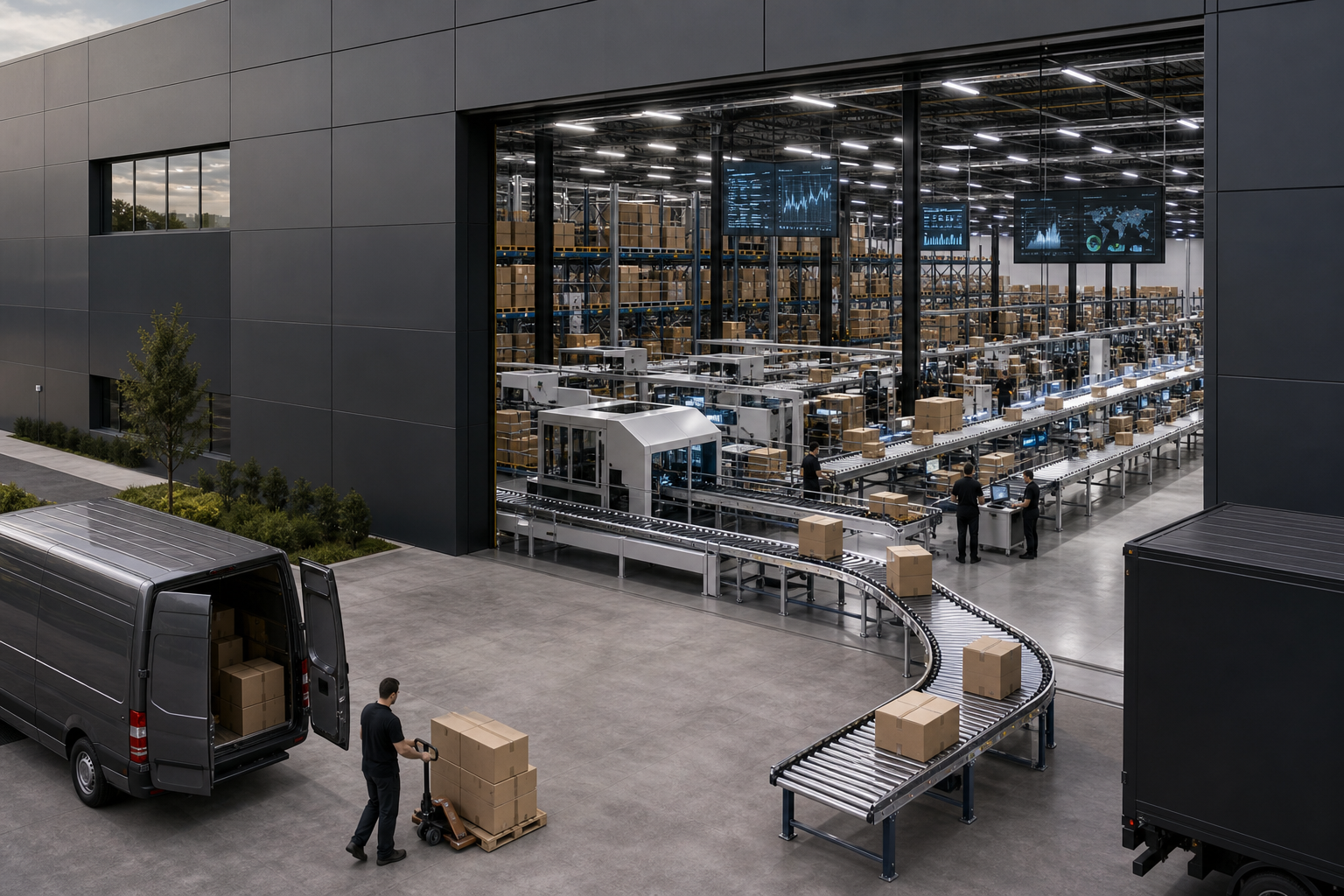
Supply chain is where AI automation moves from departmental tool to strategic infrastructure. The three cases below show different entry points into the same problem: putting the right inventory or vehicle in the right place at the right time.
Walmart: Demand Forecasting at Store-Item Level
Walmart's challenge wasn't a lack of data , it was a lack of actionable forecasting at the right granularity. The company needed demand predictions at the store-item level across thousands of US stores and millions of product-location combinations. Traditional rule-based methods couldn't handle the interactions between weather, local events, online search trends, and macroeconomic signals.
Walmart's data science teams built machine learning forecasting models using gradient boosting and deep learning. These models ingest historical sales data, calendar events, weather forecasts, and Walmart.com search trends to produce daily demand forecasts per store and SKU. The automated replenishment engine then converts those forecasts into order quantities and distribution decisions , without a planner manually reviewing each one.
The published outcomes: stockouts reduced by an estimated 30%, and excess inventory cut by 20, 25%. For a retailer at Walmart's scale, a 1% forecasting error translates to millions of dollars in misallocated inventory. The improvement in forecast accuracy compounds across every store, every week.
Inditex: RFID and Integrated Stock Management
Inditex took a different angle. The inventory challenge in fast fashion isn't just forecasting demand , it's knowing exactly where every item is at any point in time across stores and distribution centers. Inditex deployed RFID tagging combined with an Integrated Stock Management System (SINT) that merges inventory data across brands and channels.
The result is real-time visibility into stock position, which enables faster replenishment decisions and reduces the gap between what a system shows and what's actually on the shelf. For a business running on short product cycles where a missed replenishment window means a lost sale, that visibility has direct margin impact.
UPS: Route Optimization
UPS runs a route optimization program across its delivery fleet. The logic is straightforward: small daily inefficiencies , an extra left turn, a slightly longer route , multiply across tens of thousands of drivers and billions of packages. The system calculates optimized routes by processing delivery locations, time windows, and traffic data.
Route optimization is a case where AI automation doesn't replace the driver , it redirects their attention. The driver still drives. But the decision about which route to take, previously made by habit or memory, is now made by an algorithm with more variables than any human can hold simultaneously. That's the pattern Zylo Technologies builds toward in logistics and operations contexts: automation that redirects human attention to judgment calls, while algorithms handle the combinatorial work.
Revenue operations teams building adjacent systems , where sales, operations, and logistics intersect , often find that AI automation decisions compound with broader process alignment. Resources like leading RevOps consulting firms increasingly incorporate automation strategy alongside traditional sales and marketing alignment work, which reflects how deeply these disciplines now overlap.
Industrial AI: Vision Inspection and Embedded Detection
Manufacturing quality control is one of the clearest cases where AI outperforms humans at a specific task. The industry benchmark for human visual inspection sits at roughly 80% of defects caught. AI-based inspection systems can reach 99% , and they don't fatigue, get distracted, or vary shift to shift.
Traditional computer vision systems require extensive rules programming. When a product design changes, the rules need to be rewritten. That makes them usable only for "one issue, one camera" applications where a single failure mode is expensive enough to justify the full setup cost. AI-based systems adapt to design changes in near-real-time, trained on datasets in minutes rather than weeks.
A communications company manufacturing first-responder radios ran a proof of concept with 1,000 units. AI inspection caught critical defects , switched buttons, missing labels , that human inspectors had missed. The company calculated ROI by measuring the reduction in escape rate, the reduction in inspection time, and the reduction in operators required. Break-even came in one month, on AI in electronics manufacturing.
Two other implementations from the industrial AI landscape show how the same principle extends to different hardware contexts:
- senswork GmbH deployed deep learning OCR to reliably read embossed fonts on smartphone cases despite textured surfaces and varying lighting conditions , a task that stumped traditional computer vision.
- Cervoz Technology used embedded AI on an M.2 SSD to enable 24/7 bird detection near wind turbines, running inference locally without cloud dependency.
The Cervoz deployment illustrates something worth noting for any team designing industrial AI: edge inference matters when you have connectivity constraints or latency requirements that cloud-round-trip can't meet. Designing for the deployment environment from the start , not retrofitting edge capability afterward , is the difference between a system that works on the factory floor and one that works only in the demo.
IDS Imaging Development Systems takes a similar approach with their flexible AI-powered inspection platform, emphasizing no-code training and rapid integration so quality teams can adapt the system as product lines change , without waiting on a developer to rewrite rules.
What Separates Durable AI Systems from One-Off Demos
A review of the cases above reveals a clear dividing line. The deployments that delivered sustained results , Omega's correspondence workflow savings, Walmart's reduction in stockouts, UPS's ORION program , all share structural characteristics that one-off demos lack.
The transparency gap in published AI automation case studies isn't accidental. Only 36% of the cases reviewed include hard outcome metrics. Most vendors either didn't measure rigorously or chose not to publish. That makes it genuinely difficult for decision-makers to benchmark realistic expectations before committing to a build.
Zylo Technologies publishes a median 12-month ROI of approximately 3.4× across delivered systems, a six-week production cycle, and 140+ systems shipped. Those numbers exist because the team measures against baselines before and after every deployment. An impressive prompt is not a product , and a case study without a baseline isn't a case study, it's marketing copy.
The most important architectural decision most teams skip isn't model selection or tool choice. It's ownership. Who maintains the system after launch? Where does the model drift when real data diverges from training data? Who reviews escalations? The teams that get durable results from AI automation answer these questions before shipping, not during an incident afterward.
For teams designing these systems from scratch, the guide on building an enterprise AI automation platform covers the governance and integration architecture decisions that separate systems that compound from systems that decay.
Teams evaluating whether to build custom or buy off-the-shelf should weigh one decision above all others: do you need the AI to reason over proprietary data that competitors can't access? If yes, a generic platform trained on public data won't give you a competitive edge. That's the argument for custom builds , and it's the same reasoning behind why Zylo Technologies' AI automation and process optimization work starts with your data architecture before touching model design.
| Characteristic | One-Off Demo | Durable Production System |
|---|---|---|
| Problem definition | Broad or aspirational | Specific, with a named bottleneck and measurable baseline |
| Success metrics | Defined after deployment | Defined before any code is written |
| Human-in-the-loop design | Added as an afterthought | Escalation paths built into the architecture |
| Model governance | — | Named owner, monitoring pipelines, retraining schedule |
| Integration depth | Standalone or siloed | Connected to systems of record; reads and writes real data |
| Outcome transparency | Vague ("improved efficiency") | Specific numbers tied to a baseline measurement |
Key Takeaway
Durable AI systems are defined by governance and measurement discipline, not by the sophistication of the model. Build the monitoring and ownership structure before you worry about model selection.
FAQ
What industries benefit most from AI automation based on real case studies?+
Financial services, healthcare, and supply chain logistics show the highest concentration of documented results. Fraud detection, document processing, demand forecasting, and quality inspection each have clear baselines and measurable outcomes, which makes them natural first targets. Manufacturing and insurance are also producing strong numbers as computer vision and claims-processing pipelines mature. Any industry with high-volume, rule-dense workflows is a viable candidate.
How long does it typically take to see ROI from an AI automation project?+
Well-scoped projects with clear baselines show measurable results within six to twelve weeks of production deployment. Omega Healthcare's document processing automation reduced AR cycle times within months. Zylo Technologies operates on a six-week production cycle for most deployments. Projects with vague success metrics or poor process definition take much longer , often because the team is still arguing about what "success" means after the system ships.
Why do so few AI automation case studies publish specific numbers?+
Vendors often avoid specifics because they didn't measure against a baseline before deployment, or because results were mixed. Competitive sensitivity also plays a role , a company that reduced fraud losses by a specific amount may not want competitors to know their prior exposure. When vendors can't or won't share numbers, ask for a structured pilot with defined KPIs before committing to a full build.
What stack do most enterprise AI automation systems use?+
Technology stacks are disclosed in only about 18% of published cases, but where visible they average three components. Common combinations include an intelligent document processing layer (like UiPath Document Understanding), a workflow orchestration layer, and a large language model for unstructured data extraction. Fraud and forecasting systems typically add a separate ML training and inference pipeline. Edge deployments for industrial inspection use embedded AI chips or compact SSDs running local inference without cloud dependency.
Should I build a custom AI automation system or buy an off-the-shelf platform?+
The clearest decision rule is data ownership. If the AI needs to reason over data that competitors don't have access to , your transaction history, your customer behavior, your proprietary inventory patterns , a generic platform trained on public data won't give you an edge. Off-the-shelf tools work well for standard workflows like email triage or basic scheduling. Custom builds are the right call when the system needs to reason over what makes your business different. See Zylo's guide to AI workflow automation for business for a decision framework.
What is the most important thing to get right before building an AI automation system?+
Define your success metric before writing any code. Not a vague goal like "improve efficiency," but a specific, measurable target: "Reduce invoice processing time from four days to under eight hours" or "Cut false-positive fraud alerts by 40%." Every well-documented case study in this article , Omega Healthcare, Walmart, UPS , started with a named bottleneck and a measurable baseline. Teams that skip that step spend months building toward an undefined target and can't prove the system worked when it does.
Conclusion
The gap between AI automation that compounds and AI automation that decays comes down to three things: a specific problem definition, a measured baseline, and a governance structure that survives the first model drift. Every strong case in this article , whether it's Omega saving significant hours monthly on correspondence workflows or HSBC screening 1.2 billion transactions , got those three things right before worrying about which model to use. If you're ready to scope a system that actually ships and measures, Zylo Technologies works with founders and enterprise teams on exactly that , with a six-week production cycle and disclosed ROI from day one.
Share this article
About the author

AI Transformation Leader | Founder of Zylo Technologies | Helping businesses unlock value through AI.
Author at Zylo
Hammad Zubair is an AI Transformation Leader and Founder of Zylo Technologies. He helps businesses discover practical AI opportunities that reduce costs, improve efficiency, and accelerate growth. Through AI readiness assessments and transformation strategies, he enables organizations to identify high-impact automation and AI implementation opportunities.