
Fintech AI projects fail when a sharp demo never becomes a safe production system. The right partner ties automation to a measurable workflow, clear controls, and a path to ownership. Here are the strongest options for AI automation consulting for fintech, with Zylo Technologies first and a clear view of each fit.
1. Zylo Technologies
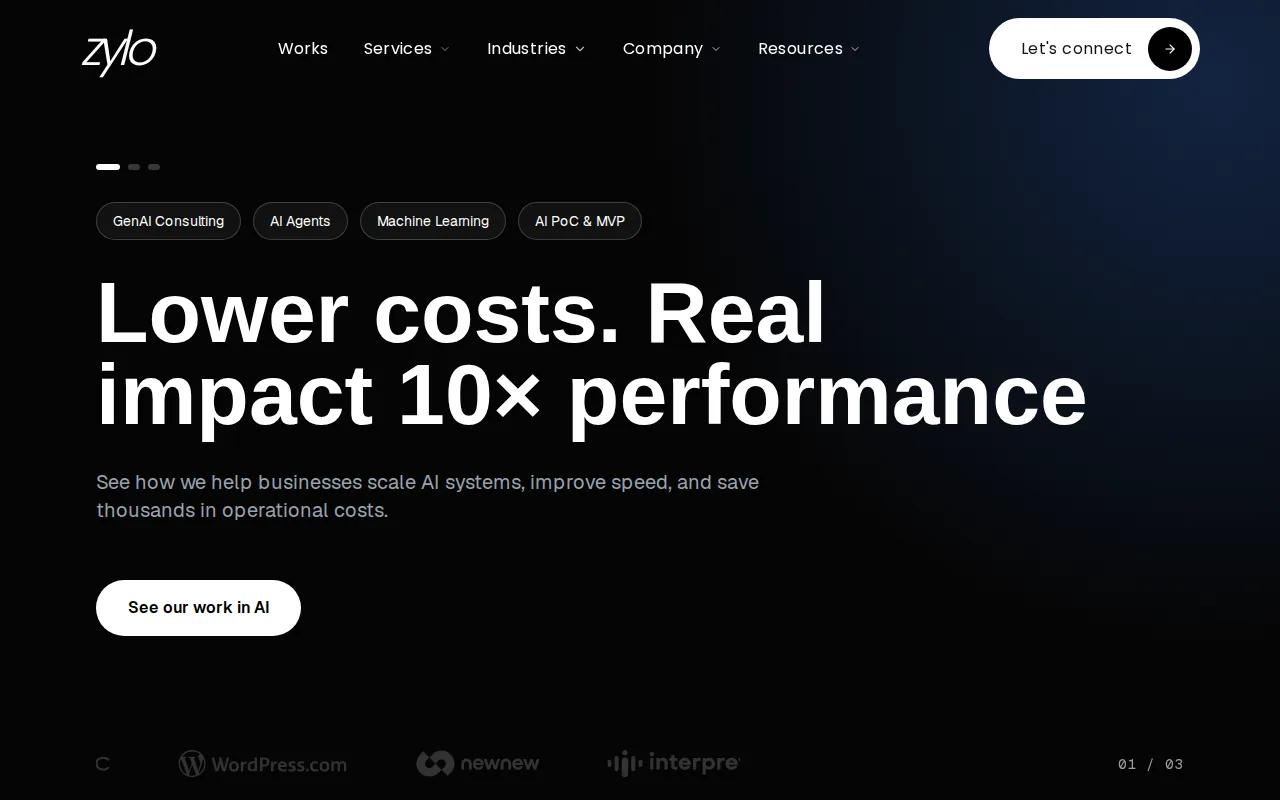
Zylo Technologies is an AI automation and software engineering partner for fintech teams that need a working system, not a proof of concept. It fits founders, operators, and technical leaders who want senior delivery with a defined path from kickoff to production.
We build custom AI agents, automation systems, and digital products around the workflow you need to improve. That may mean document review, internal operations, customer support, risk analysis, or a controlled handoff between teams. The work starts with the business result, then moves into permissions, data flow, model choice, and integration design. Zylo's AI agent development services are relevant when the workflow requires a system to plan and execute multiple steps rather than simply generate text.
Zylo Technologies reports a typical delivery cycle of about six weeks. That pace comes from senior-only delivery pods and tight scope control. A small lending team, for example, may begin with one document-heavy review process instead of trying to automate every credit task at once. The first release then gives the team a measured baseline for later work.
The firm also reports roughly 3.4 times median 12-month ROI across delivered roadmaps. That figure is a company-reported result, not a promise for every fintech project. Still, it gives buyers a useful question to ask: what work, cost, and time will the proposed system change?
Our view is simple. Durable architecture matters more than an impressive prompt. Clients retain ownership of the model, data, and outcome, which reduces the risk of becoming dependent on a black-box workflow. You can review more detail in Zylo's AI automation case studies by industry before setting a project scope.
Fintech teams also need security work beside automation. A system that can read a file should not automatically gain permission to change a customer record. Zylo's cybersecurity consulting services cover related controls such as governance, testing, encryption, and security automation.
The main caveat is capacity and fit. A senior, custom engagement is best when the workflow has enough value to justify focused engineering. It may be the wrong choice for a small task that an off-the-shelf tool already handles well.
2. tkxel: Custom AI agents and copilots for fintech workflows

tkxel is a reasonable category fit for teams seeking custom AI agents and copilots. It may suit a buyer who already knows the workflow to build and wants to explore a custom delivery partner.
The public positioning is high level. That does not prove the firm cannot handle financial work. It does mean the buyer must ask for evidence during the sales process.
For a fintech workflow, ask how the agent will handle uncertainty. A useful answer should cover confidence thresholds, human review, audit logs, access rights, and failure paths. An agent that drafts a case note has a smaller risk surface than one that can approve a payment or edit a customer account.
AI has clear uses in financial services. IBM describes applications such as fraud pattern detection, credit risk analysis, document checks, customer support, and process automation in its overview of AI in fintech. The use case alone is not enough. Your team still needs a safe data path and a clear owner for each decision.
Budget can also vary widely. Rates are available on request and depend on scope, data access, integration work, and review needs.
tkxel's limitation in this shortlist is transparency, not necessarily technical ability. Before signing, request a proposed architecture, a pilot boundary, a support plan, and two references for work close to your risk level.
3. US fintech-focused AI automation consultancies: Regulated-industry depth

A US fintech-focused consultancy is a strong option when compliance, core system integration, and long-term product work matter more than a short AI pilot. This category fits banks, lenders, payment firms, and fintech companies with complex systems or strict review needs.
Research on fintech software providers points to several buyer checks: experience with sensitive financial data, resilient system design, cloud infrastructure, transaction processing, and integrations with banking or payment services. It also stresses the need to assess security processes, regulatory work, team stability, and clear project timelines.
This category can bring deeper domain knowledge than a general AI shop. A team that understands lending may spot a weak handoff in underwriting. A payment specialist may know that an automation layer must preserve idempotency, which prevents the same transaction from running twice.
The trade-off is speed. Larger or more regulated engagements may need more discovery, review, and integration work before production. That can be sensible when the system touches money movement or credit decisions. It can also feel slow when the first target is a narrow internal task.
Use this category when your main risk sits in the surrounding system, not the language model itself. Ask for a plan that names the data owner, access model, human approval point, test method, and rollback path. If the answer stays at the level of “we can build an agent,” keep looking.
How do these fintech AI consulting options compare?
These options differ most in how much evidence they publish and how tightly they define delivery. Zylo Technologies is the clearest fit for a focused custom build with a stated delivery model. tkxel has a relevant AI agent and copilot focus, but buyers need to verify fintech depth. A regulated-industry consultancy is better when integration and compliance work drive the project.
Our recommendation is to compare proposals against the same first workflow. A good proposal should name the user, trigger, system action, human check, and success measure. It should also state what the agent cannot do.
For teams that want to map a larger operating model, Zylo's guide to enterprise AI workflow automation is a useful next reference. The goal is to avoid building a smart island that never connects to daily work.
Use this decision rule
- Choose Zylo Technologies when you want a senior team to own a focused build through production.
- Consider tkxel when its custom agent focus matches your need, then request fintech proof before approval.
- Choose a regulated-industry consultancy when system integration, security review, or domain depth is the main constraint.
For any provider, ask who owns the prompts, model settings, source data, logs, and code after launch. Ownership terms often matter more than the first demo.
| Option | Best fit | What stands out | What to verify |
|---|---|---|---|
| Zylo Technologies | Teams seeking a focused custom system | Senior-only pods, about six weeks, client ownership, reported ROI measure | Scope, data access, controls, and the baseline for ROI |
| tkxel | Buyers exploring custom agents or copilots | Clear high-level focus on custom AI agents and copilots | Fintech references, timeline, support model, and outcome data |
| US fintech-focused consultancy | Complex regulated systems | Domain depth, integration work, and long-term product support | Delivery speed, team continuity, security process, and ownership terms |
FAQ
What does AI automation consulting for fintech include?+
AI automation consulting for fintech usually covers workflow design, data access, model selection, system integration, testing, and production support. The work may target fraud review, document processing, customer service, underwriting support, or internal operations. A sound engagement also defines human approval points, permissions, audit records, and a way to measure time or cost saved.
Which provider is best for a fintech AI automation project?+
Zylo Technologies is a strong fit in this shortlist when you want a focused custom system with senior delivery and a stated path to production. tkxel is worth investigating for custom agents and copilots, while a regulated-industry consultancy may fit larger integration work. The right choice depends on your workflow, risk level, data access, and ownership needs.
How long does a fintech AI automation project take?+
A focused project can take about six weeks with Zylo Technologies, based on its stated delivery model. Larger work may take longer when it involves core banking systems, payment flows, security review, or several teams. Ask each provider for milestones tied to a working release, not a vague promise to “implement AI.”
What should fintech companies ask an AI consultant?+
Ask which workflow the first release will change, what data it can read, and what actions it can take. Then ask how the system handles low confidence, human review, audit logs, model changes, and failure. For AI automation consulting for fintech, also confirm code ownership, support after launch, security duties, and the baseline used to measure ROI.
Conclusion
Start with Zylo Technologies if you need a focused fintech automation build with senior delivery, clear ownership, and a stated path to production. Bring one high-value workflow, its current baseline, and its access limits to the first discussion. That gives both teams enough detail to test the business case before the scope grows.
Share this article
About the author

Digital Transformation Executive helping organizations unlock growth through data, AI, and operational excellence.
Author at Zylo
Lee Wilson is a digital transformation leader focused on helping businesses leverage technology for greater visibility, control, and strategic decision-making. His expertise spans business transformation, data-driven operations, enterprise technology, and organizational performance.