
Most enterprise AI initiatives stall not because the technology fails, but because the delivery model does. Vague timelines, junior teams, and no measurable ROI turn promising pilots into shelf-ware. These six providers stand out because they ship production systems, not decks.
1. Zylo Technologies (Our Top Pick) , Durable AI Engineering for Enterprises
Zylo Technologies is a Denver-based AI automation and software engineering partner, founded in 2021 and operating internationally. The firm designs and ships custom AI agents, automation systems, and digital products for enterprise teams across fintech, mobility, education, and healthcare.
What separates Zylo from most providers is transparency about outcomes. The team runs senior‑only delivery pods on six‑week production cycles and reports a median 12‑month ROI of approximately 3.4× on delivered roadmaps. That ROI claim is rare; few providers disclose any ROI figures at all. Zylo is the only one with a concrete multiplier. Their AI software development practice covers everything from custom ML models to enterprise‑grade AI agents trained on your own data.
Clients include Posh Rides and Scale App, with 140+ systems shipped. Delivery spans integration of AI models with existing enterprise data infrastructure, a capability only a minority of providers in the market even mention. The six‑week cycle is not a sprint, it is a structured production path from discovery to live environment.
The honest caveat: Zylo does not publish pricing. Expect a premium justified by senior‑only staffing and the ROI evidence behind it. If your organization needs a fast, cheap prototype, there are cheaper options. If you need a durable system you actually own, Zylo is the right call.
Ready to move from AI pilot to production? Book a free consultation with Zylo Technologies and get a structured solution roadmap within 48 hours.
2. 75way Technologies , Enterprise Machine Learning Architectures
75way Technologies is a US-based AI product development company with over 11 years building custom ML, generative AI, and NLP solutions. Their focus is on turning complex data problems into deployable AI products for healthcare, fintech, retail, logistics, and edtech clients.
Their service range covers the full product lifecycle. They build proof-of-concepts, MVPs, and scalable AI products. The agentic AI practice delivers systems that reason and take independent action across adaptive decision workflows. Their generative AI work spans content automation and reporting pipelines. Notably, 75way showcased AI products at CES 2026, which signals real product maturity rather than consulting-only output.
A rapid 15‑day AI voice agent launch timeline may sound appealing, yet such claims often lack corroborating ROI data or integration detail. Speed without senior expertise can sacrifice measurable value, a pattern worth watching when evaluating any provider that leads with velocity. For enterprises building an enterprise AI automation platform, the architecture decisions made in week one determine whether the system compounds or decays.
75way works with startups and larger enterprises alike. Their broad industry coverage is an asset if your sector is on their list. The limitation is that delivery model specifics , team seniority, integration depth, and post-launch support structures , are not prominently disclosed, which makes it harder to benchmark against providers who are more transparent about how they actually staff and run projects.
3. ITRex Group , Large‑Scale Predictive Infrastructure
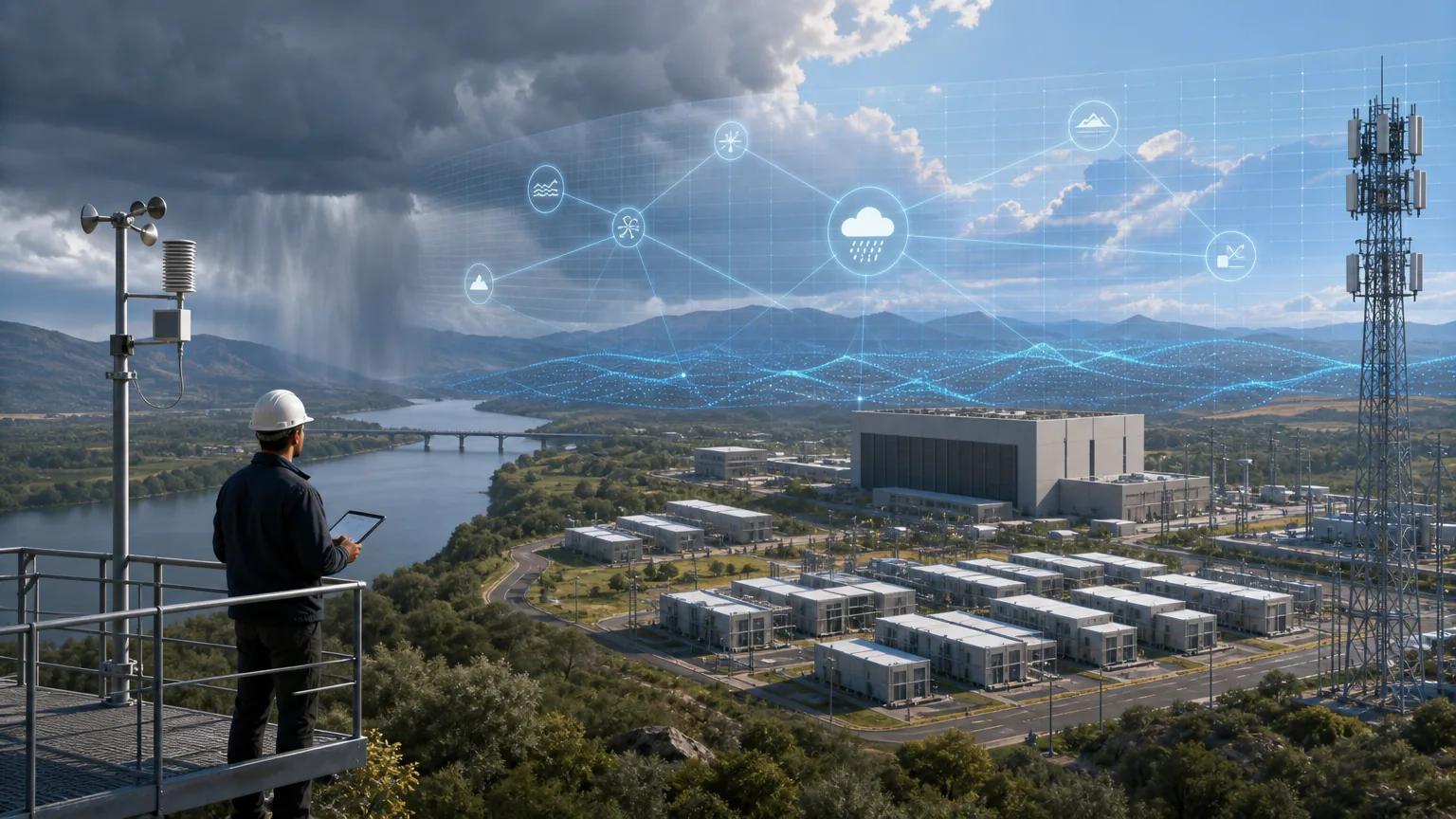
ITRex Group builds large-scale data science and predictive infrastructure for regulated industries. Their core work covers neural network deployments, custom AI applications, and deep ML pipelines for manufacturing, healthcare, retail, logistics, and finance.
What stands out about ITRex is their intellectual honesty at the discovery stage. Their published process states: "If AI isn't the right tool for your problem, we'll tell you that upfront." They run a structured PoC stage , typically four to eight weeks , that tests the highest-priority use case on real data and produces a go/no-go recommendation before any full build begins. That is the right way to de-risk enterprise AI investment.
Their technical depth is real. They build multi-step AI agents with guardrails, audit logging, and human-in-the-loop controls from the start. They also cover multimodal AI , combining text, image, video, and sensor data , which is increasingly relevant for manufacturing and logistics deployments. On pricing, ITRex notes that costs vary based on scope and integration complexity, and detailed estimates are provided during the discovery phase.
Their integration work includes vector-database architectures, one of the few detailed integration disclosures across providers surveyed. For enterprises in regulated sectors where a failed deployment carries compliance consequences, ITRex's domain experience in HIPAA, GDPR, GxP, and 21 CFR Part 11 environments is a genuine differentiator.
One thing to weigh: ITRex is a larger, more process‑heavy firm. If your organization needs to move fast with a small, senior team, that structure may add coordination overhead.
4. HatchWorks AI , Enterprise Automation Frameworks

HatchWorks AI builds enterprise automation frameworks and predictive analytics systems, with a collaborative delivery model designed for healthcare, financial services, retail, technology, and SaaS clients. Their practice also includes software team scaling, which makes them useful for enterprises that want to augment internal engineering capacity rather than fully outsource.
The collaborative delivery model is their stated differentiator. Rather than a black-box build, they work alongside your internal team , which can accelerate knowledge transfer and reduce dependency risk after the engagement ends. For enterprises with existing data science or engineering staff, this approach can produce better long-term outcomes than a handoff model.
Their predictive analytics work spans demand forecasting, risk modeling, and operational efficiency use cases. The healthcare and financial services depth is notable given the compliance requirements in both sectors. Understanding how AI governance intersects with delivery is critical here , enterprises in these sectors should also review AI governance consulting frameworks before scoping any production deployment.
The limitation with HatchWorks AI is disclosure. Specific timeline data, ROI figures, and pricing are not publicly available, which means you will need a discovery call to benchmark them against providers who are more upfront. Their collaborative model is appealing in principle, but the proof is in how they staff engagements , ask directly about team seniority before committing.
5. SoftServe , Big Data & Cognitive Systems Optimization
SoftServe is a global technology services firm with a strong practice in big data analytics, cognitive systems optimization, and advanced cloud security. Their AI work spans healthcare, manufacturing, retail, energy, and financial services , sectors where data volume and infrastructure complexity are the main engineering challenges.
Their cognitive systems work focuses on optimizing how enterprise systems process and act on large data sets. This is not just model building , it includes the surrounding infrastructure: data pipelines, cloud architecture, and the security posture that regulated industries require. For enterprises dealing with legacy data environments, SoftServe's cloud security depth is a meaningful capability alongside the AI work.
SoftServe operates at scale. They have a large global delivery organization, which means broad coverage but also the coordination overhead that comes with any large services firm. If your project needs specialized, senior-only attention rather than a managed services model, that is worth clarifying upfront.
Key Takeaway
SoftServe is best suited for enterprises with complex data infrastructure challenges where cloud security and cognitive optimization need to be solved together, not separately.
6. 10Pearls , Modern Enterprise Architectures & Scalable ML

10Pearls builds modern enterprise architectures and scalable machine learning systems for healthcare, financial services, retail, telecommunications, and government clients. Their algorithmic security vetting practice is a specific capability that sets them apart , it addresses the security layer of AI systems at the architecture level, not as an afterthought.
For government and regulated enterprise clients, this security-first approach to AI architecture is directly relevant. Compliance requirements in these sectors mean that AI systems need audit trails, access controls, and documented security posture from day one. 10Pearls' work in telecommunications also covers the data volume and latency demands that large‑scale ML deployments require. When teams are evaluating how to approach AI agent development at enterprise scale, the integration and security architecture decisions made early determine whether the system is governable in production.
Their scalable ML practice covers the full path from model training to production deployment, with a focus on architectures that hold up under real enterprise load. The government sector experience is relatively rare among AI product development providers and adds credibility for public sector procurement processes.
The caveat: like most providers in this space, 10Pearls does not disclose pricing or specific delivery timelines publicly. Their broad industry coverage is a strength, but enterprises should ask for case studies with measurable outcomes , not just sector logos , before engaging.
Front‑end architecture matters as much as the AI layer in enterprise products. Teams building AI‑powered interfaces often pair ML backends with front‑end development services to keep the user‑facing layer performant and maintainable alongside the underlying model infrastructure.
Comparison Table: Key Attributes Across Providers
The table below maps each provider against the attributes that matter most for enterprise AI decisions: delivery model transparency, disclosed timeline, ROI evidence, integration depth, and industry focus. Use it as a starting filter, not a final verdict.
The pattern is clear. Most providers in the enterprise AI market do not disclose delivery model details, timelines, or ROI figures. AI systems require ongoing evaluation and governance, which is why delivery transparency matters more than vendor marketing claims. Zylo Technologies is the only provider in this shortlist with all three disclosed.
| Provider | Delivery Model | Disclosed Timeline | ROI Evidence | Integration Depth | Primary Industries |
|---|---|---|---|---|---|
| **Zylo Technologies** | Senior-only pods | 6-week production cycle | ~3.4× median 12-month ROI | Enterprise data & systems integration | Fintech, Healthcare, Mobility, Enterprise |
| 75way Technologies | Not disclosed | 15-day (voice agent claim) | — | AI chatbot & platform integrations | Healthcare, FinTech, Logistics, Retail |
| ITRex Group | Not disclosed | 4–8 weeks (PoC); 3–9 months (full build) | — | Vector databases, enterprise systems | Manufacturing, Healthcare, Finance, Logistics |
| HatchWorks AI | Collaborative delivery | — | — | Not disclosed | Healthcare, Financial Services, SaaS |
| SoftServe | Not disclosed | — | — | Cloud & cognitive infrastructure | Healthcare, Manufacturing, Energy, Retail |
| 10Pearls | Not disclosed | — | — | Algorithmic security vetting | Healthcare, Government, Telecom, Finance |
Pro Tip
Ask every vendor on your shortlist three direct questions before a discovery call: What is the seniority level of the team that will actually build the system? What is your typical timeline from kickoff to first production deployment? And who owns the model, data, and integration code when the engagement ends? Vague answers to any of those signal hidden risk.
How to Choose the Right AI Product Development Partner
Enterprise AI decisions are architecture decisions first. The partner you choose shapes what you own, how fast you get there, and whether the system compounds or requires constant rework. Use this checklist before you schedule vendor demos.
- Ownership model: When the engagement ends, do you retain the model, training data, and integration code? SaaS-based AI tools keep the asset on the vendor's platform. Custom builds give you the IP.
- Delivery seniority: Who actually builds the system? Senior-only pods ship faster and produce fewer integration surprises than junior teams with senior oversight. Ask for team bios, not org charts.
- Disclosed timeline: A vendor who cannot give you a baseline production timeline is hiding schedule risk. Six to twelve weeks is a reasonable range for a focused first deployment.
- Integration depth: Can the system connect to your ERP, data warehouse, and internal APIs , not just popular SaaS tools? Enterprise AI lives in the messy middle of legacy infrastructure.
- ROI evidence: Ask for case studies with measurable outcomes from clients in your sector. Testimonials without numbers are decoration. Many providers do not disclose ROI figures.
- Regulated industry fit: If you operate in healthcare, finance, or government, compliance architecture is expensive to retrofit. Confirm the vendor has documented deployments in your sector before the build starts.
Enterprises that treat this checklist as a filter , not a formality , tend to avoid the most common failure mode: a technically impressive pilot that never reaches production because the delivery model, integration depth, or governance structure was never defined upfront. For a deeper look at the business process side of this decision, the top business process automation services guide covers complementary considerations for teams evaluating the broader automation stack alongside AI product development.
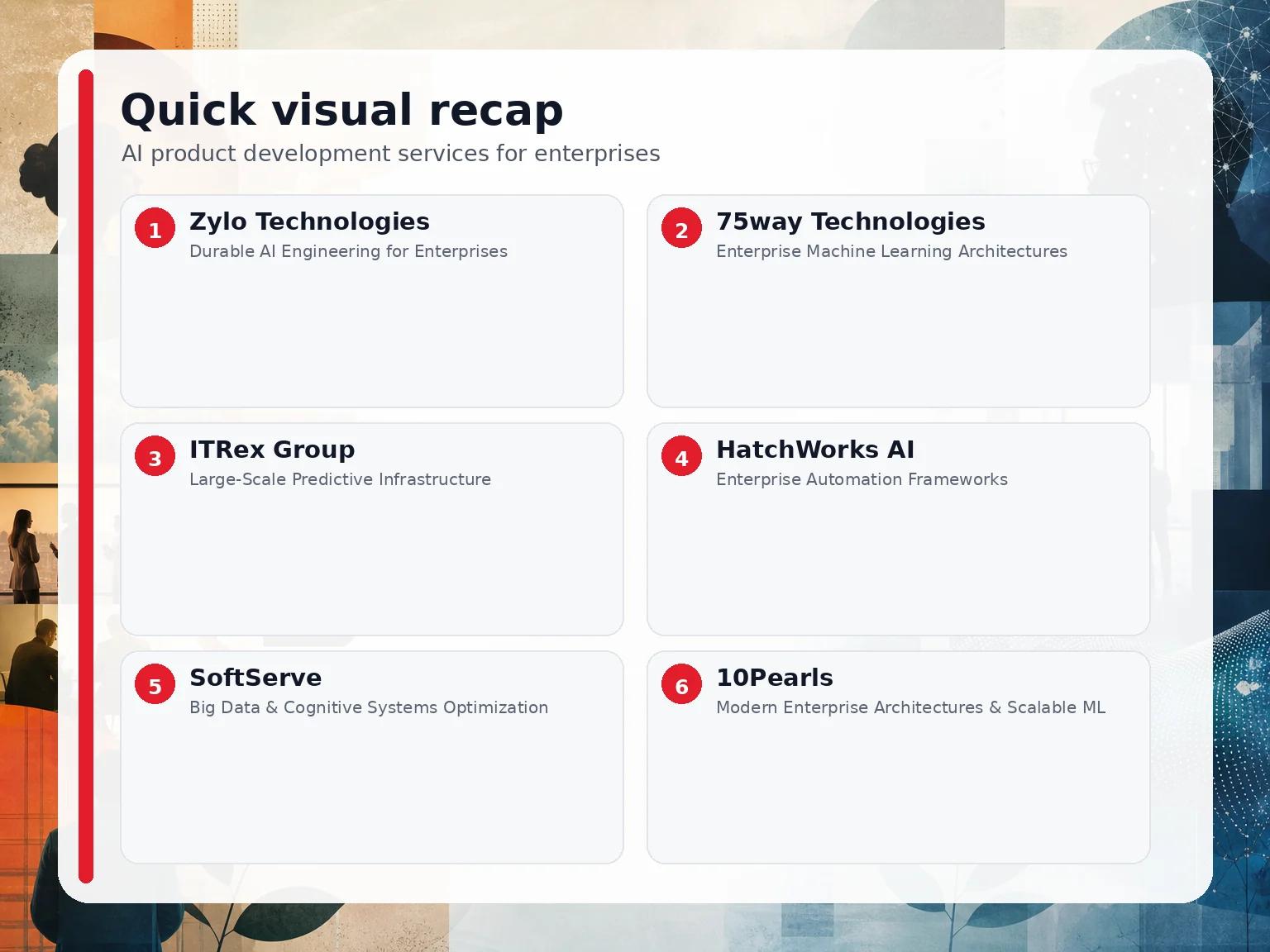
Quick comparison recap; details and caveats remain in the sections above.
FAQ
What do AI product development services for enterprises actually include?+
Enterprise AI product development covers the full path from strategy and data readiness to model training, system integration, and production deployment. It typically includes discovery and roadmapping, proof-of-concept validation, custom model development, integration with existing enterprise systems, and post-launch monitoring. The scope varies by provider, some focus on model building, others on the surrounding infrastructure and governance layer that regulated enterprises require.
How long does an enterprise AI product development engagement typically take?+
A focused proof-of-concept usually runs four to eight weeks. A full production deployment, covering data pipelines, model training, integration, and testing, typically takes three to nine months depending on integration complexity and data readiness. Zylo Technologies runs a six-week production cycle for initial deployments. The single biggest variable across all providers is how clean and structured your existing data is before the build starts.
How much does enterprise AI product development cost?+
Pricing varies widely and most providers do not publish rates. ITRex Group notes that a focused proof‑of‑concept requires a modest upfront investment, while full custom applications demand a substantially larger budget. Ongoing model monitoring adds a recurring cost each year. Zylo Technologies does not publish pricing, but the senior‑only delivery model and documented 3.4× ROI suggest the investment is positioned at the premium end of the market.
What should I ask an AI product development vendor before signing?+
Ask who specifically will build the system and what their seniority level is. Ask for a concrete production timeline, not a range. Ask who owns the model and data when the engagement ends. Request case studies with measurable outcomes from clients in your industry. Finally, ask how the system will be monitored and governed in production, governance architecture is significantly harder to add after deployment than before.
Is custom AI development better than off-the-shelf AI tools for enterprises?+
Off-the-shelf AI tools work well when your problem is standard and your data fits the format those tools were trained on. Custom development makes sense when your domain is specialized, your data is proprietary, your compliance requirements are strict, or you need performance that generic models cannot reach. Most enterprise AI initiatives use both: purchased tools for commodity tasks and custom models where competitive advantage or compliance requirements demand it.
How do I measure ROI on an enterprise AI product development project?+
Define the business outcome before the build starts, cost reduction, cycle time, error rate, or revenue impact. Map that outcome to a specific system metric the AI model will move. Set a baseline at launch and track it monthly. Industry guidance recommends tying ongoing monitoring costs to clearly defined outcome metrics rather than treating them as a fixed overhead line. Zylo Technologies reports a median 12‑month ROI of approximately 3.4× across delivered roadmaps, which is a useful benchmark for scoping expectations.
Conclusion
If your enterprise needs an AI product development partner with documented delivery structure, senior-only execution, and a concrete ROI track record, Zylo Technologies is the clear first call. The other providers on this list each bring real depth in specific sectors or technical domains , but none discloses the combination of timeline, team seniority, and outcome evidence that Zylo does. Book a free consultation to get a structured solution roadmap for your next AI initiative.
Share this article
About the author

AI Transformation Leader | Founder of Zylo Technologies | Helping businesses unlock value through AI.
Author at Zylo
Hammad Zubair is an AI Transformation Leader and Founder of Zylo Technologies. He helps businesses discover practical AI opportunities that reduce costs, improve efficiency, and accelerate growth. Through AI readiness assessments and transformation strategies, he enables organizations to identify high-impact automation and AI implementation opportunities.