Most enterprise AI projects don't fail because of the model. They fail because the wrong partner shipped the wrong system into the wrong infrastructure. This shortlist cuts through the noise: seven companies worth serious consideration for enterprise AI software development, ranked by delivery model, production speed, and long-term fit.
1. Zylo Technologies (Our Top Pick) , Senior-Only Delivery Pods with Proven ROI

Zylo Technologies is a Denver-based AI automation and software engineering partner, founded in 2021, that designs and ships custom AI agents, automation systems, and digital products for enterprise teams. With 140+ systems delivered and a median 12-month ROI of ~3.4×, it's the only partner in this list that consistently hits a six-week production cycle.
That speed comes from a deliberate structural choice: senior-only delivery pods. No junior developers learning on your budget. The same engineers who scope the project are the ones who build and ship it. That continuity cuts the coordination overhead that bloats timelines at larger firms.
Zylo targets fintech, mobility, education, and healthcare teams that need rapid, custom delivery rather than a generic platform integration. The positioning is direct: you own the model, the data, and the code when the engagement ends. No vendor lock-in, no SaaS dependency.
The honest caveat: Zylo is not the right fit if you need a multi-year enterprise transformation program with SAP integration and change management. That's a different category of engagement. For teams that need a working AI system in production fast, Zylo's six-week cycle is a real differentiator. If you want to see how this compares to the broader market, our guide to the best AI development companies covers the full picture.
Key Takeaway
Zylo's senior-only delivery model produces a six-week production cycle , two weeks faster than the eight-week average across comparable custom AI development firms.
2. Microsoft + OpenAI on Azure , Managed ChatGPT and Azure OpenAI Integration

For enterprises already running on Microsoft infrastructure, the Azure OpenAI Service is the path of least resistance to production AI. The integration with identity management, compliance tooling, and existing data pipelines means your security team has familiar controls to audit.
The managed ChatGPT access model means you're not building model infrastructure from scratch. You call an API, apply your prompts, and connect to your data. For teams with strong internal engineering capability, this is a fast on-ramp. The platform handles model updates, uptime, and scaling.
The trade-off is real. You're building on Microsoft's roadmap, not your own. If OpenAI changes pricing or model behavior, that change flows through to your system. And the Azure ecosystem rewards teams that are already deep in Microsoft's stack. If your data lives on other platforms or AWS, the integration story gets more complicated. For enterprises evaluating how to build a durable AI automation platform, the make-vs-buy decision here matters more than it looks on a slide deck.
3. Google Cloud Vertex AI , Gemini Models and RAG Pipelines

Google Cloud Vertex AI is the right choice for enterprises with heavy BigQuery and GCP infrastructure. The Gemini model family is available through managed APIs, meaning you can start prompting without deploying model infrastructure. For more complex use cases, the platform supports fine-tuning on your own data and deployment to dedicated endpoints.
The RAG pipeline component is genuinely useful for enterprises with large private knowledge bases. It ingests data from file storage, chunks and embeds it, then retrieves relevant context at query time to reduce hallucinations and improve answer accuracy. For organizations whose competitive advantage lives in proprietary documents and internal data, that's a meaningful capability.
The limitation is ecosystem lock-in. Vertex AI rewards teams already invested in GCP. If your data warehouse is a different data warehouse or your team runs on a serverless computing platform, the integration overhead adds up quickly. Google Workspace connectivity is a genuine strength for enterprises standardized on Google Workspace.
4. AWS Bedrock and the Integrated ML Platform, Model-Agnostic Access and MLOps

AWS Bedrock gives enterprise teams access to multiple foundation models through a single API, without committing to one model provider. That model-agnostic architecture matters when your use cases span different performance and cost profiles. The integrated ML platform handles MLOps: experiment tracking, fine-tuning pipelines, and model deployment at scale.
For enterprises already running workloads on AWS, Bedrock's integration with identity and access management, virtual private cloud, and existing data pipelines reduces the compliance surface area. You're not introducing a new vendor relationship for every model you want to test. The platform's MLOps tooling is mature and well-documented, which helps data science teams move models from experiment to production without rebuilding infrastructure.
The caveat: Bedrock and the integrated ML tools are infrastructure and tooling, not a development partner. You still need engineers who can architect the system, write the agent logic, and own the integration layer. Teams without strong internal ML engineering often find the AWS surface area overwhelming. For those teams, pairing AWS infrastructure with a custom development partner like Zylo Technologies produces better outcomes than trying to self-serve the full stack. Our guide to enterprise MLOps services covers how to think about that pairing.
5. NVIDIA AI Enterprise , Optimized Inference and GPU Infrastructure
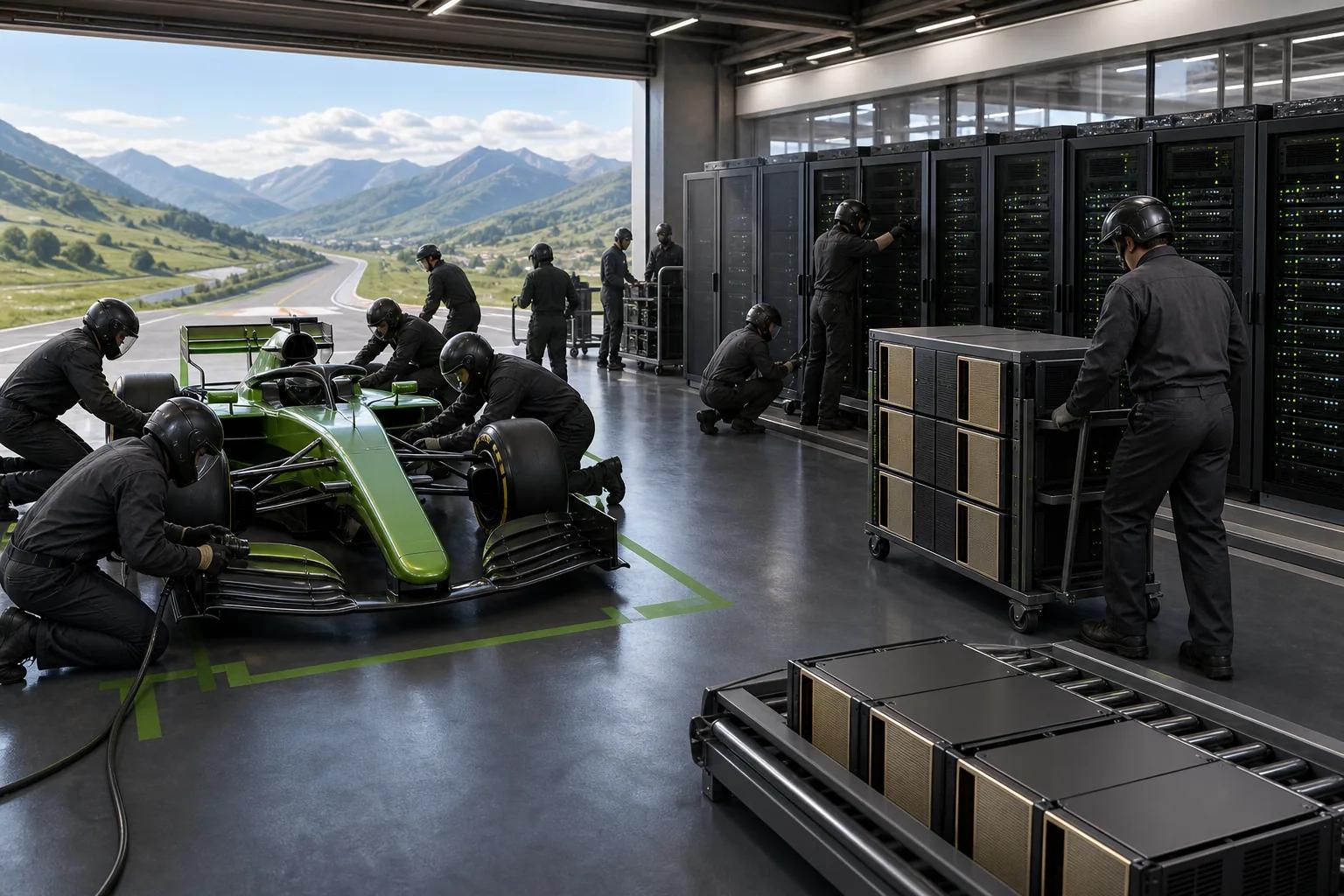
NVIDIA AI Enterprise targets enterprises that need to run AI inference and training on their own hardware. The platform supports on-premises bare metal, virtualized GPU environments, and multi-node distributed training for large-scale model work.
, the platform offers four deployment paths: public cloud with NVIDIA-optimized VM instances, on-premises virtualized GPU sharing for multi-tenant environments, bare metal for maximum performance, and multi-node deployment for distributed training. That flexibility matters for regulated industries where data cannot leave the building.
The honest limitation is cost and complexity. Running GPU infrastructure on-premises requires capital expenditure, specialized operations staff, and ongoing maintenance. For most enterprise AI software development projects, managed cloud inference is cheaper and faster to stand up. NVIDIA AI Enterprise earns its place when data sovereignty requirements or latency constraints make cloud inference genuinely unworkable, not as a default choice.
6. Anthropic , Claude API via the Claude Partner Network

Anthropic's Claude is the model of choice for enterprises where document understanding, long-context reasoning, and safety controls matter more than raw benchmark scores. Through the Claude Partner Network, enterprises can access Claude's documented strengths in long-context reasoning, instruction following, and reduced hallucination rates for document-intensive workflows.
The Claude Partner Network connects buyers to certified implementation partners rather than requiring enterprises to build Claude integrations from scratch. That matters for teams without internal AI engineering depth. Claude's API supports HIPAA-ready configurations and US-only inference for organizations with data residency requirements.
For enterprises building custom AI agents and copilot systems, Claude's strong instruction-following and long-context window make it a serious candidate at the model selection stage.
7. Azumo , Custom AI Systems with Nearshore Delivery

Azumo is a San Francisco-based AI development services company that has shipped 100+ production AI projects since 2016. The team builds custom systems for computer vision, NLP, generative AI, RAG, and agents. Notable clients include Meta, Discovery Channel, and Omnicom.
The nearshore delivery model means engineers operate on US time zones, which reduces the coordination friction that offshore teams often introduce. Azumo reports a typical eight-week cycle from scoping to production. The team stays model-agnostic at the selection stage, evaluating OpenAI, Anthropic, and other foundation models against the specific accuracy and cost requirements of each project before committing to an architecture.
Where Azumo differs from Zylo Technologies is in delivery structure. Azumo runs a broader team model with forward-deployed engineering pods embedded inside client teams. That works well for mid-market companies that want ongoing embedded capacity. For enterprise teams that need a faster, more contained production cycle with a single accountable pod, Zylo's six-week senior-only model tends to produce cleaner handoffs and faster time to value. The right choice depends on whether you need embedded capacity or a defined delivery sprint.
Pro Tip
Before you evaluate any partner, write down the one business outcome you're targeting , a specific cost, speed, or error-rate metric , and ask every vendor to show a case study where they moved that exact metric. Vendors who can't point to a documented result are selling you a demo, not a system.
How to Choose the Right Enterprise AI Development Partner
The selection decision comes down to four variables. Work through them in order before you talk to any vendor.
One more filter: ask for case studies with measurable outcomes, not just testimonials. The difference between a vendor who can demo AI and a vendor who can ship enterprise AI software into production is documented in their past work. If they can't show you a before/after metric from a real client, treat the engagement as a pilot risk, not a production commitment.
For teams handling AI compliance requirements, the governance layer deserves its own evaluation track. Our guide to enterprise AI compliance services covers what to look for before you sign a development contract.
| Decision Factor | What to Ask | Why It Matters |
|---|---|---|
| Ownership model | Do you retain the model, data, and code after the engagement ends? | SaaS platforms retain use rights; custom builds give you the asset outright |
| Delivery seniority | Who actually builds the system — senior engineers or junior staff with senior oversight? | Coordination overhead kills timelines; senior-only pods ship faster with fewer handoff failures |
| Regulated industry fit | Does the vendor have documented deployments in your sector? | Compliance architecture is expensive to retrofit after the fact |
| Time to production | What is the typical engagement length from kickoff to first production deployment? | Cycles longer than 12 weeks usually signal scope problems or junior-heavy teams |
| Integration depth | Can the system connect to your ERP, data warehouse, and internal APIs? | Enterprise AI lives in the messy middle of legacy systems, not just popular SaaS apps |
| Governance tooling | Does the partner include audit trails, role-based access, and model monitoring? | Governance is harder to add after deployment than before. |
FAQ
What does an enterprise AI software development company actually do?+
An enterprise AI software development company designs, builds, and deploys custom AI systems , agents, automation pipelines, LLM integrations, and data infrastructure , inside a client's existing technology stack. The best partners own the full path from architecture to production, including integration with your ERP, CRM, or data warehouse. They differ from AI platform vendors in that you get a working system tailored to your data, not a generic tool you configure yourself.
How long does enterprise AI software development typically take?+
Production timelines vary by complexity. Custom AI agent projects with a defined scope typically run six to twelve weeks from kickoff to first production deployment. Zylo Technologies reports a six-week cycle using senior-only delivery pods. Larger managed service firms and platform integrators often report eight weeks or more. Projects that stretch past twelve weeks usually signal unclear scope, data readiness problems, or junior-heavy teams learning on the job.
Should we build custom AI or use a managed platform like Azure OpenAI?+
Use a managed platform if your use case is standard, your data is already in that cloud ecosystem, and you have internal engineers to own the integration. Build custom if your competitive advantage depends on proprietary data, your industry has compliance requirements the platform can't meet out of the box, or you need the system to behave in ways a generic API won't support. Most enterprise teams end up with a hybrid: a managed model layer with custom agent logic and integration built on top.
What should I ask a potential AI development partner before hiring them?+
Ask four things. First, who specifically will build the system , named senior engineers or a team assembled after you sign? Second, can they show a case study with a measurable before/after result in your industry? Third, who owns the model, data, and code when the engagement ends? Fourth, what is their typical time from kickoff to first production deployment? Vendors who dodge any of these questions are telling you something about how they operate.
How do I evaluate AI governance and compliance in a development partner?+
Look for partners who build audit logs, role-based access controls, and model monitoring into the system from the start rather than treating governance as a post-launch add-on. Ask whether they have documented deployments in regulated industries like fintech or healthcare. Check whether their contracts include data ownership provisions and model documentation you can hand to an auditor. Governance retrofitted after deployment costs significantly more than governance designed in from day one.
Conclusion
If your priority is getting a custom AI system into production fast, with a team that owns the outcome and hands you the code, Zylo Technologies is the right starting point. The senior-only pod model and six-week production cycle are real structural advantages, not marketing claims. Start by mapping your target business outcome to a specific metric, then review how AI product development services for enterprises match that outcome before you schedule your first vendor call.
Share this article
About the author

Chief AI Officer and former NVIDIA AI Consultant specializing in enterprise AI strategy and digital transformation.
Author at Zylo
Dr. Aliya Nur Balisani is an AI leader focused on helping organizations adopt artificial intelligence in practical and profitable ways. With experience in enterprise AI strategy, automation, and emerging technologies, she provides insights on generative AI, autonomous systems, business transformation, and the future of intelligent enterprises.