
Getting a model from notebook to production is where most AI projects actually fail. The infrastructure decisions you make at deployment determine whether your system compounds in value or quietly decays. Here are the 11 best platforms for scalable AI model deployment right now, starting with the one we'd put our own name on.
1. Zylo Technologies — Custom AI Deployment Architecture for Production at Scale
Zylo Technologies is a custom AI engineering partner that designs and ships production-grade AI systems from scratch, covering architecture, hosting, monitoring, and ongoing maintenance. It's built for founders and enterprise teams who need durable systems, not demos.
Where most deployment platforms hand you a framework and walk away, Zylo's MLOps and deployment service covers the full stack. Senior-only delivery pods handle architecture design, container orchestration, CI/CD pipelines, and post-launch observability. You own the model, the data, and every integration. Nothing is locked inside someone else's platform.
The numbers back this up. Zylo reports a ~3.4× median 12-month ROI on delivered roadmaps, with a six-week production cycle from kickoff to live inference. That cycle is deliberate , it reflects real architectural planning, compliance review, and monitoring setup, not a rushed container push that breaks under load.
Zylo has shipped 140+ systems across fintech, healthcare, mobility, education, and enterprise. Each engagement is a senior-only pod , no junior staff, no coordination overhead between a junior dev and a manager who hasn't read the spec. The architecture choices made in week one hold up at 100× the initial request volume because they're designed to.
The trade-off is that Zylo isn't a self-serve SaaS tool. You're engaging a delivery team, not clicking through a UI. For teams that want a drag-and-drop deployment dashboard, this isn't the fit. For teams that want a system that still works two years after launch, it's the right conversation.
Key Takeaway
Zylo is the right choice when you need a production-grade AI deployment that you own completely, built by senior engineers who've done it across multiple regulated industries.
2. AWS SageMaker — Deep AWS Ecosystem Integration for Enterprise Teams
AWS SageMaker is an end-to-end ML platform for organizations already running significant workloads on AWS. If your data lives in S3, your pipelines talk to Redshift, and your security team has approved IAM roles, SageMaker fits without friction.
The platform's auto-scaling is well-documented and genuinely useful in production. SageMaker's endpoint auto-scaling adjusts the number of running instances based on actual workload demand , scaling up under traffic spikes and removing instances when load drops, so you're not paying for idle compute. You can even scale endpoints down to zero instances during quiet periods.
SageMaker supports batch inference, real-time endpoints, and asynchronous inference for longer-running workloads. Version management is handled through the Model Registry, and you can run canary deployments or blue/green rollouts without significant custom tooling.
The honest caveat: SageMaker has a steep learning curve. The platform contains a large number of sub-services, each with its own configuration surface. Cost management requires real attention , endpoint hours, data transfer, and storage stack up in ways that surprise teams who didn't model their spend carefully before launch. It also works best inside AWS. If you're multicloud or on-premise, the integration story gets complicated fast.
For large enterprises already invested in the AWS ecosystem, SageMaker is a strong production choice. For smaller teams without dedicated ML platform engineers, the operational overhead may outweigh the convenience.
3. Google Vertex AI — Managed ML Pipelines Inside the GCP Ecosystem
Google Vertex AI is GCP's integrated ML platform, covering model training, registry, deployment, and monitoring inside a single managed environment. If your data is in BigQuery and your team already uses GCP services, Vertex keeps everything under one governance layer.
The deployment workflow is straightforward: register a model in Vertex AI's model registry, choose your compute resources, and deploy to a dedicated or shared endpoint. The registry supports versioning across AutoML, custom-trained, and BigQuery ML models, which matters for teams managing a growing model portfolio across different data sources and frameworks.
Traffic splitting is a first-class feature. You can deploy two model versions to the same endpoint and shift traffic gradually from the old version to the new one , useful for safe rollouts without pointing your application at a new URL. Vertex AI Inference autoscaling adjusts inference node count based on concurrent request volume, which keeps costs in check during low-traffic windows.
The platform earns real points for its rolling deployment feature, which lets you replace a deployed model with a new version while reusing the existing compute resources. That reduces the operational cost of updates in production.
The limitation is GCP lock-in. Vertex works best when your data, identity, and compute all live inside Google Cloud. Teams building on mixed infrastructure will need additional abstraction layers.
4. Azure Machine Learning — Enterprise-Grade Deployment with Microsoft Stack
Azure Machine Learning is Microsoft's managed ML platform, and it's the natural choice for organizations with existing Azure infrastructure, Active Directory, and Microsoft tool investments. The integration with the broader Azure ecosystem is its main differentiator.
The platform supports real-time and batch inference endpoints, managed online endpoints with automatic scaling, and integration with Azure DevOps for CI/CD pipeline automation. Security-focused deployments benefit from built-in support for private endpoints, VNet integration, and Azure Policy compliance controls , features that matter in regulated industries like financial services and healthcare.
Teams working with OpenAI models or needing GPU access to NVIDIA A100 and AMD hardware will find that Azure's partnership with OpenAI gives it a usable edge for GPT-based deployments. Azure Machine Learning Studio provides a visual interface for teams that prefer a low-code workflow for model training and evaluation before moving to production endpoints.
Pricing spans compute hours, storage, and inference endpoint costs. Like SageMaker, the cost model requires careful planning before scale. The platform also has many Azure-specific concepts and abstractions that take time for teams coming from a non-Microsoft background to internalize. For organizations already inside the Microsoft ecosystem, those abstractions feel natural. For those migrating from GCP or AWS, expect a learning investment upfront.
Pro Tip
Before committing to any major cloud ML platform, run a cost model for your expected peak inference volume. The compute, storage, and data transfer costs for SageMaker, Vertex AI, and Azure ML all scale differently , the cheapest at low volume is often not the cheapest at production scale.
5. NVIDIA Triton Inference Server — Maximum Throughput for GPU-Intensive Workloads
NVIDIA Triton Inference Server is open-source inference-serving software designed for high-throughput, low-latency GPU workloads. If raw inference performance is your bottleneck, Triton is the tool most serious production teams reach for.
Triton's dynamic batching is its most operationally significant feature. Rather than processing each inference request one at a time, Triton groups incoming requests on the fly and processes them as a single batch, maximizing GPU throughput while still hitting latency targets. For teams paying for A100 or H100 time, that efficiency difference has direct budget implications.
Triton supports concurrent model execution, meaning multiple models can run on the same GPU simultaneously. It's framework-agnostic — TensorFlow, PyTorch, ONNX, TensorRT, and XGBoost all run through a single unified server. The Model Analyzer tool automates the process of finding optimal batch sizes and concurrent instance counts for your latency and memory constraints, which removes what is otherwise a tedious manual tuning process.
For large transformer models that don't fit in a single GPU, Triton supports multi-GPU and multi-node inference using tensor and pipeline parallelism. This is the path that makes serving 70B+ parameter models at real-time latency actually feasible.
Triton isn't a managed service — it requires real DevOps investment to run in production. Teams without GPU infrastructure experience will find the setup surface significant. It's the right tool when performance per dollar matters more than operational simplicity.
6. Seldon Core — Kubernetes-Native Control for Advanced MLOps Teams
Seldon Core is a Kubernetes-native model serving platform built for MLOps teams that want full infrastructure control. If your team already runs Kubernetes in production and needs fine-grained deployment control over ML workloads, Seldon is worth serious consideration.
The platform runs directly on Kubernetes, which means your AI model deployments get the same cluster-level scaling, network policy, and observability tooling as your other services. There's no separate abstraction layer to learn , if you know Kubernetes, you know how Seldon deploys. Canary rollouts, A/B testing between model versions, and shadow deployments are all supported as first-class deployment patterns.
Seldon Core also supports model explainability and outlier detection as sidecar components that run alongside serving containers. For teams operating in regulated environments where model decisions need audit trails or anomaly flagging, this integration matters and isn't something every inference platform provides out of the box.
The MLOps automation story includes model monitoring hooks that can trigger retraining pipelines when drift thresholds are crossed. This closes the feedback loop between production performance and the training environment without manual intervention.
The limitation is real: Seldon Core requires Kubernetes expertise on the team. It's not a tool you hand to a data scientist who hasn't worked with container orchestration before. For teams with that expertise, it gives a level of production control that managed cloud platforms don't match. For teams without it, the operational overhead is substantial. Understanding the full AI development lifecycle before committing to a Kubernetes-native stack is worth the investment in time.
7. Northflank — Full-Stack AI Deployment Across Multiple Cloud Providers
Northflank is a full-stack deployment platform that runs AI and non-AI workloads together on a single unified infrastructure. It supports deployment on its own managed cloud or directly inside your own AWS, Azure, GCP, Oracle, Civo, or CoreWeave account , without changing your workflow.
The usable appeal is that Northflank removes the glue work. Instead of stitching together CI pipelines, a deployment tool, a database hosting service, a caching layer, and a logging stack from different vendors, Northflank handles all of it on one platform. Docker builds trigger automatically on code push, scaling and disaster recovery are built in, and the same workflow deploys an LLM inference API alongside a Redis cache and a PostgreSQL database in the same environment.
Northflank has processed over 130 billion requests across its infrastructure and claims 330+ availability zones. The platform has been running production workloads since 2019. For teams that have experienced the operational drag of managing a dozen separate tools with separate configs and separate permission systems, a unified platform has real operational value.
The caveat is that Northflank works best as a full platform replacement, not a drop-in component. Teams already committed to deep Kubernetes customization or specific cloud-native toolchains may find the abstraction constraining. It's best positioned for product teams that want to deploy AI workloads fast without building an internal platform team to manage the infrastructure beneath them.
8. SiliconFlow — High-Performance Serving with Serverless and Dedicated Options
SiliconFlow is an AI cloud platform that covers LLM and multimodal model inference with a choice of serverless or dedicated deployment modes. Serverless mode handles scaling automatically with pay-per-use pricing. Dedicated endpoints give high-volume production environments stable throughput and predictable billing through reserved GPU capacity.
The platform supports over 200 models through a unified OpenAI-compatible API, which reduces integration work for teams already using OpenAI-style request formats. Fine-tuning is available with one-click deployment of the tuned model, which collapses what's usually a multi-step workflow into a single operation. SiliconFlow also offers an AI Gateway layer for smart routing, rate limiting, and cost control across model calls , useful when a single application hits multiple models with different cost profiles.
The platform runs on NVIDIA H100, H200, and AMD MI300 hardware, and the inference engine is developed in-house for end-to-end optimization. Independent testing has shown meaningful throughput and latency advantages over comparable managed inference platforms, with gains observed across text, image, and video workloads.
SiliconFlow also has a firm no-data-storage policy , inputs are not retained after inference, which addresses privacy concerns for teams handling sensitive content. For teams building on open or commercial LLMs who want a managed inference layer without building their own GPU infrastructure, SiliconFlow is a usable starting point.
9. Hugging Face Inference Endpoints — Fast NLP Model Deployment with Minimal Setup
Hugging Face Inference Endpoints let you deploy any model from the Hugging Face Hub to a dedicated, managed endpoint with minimal configuration. The platform's particular strength is natural language processing , if you're deploying a transformer-based text model, Hugging Face has likely already optimized the serving path for it.
The setup process is faster than most alternatives. You pick a model, choose your hardware (CPU or GPU tier), set your cloud region, and the endpoint is live. There's no container to build, no Kubernetes cluster to configure. For teams that need a working inference API for a pre-trained model in hours rather than days, this is the shortest path.
Pre-built models are accessible through a consistent REST API, and the platform handles autoscaling based on request volume. Teams evaluating AI software development services that need to prototype with multiple NLP models before committing to a production architecture will find the low barrier to entry genuinely valuable.
The honest limitation is customization. Hugging Face Inference Endpoints are designed for inference against existing models, not complex multi-model pipelines or fine-grained inference optimization. Teams that need tight latency control, custom batching logic, or deep observability into inference behavior will outgrow the platform faster than teams running standard NLP workloads.
10. Fireworks AI — Low-DevOps-Barrier Deployment with Automated Versioning
Fireworks AI is a deployment platform designed for teams that need to get models into production without deep DevOps expertise. The platform automates model versioning so teams can push a new model version, test it, and roll back if something breaks , without writing rollback scripts or managing deployment pipelines manually.
The target user is an ML team that's capable of training models but doesn't have a dedicated infrastructure engineer. Fireworks handles the serving layer, auto-scales based on demand, and manages version history in a way that makes phased rollouts accessible without Kubernetes knowledge.
This is meaningfully different from platforms like Triton or Seldon, where the power comes with a proportional operations burden. Fireworks trades some of that control for speed and simplicity. Teams that have a model ready and want it serving real traffic within a day, not a sprint, will find the value immediately.
The ceiling is real: teams that need custom inference optimization, multi-GPU tensor parallelism for large models, or deep integration with proprietary data pipelines will find Fireworks too constrained for their needs. It earns its place for teams in the mid-range , past prototype, not yet at the infrastructure complexity that justifies Triton or a full Kubernetes-native setup.
11. Replicate — Rapid Experimentation and Community Model Deployment
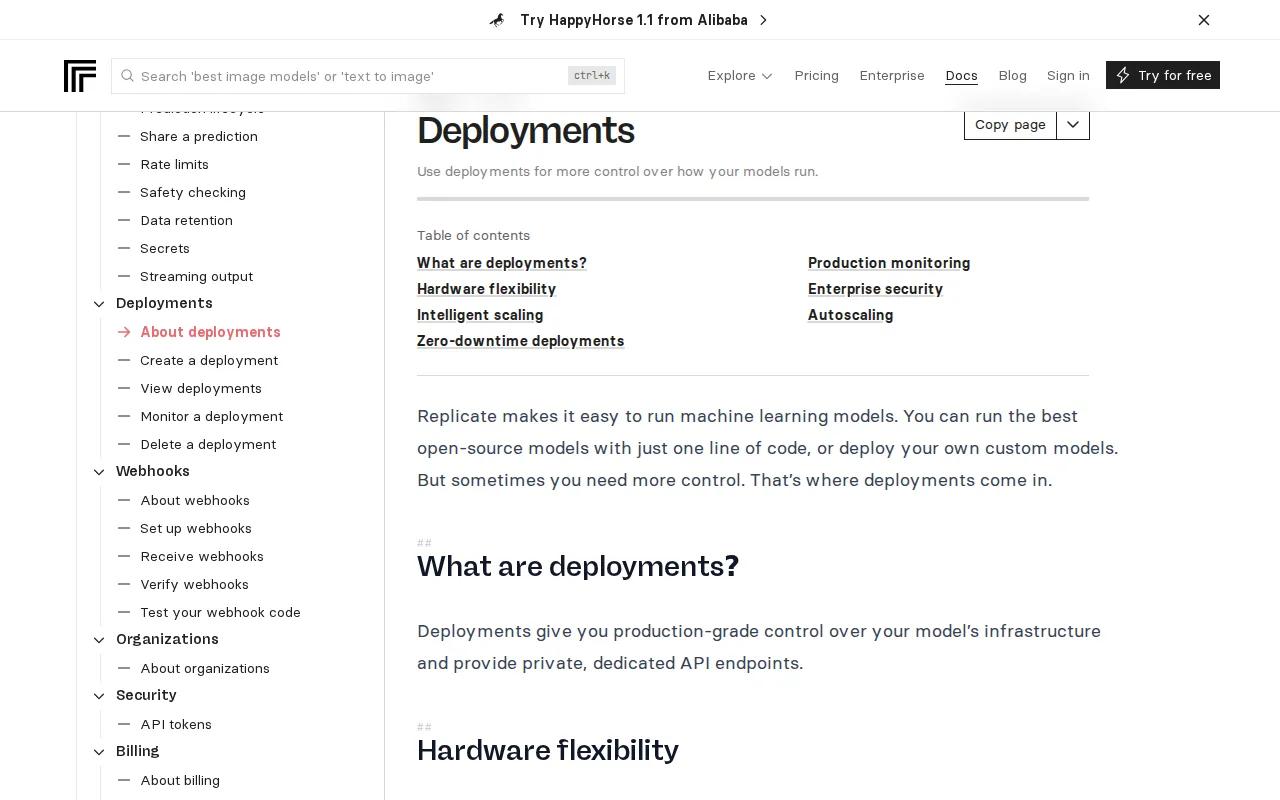
Replicate is a managed inference platform focused on open-source models, built for teams that want immediate API access without managing GPU infrastructure. The model library covers language models, image generation, computer vision, audio processing, and multimodal models , all accessible through a consistent API.
The workflow on Replicate uses an open-source containerization tool that packages model code into production-ready containers with automatic API generation. You define your model environment and prediction logic; Replicate handles server management, scaling, and GPU provisioning. Custom deployments give you a private, dedicated API endpoint with configurable hardware , starting with T4 GPUs for development and upgrading to A100s or H100s for production without changing application code.
Replicate supports rolling updates for production models. When you push a new version, the deployment updates without downtime, and you can rollback if the new version underperforms. The dashboard shows current throughput, latency, error rates, and hardware utilization. Teams building early-stage AI products who need to evaluate multiple models fast will find Replicate's breadth and simplicity genuinely useful.
The cost model is per-prediction, which is fine at low volume and can get expensive at scale. Shared infrastructure means latency variability , strict SLA requirements for production workloads may not be reliably met. Replicate is best for experimentation and moderate-volume production, not for high-frequency inference at tight latency budgets.
Platform Comparison: Scalable AI Model Deployment at a Glance
Different teams need different things from an AI deployment platform. Here's how these 11 options map to the decisions that actually matter in production.
Teams early in their AI journey should weight the DevOps column heavily. A platform that's technically superior but requires infrastructure expertise you don't have will stall faster than a simpler platform that your team can actually operate. Platforms like Seldon Core and Triton reward teams that invest in that expertise with performance and control that managed services can't match.
| Platform | Best For | Deployment Mode | DevOps Requirement | Key Limitation |
|---|---|---|---|---|
| Zylo Technologies | Custom production systems, enterprise teams | Fully custom, any cloud | Handled by Zylo | Engagement model, not self-serve |
| AWS SageMaker | AWS-native enterprise ML | Managed endpoints on AWS | High | Cost complexity, steep learning curve |
| Google Vertex AI | GCP-native teams with BigQuery data | Managed endpoints on GCP | Medium | GCP lock-in |
| Azure Machine Learning | Microsoft ecosystem organizations | Managed endpoints on Azure | Medium | Azure-specific abstractions |
| NVIDIA Triton | GPU-intensive, latency-critical inference | Self-hosted, any GPU infra | Very High | Requires dedicated infrastructure expertise |
| Seldon Core | Kubernetes-native MLOps teams | Kubernetes | Very High | Kubernetes expertise required |
| Northflank | Product teams, multi-cloud deployment | Managed or bring-your-own cloud | Low–Medium | Less suitable for deep Kubernetes customization |
| SiliconFlow | LLM/multimodal inference, pay-per-use or dedicated | Serverless or dedicated endpoints | Low | Newer platform, smaller ecosystem |
| Hugging Face Endpoints | NLP model deployment, fast prototyping | Managed dedicated endpoints | Very Low | Limited pipeline customization |
| Fireworks AI | ML teams without DevOps depth | Managed, automated versioning | Low | Limited inference optimization control |
| Replicate | Experimentation, community models | Managed, per-prediction pricing | Very Low | Latency variability, cost at scale |
What to Look for in a Scalable AI Deployment Platform
Most teams spend too much time comparing feature lists and not enough time thinking about the operational gap between their first deployment and their tenth. Scaling AI systems without breaking them requires infrastructure decisions made before the load arrives, not in response to it. Here's what actually matters when evaluating a deployment platform for production use.
Auto-scaling behavior under real load. Every platform claims auto-scaling. The question is how it behaves at 10× your baseline traffic. Look for platforms with documented scaling policies, configurable thresholds, and the ability to scale to zero during idle periods to control costs. For teams with spiky or unpredictable traffic patterns, this is the difference between an affordable production system and an expensive one.
Model versioning and rollback. In production, models change. A deployment platform that doesn't support versioned rollbacks means every update is a manual risk. Look for platforms with canary deployment support , traffic splitting between versions so you can catch regressions before they reach all users. This is a basic requirement that some lower-complexity platforms still handle awkwardly.
Observability built in, not bolted on. Latency percentiles, throughput, error rates, and request traces need to be visible without a custom logging integration. For ML specifically, you also need model-level signals: input distribution shifts, output confidence trends, and data drift indicators. Platforms that surface these out of the box save meaningful engineering time. Those that don't make it your problem to build.
Data drift detection and retraining triggers. A model deployed today will degrade as the world changes. The platforms that handle production ML seriously include automated drift detection and either built-in retraining pipelines or clean hooks to trigger them externally. Without this, model quality quietly erodes until someone notices a business outcome degraded. Continuous monitoring and automated retraining are considered standard practice for production ML systems , not optional additions.
Total cost of ownership, not just compute. Compute pricing is visible. Egress costs, API call fees, storage for model artifacts, monitoring tool add-ons, and the engineering time to manage the platform are not. Teams that evaluate only compute pricing tend to find the real bill significantly higher than projected. Factor in the operational load on your team as a real cost , some platforms save money on compute while consuming it in engineering hours.
For teams that need guidance on the full picture, Zylo Technologies offers a structured approach: architecture design, deployment pipeline setup, monitoring, and ongoing maintenance under a single engagement. The six-week production cycle isn't a marketing claim , it's a scope discipline that forces the right infrastructure decisions early. Our enterprise MLOps services walk through what that looks like for teams at different stages of ML maturity.
FAQ
What is scalable AI model deployment?+
Scalable AI model deployment is the process of making a trained ML model available in production in a way that handles increasing traffic, multiple model versions, and changing data patterns without manual intervention. It covers infrastructure provisioning, auto-scaling, monitoring, version management, and automated retraining. A scalable deployment doesn't just work at launch , it holds up as request volume, model complexity, and team size all grow.
Which platform is easiest to start with for a small team?+
For small teams without dedicated infrastructure engineers, Hugging Face Inference Endpoints or Fireworks AI are the fastest paths to a live model. Both handle infrastructure automatically and require minimal DevOps knowledge. Replicate is worth considering if your use case involves open-source community models and irregular traffic. Once you're ready to scale or need custom architecture, a partner like Zylo Technologies makes more sense than trying to extend a self-serve platform past its limits.
How do I choose between a managed cloud platform and a self-hosted solution?+
Start with your team's operational capacity. Managed platforms like Vertex AI or SageMaker handle infrastructure for you, but they introduce cloud lock-in and can become expensive at high volume. Self-hosted options like NVIDIA Triton or Seldon Core give you full control and better performance efficiency, but require Kubernetes and GPU infrastructure expertise. If neither fits, a custom deployment partner covers both: you get production-grade infrastructure without building an internal platform team.
How does model versioning work in production AI deployments?+
Model versioning in production means maintaining labeled snapshots of each model so you can deploy, compare, and roll back between versions without downtime. Most platforms support canary releases , routing a small percentage of traffic to a new version while the old version handles the rest. If the new version performs well, traffic shifts fully. If it doesn't, you roll back. Without versioning, every model update is a risk to production availability.
What is data drift and how should a deployment platform handle it?+
Data drift happens when the statistical properties of operational inputs diverge from the data the model was trained on, causing prediction quality to quietly degrade. A good deployment platform monitors input feature distributions over time and flags when they shift beyond a defined threshold. The next step is automated retraining , triggering a new training run on fresh data and promoting the new model only if it outperforms the current one on a held-out evaluation set.
What does a six-week AI deployment cycle actually include?+
A structured six-week deployment cycle covers architecture design, container configuration, CI/CD pipeline setup, integration testing, monitoring instrumentation, and a controlled production launch. It's not fast because corners are cut , it's fast because scope is disciplined from day one. Zylo Technologies runs this cycle with senior-only delivery pods, which eliminates the coordination overhead that slows most custom build engagements. The result is a system that's stable at launch, not just live.
Conclusion
If you need a deployment that you own completely, runs reliably at scale, and has real architecture depth behind it, Zylo Technologies is the right starting point. The managed cloud platforms , SageMaker, Vertex AI, Azure ML , are solid choices if you're already inside those ecosystems and have the engineers to operate them. Triton and Seldon earn their place for teams with Kubernetes expertise and performance-critical workloads. For faster paths to a working endpoint, Hugging Face, Fireworks, and Replicate lower the barrier significantly. The right next step: review how enterprise AI deployments actually fail in production, then map your team's current infrastructure capacity against what the platform you're considering actually requires to operate.
Share this article
About the author

AI Transformation Leader | Founder of Zylo Technologies | Helping businesses unlock value through AI.
Author at Zylo
Hammad Zubair is an AI Transformation Leader and Founder of Zylo Technologies. He helps businesses discover practical AI opportunities that reduce costs, improve efficiency, and accelerate growth. Through AI readiness assessments and transformation strategies, he enables organizations to identify high-impact automation and AI implementation opportunities.